Clear Sky Science · en
Mechanisms of stress distribution influenced by numerical model size and goaf parameters in multi-coal seam mining
Why underground stress matters for mining safety
Modern coal mining increasingly takes place deep underground, where several coal layers lie one above another. When one of these layers is mined, the rock around it does not simply sit still: it bends, cracks, and redistributes its internal forces. If these shifting forces, or stresses, are not understood correctly, roofs can collapse, pillars can fail, and gas can be suddenly released. This study asks a deceptively simple question with big safety implications: how much do our computer models of these stresses depend on how we draw the model box, and on how we represent the empty, caved-in space left behind by mining?
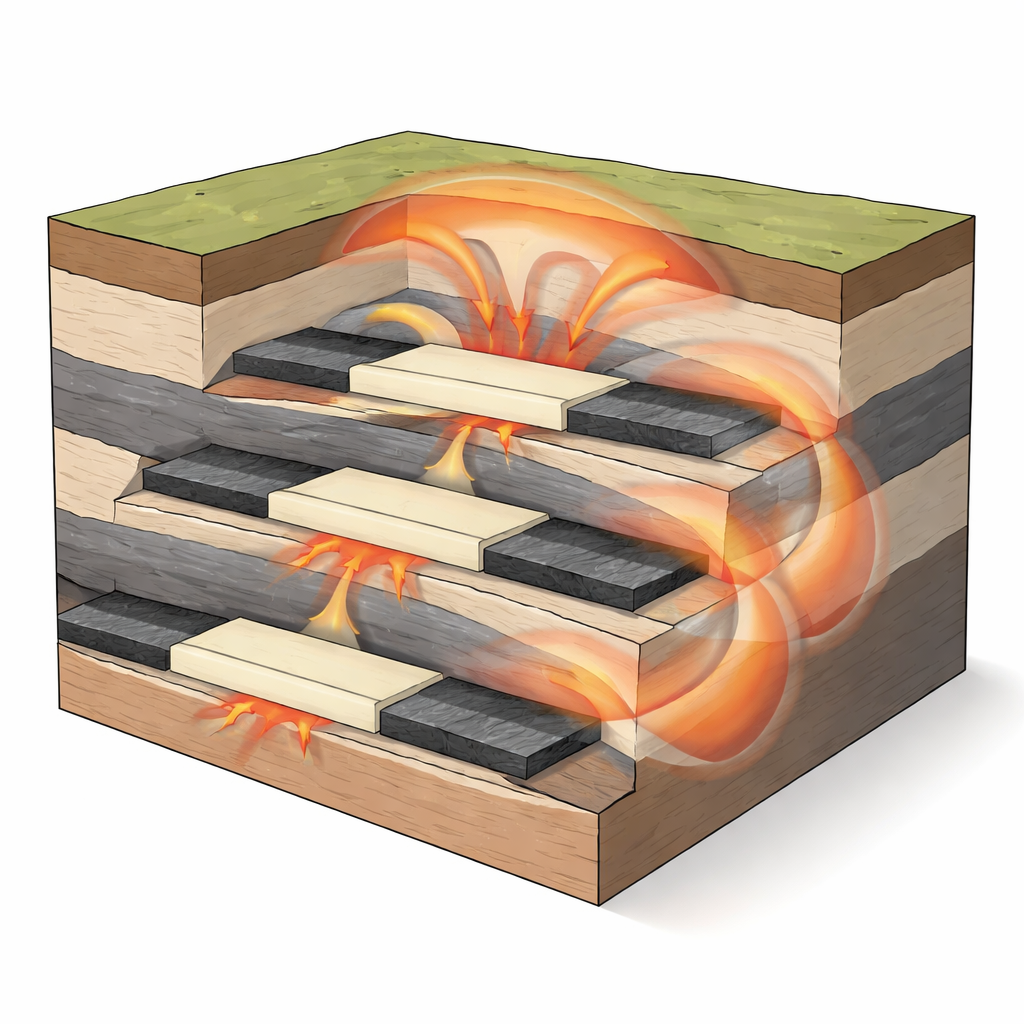
Peering into stacked coal layers
The researchers focused on a Chinese mining district where five workable coal seams sit relatively close together. As mining progresses through these layers, the voids left behind—called goafs—stack up vertically, separated only by rock beds of varying strength. To explore how stresses shift in such a setting, the team used FLAC3D, a widely used simulation program in mining engineering. They built two versions of the underground world: a narrow, thin model just wide enough to cover a single longwall panel, and a large, full-width model that extends much farther sideways. They then simulated a realistic sequence of panel extraction through different seams, tracking how the weight of the overlying rock transfers to the remaining coal and rock as each new void is created.
How the size of the model changes the picture
One might expect that a smaller model, with artificial side boundaries closer to the mining area, would distort the stress picture—and it does, but in a specific way. The thin model tends to show stronger stress build-up at the edges of a freshly mined panel, especially in the early stages when only one or two seams have been extracted. Because the sides of the model cannot move as freely, they act like stiff walls, forcing stresses to concentrate near the goaf edges. In the larger model, stresses spread out more smoothly and the contour patterns look more realistic. However, once three or more seams have been mined, the difference in peak stress values between the thin and large models shrinks. Crucially, both models put the stress peaks in almost the same places along the coal seams—the model size mostly changes how high the peaks are, not where they occur.
What really matters inside the mined-out void
A much bigger difference appeared when the team changed how they represented the goaf itself. In one version, the goaf was treated as a true void—the so-called Null model—offering no resistance, so stresses gather mainly at its sides. In the other, the Double-Yield model treated the caved rock as a loose but compactable material that can gradually take some load. Under this more realistic setup, stress does not just cluster at the goaf edges; it is partly picked up by the compacting rubble and then transferred upward into the overlying roof rock. As more seams are mined and more goafs stack above or below one another, the Double-Yield model captures how stresses can recover within the caved zones and move through them, whereas the Null model leaves large, unrealistic zones of near-zero stress. The choice of goaf model strongly shifts where the stress peaks appear along the coal seams, far more than any change in the outer size of the numerical grid.
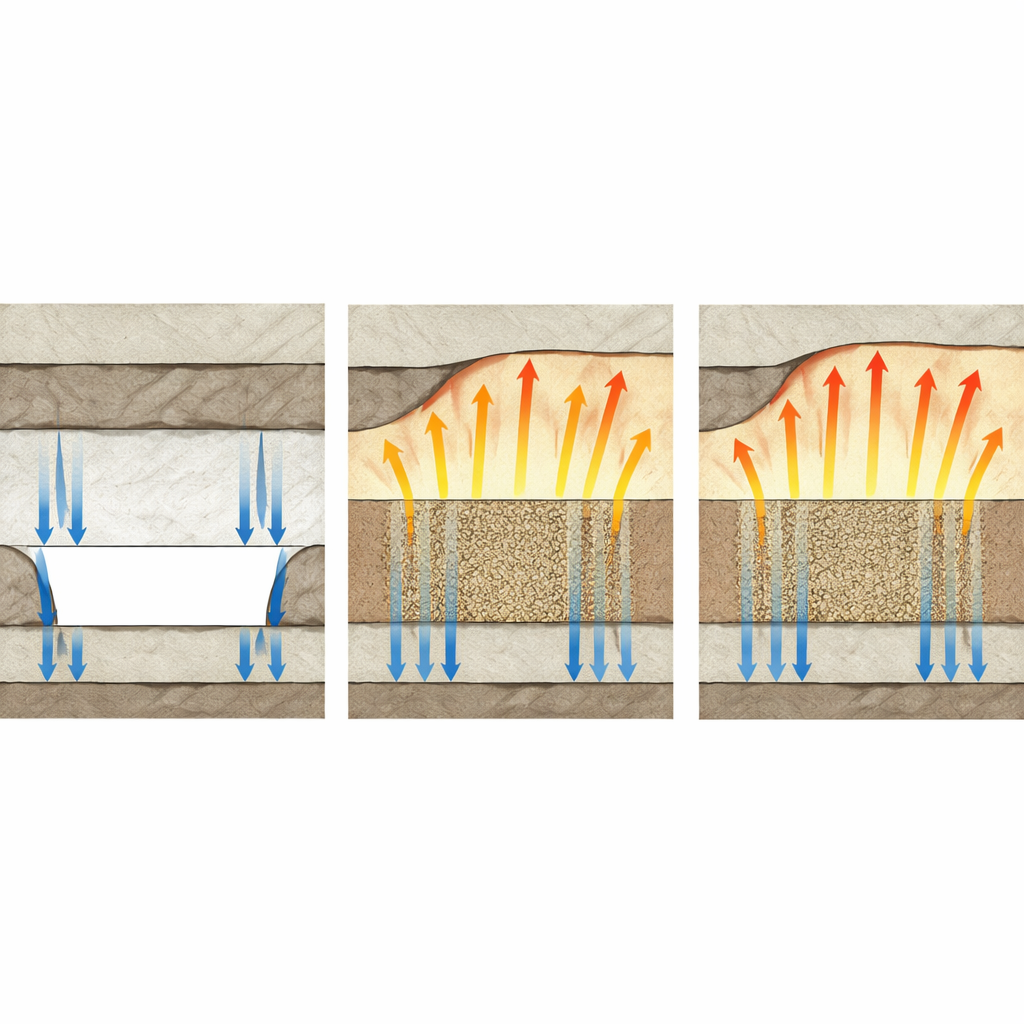
The role of a collapsing roof
The study also explored how the angle at which the roof rock caves into the goaf affects stress behavior when using the Double-Yield model. By testing several caving angles, the authors found that steeper, more extensive roof caving leads to stronger compaction of the broken rock and better contact between fragments. As a result, the caved zone carries more of the overlying weight, stress inside the goaf increases, and the main stress concentrations shift upward into the roof strata above the mined panel instead of staying tightly focused at the panel edges. This behavior matches field observations better than the simpler void assumption and highlights the importance of calibrating goaf properties from real measurements of how caved rock compresses underground.
What this means for safer multi-seam mining
In plain terms, the study shows that for multi-layer coal mining, getting the goaf right in the model is more important than drawing a very large model box. A narrow model can still predict where dangerous stress hotspots will form, provided engineers understand that it may overestimate how intense those peaks are. But using a realistic, compacting goaf model—tuned to site conditions and roof caving angle—is essential to capture how stresses travel through stacked mined-out zones and into remaining coal seams. This guidance helps mine designers choose efficient yet reliable simulations, improving the placement of pillars, supports, and roadways so that the invisible forces in deep coalfields are managed before they become disasters.
Citation: Wang, N., Paneiro, G.A., Li, Y. et al. Mechanisms of stress distribution influenced by numerical model size and goaf parameters in multi-coal seam mining. Sci Rep 16, 11137 (2026). https://doi.org/10.1038/s41598-026-42013-0
Keywords: multi-seam coal mining, goaf compaction, numerical modeling, stress redistribution, mine roof stability