Clear Sky Science · en
Loop anchor tension band wiring for olecranon fractures reduces Kirschner wire migration rate: a retrospective comparative study
Why this matters for broken elbows
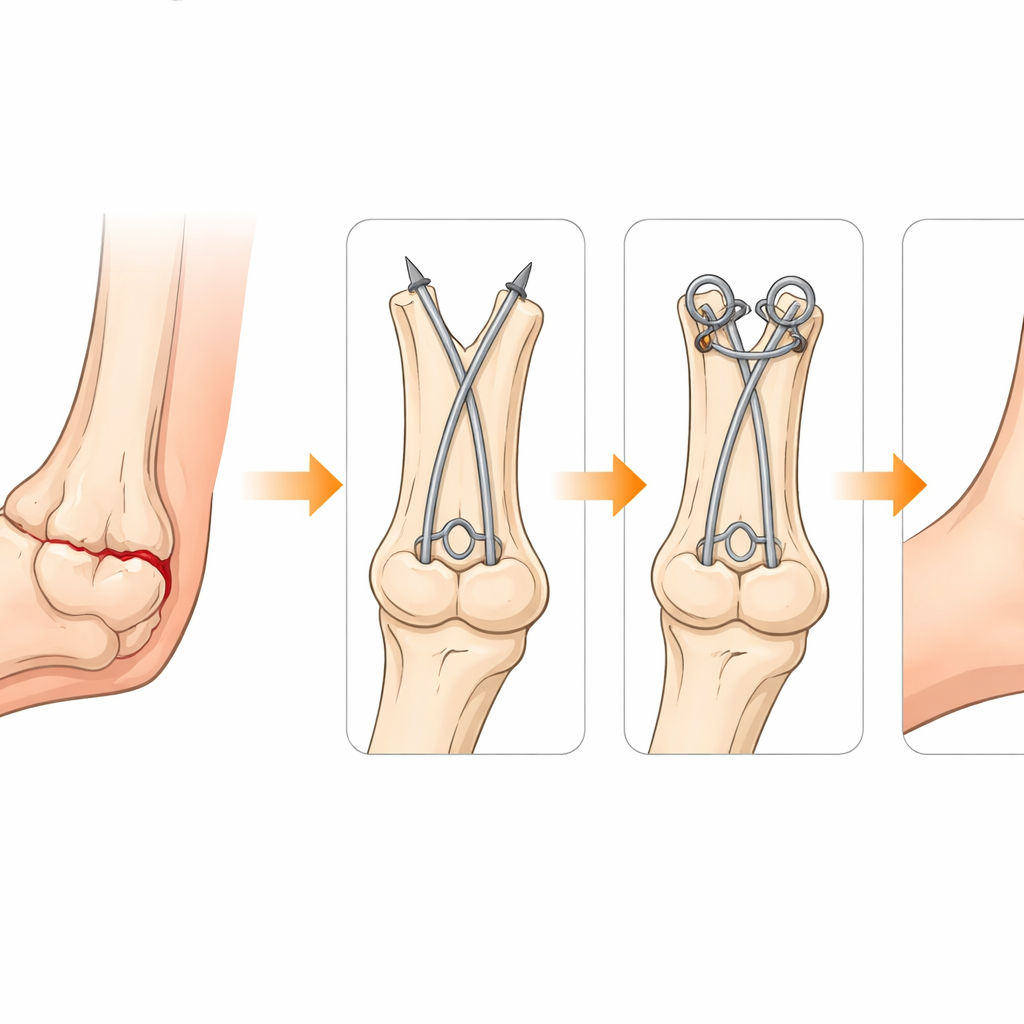
When people fall and land on a bent elbow, the bony tip of the joint—the olecranon—often breaks. Surgeons commonly repair these fractures using slender metal pins and wires. While this approach usually restores motion, the pins can slowly back out toward the skin, causing pain, irritation, and sometimes another surgery. This study tests a simple twist on the standard wiring method that aims to stop those pins from migrating while keeping the operation quick, reliable, and affordable.
A common injury with a common fix
Olecranon fractures are among the most frequent breaks around the elbow. For many straightforward fractures, surgeons rely on a method called tension band wiring. In the traditional version, two smooth pins (Kirschner wires, or K-wires) are placed along the inside of the bone, and a wire looped in a figure eight pulls the broken pieces together. A modified “AO” version tries to secure the far ends of the pins by driving them through the front wall of the bone for extra grip. While this can improve mechanical strength in the lab, it also carries risks: injury to nearby nerves and blood vessels, restricted rotation of the forearm, and the formation of unwanted bone bridges between neighboring bones.
A small loop with a big job
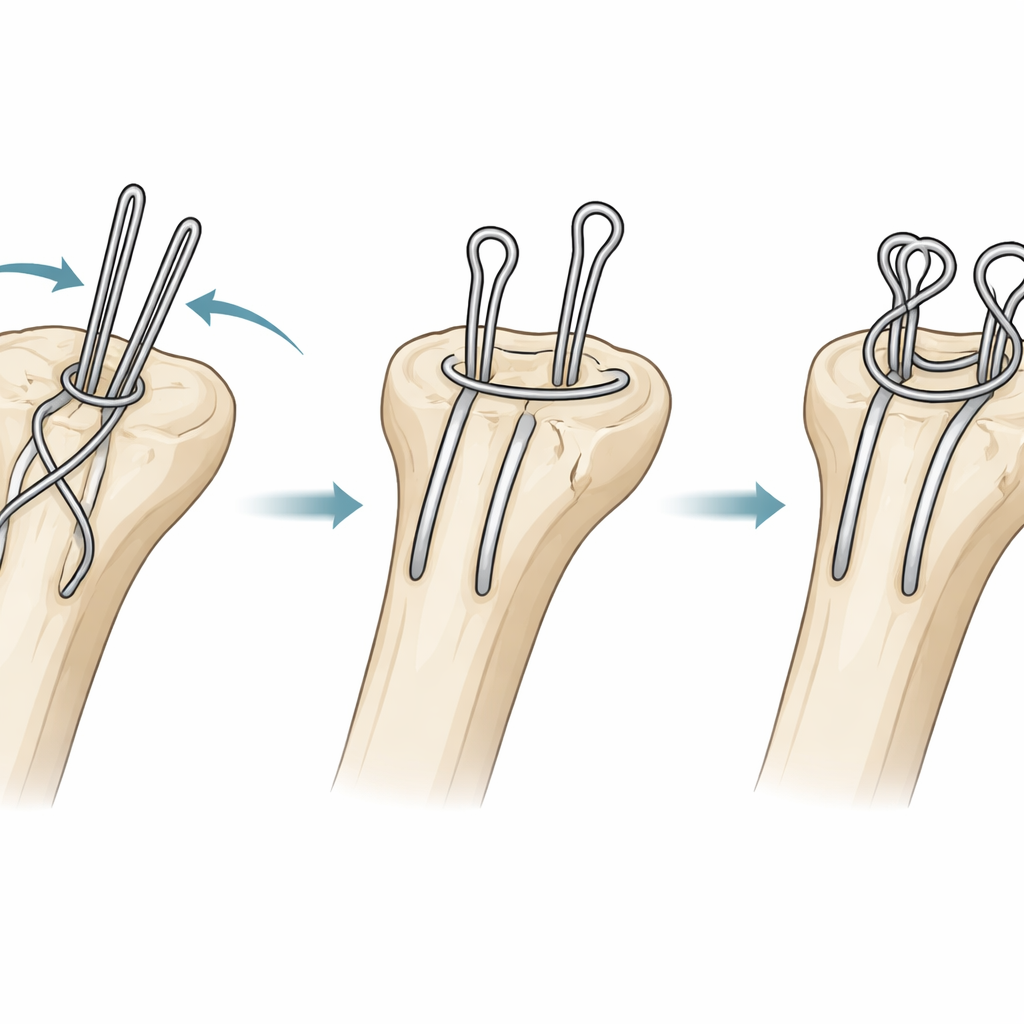
The team studied an alternative called loop anchor tension band wiring. Instead of forcing the far ends of the pins through the front of the bone, both pins stay safely inside the hollow channel of the ulna. At the back of the elbow, the surgeon bends the exposed ends of the pins into small loops that rest snugly against the bone surface. The traditional figure-of-eight wire is then threaded through these loops and tightened. This simple change effectively “locks” the pins in place, preventing them from sliding backward under everyday forces while avoiding the hazards of punching through the front of the bone.
Comparing two ways to repair the same break
The researchers reviewed 83 olecranon fractures treated at a single hospital over roughly a decade. Sixty-two elbows received the AO-modified method and 21 received the loop anchor version. The groups were similar in age, sex, fracture type, and follow-up time. The team tracked how often the pins moved backward, how often the hardware had to be removed or revised, how quickly the bone healed, how long surgery took, and how well patients could use their arms after six months. Arm function was scored using two standard patient scales that rate pain, daily use, and elbow performance.
What they found in the operating room and afterward
The most striking difference was pin movement. In the traditional group, more than six out of ten cases showed backward migration of the pins on X-rays. In the loop anchor group, this happened in only one out of 21 elbows. All five revision operations in the study were needed in the traditional group and were triggered by runaway pins. People with the loop anchor repair also spent less time on the operating table, with surgery lasting about three quarters as long as in the traditional group. While both methods produced solid bone healing and similarly high functional scores, patients with the loop anchor construct reported less irritation at the back of the elbow, a common reason for requesting hardware removal.
Who might benefit most
The study also looked separately at simpler fractures and more shattered ones, using a standard Mayo classification. Within each method, outcomes such as healing time, pain, and arm use were similar between the simpler and more complex fractures. However, under the traditional method, more complex fractures tended to need more revision surgeries, suggesting they are especially prone to pin migration. The loop anchor technique seemed to blunt this problem, with almost no migration even in the more difficult fracture patterns, though the authors note that the number of cases was modest and the study design was retrospective.
What this means for patients
For patients with common olecranon fractures, this work suggests that a small change in how surgeons bend and secure existing hardware can make a big difference in comfort and safety. The loop anchor tension band technique keeps the pins inside the bone, lowers the chance that they will creep toward the skin, and reduces back-of-the-elbow irritation and surgical time, all while preserving excellent healing and arm function. Although larger, carefully matched studies are still needed, this simple, low-cost adjustment may help many people recover from elbow fractures with fewer complications and fewer return trips to the operating room.
Citation: Ho, W., Lin, CH., Yao, SH. et al. Loop anchor tension band wiring for olecranon fractures reduces Kirschner wire migration rate: a retrospective comparative study. Sci Rep 16, 12114 (2026). https://doi.org/10.1038/s41598-026-42012-1
Keywords: olecranon fracture, tension band wiring, Kirschner wire, elbow surgery, orthopedic fixation