Clear Sky Science · en
Smart grid inverter control: integrating RNN, model predictive, and adaptive sliding mode controller for optimal harmonic mitigation
Why cleaner power from renewables matters
As more homes, cars, and industries draw electricity from solar panels, wind farms, and battery systems, the power grid must handle fast-changing and sometimes “messy” electricity. These fluctuations can create electrical ripples called harmonics that waste energy, overheat equipment, and shorten the life of devices. This paper presents a new way to control electronic converters that connect renewables to the grid, keeping the electricity clean and stable even when conditions are harsh and unpredictable. 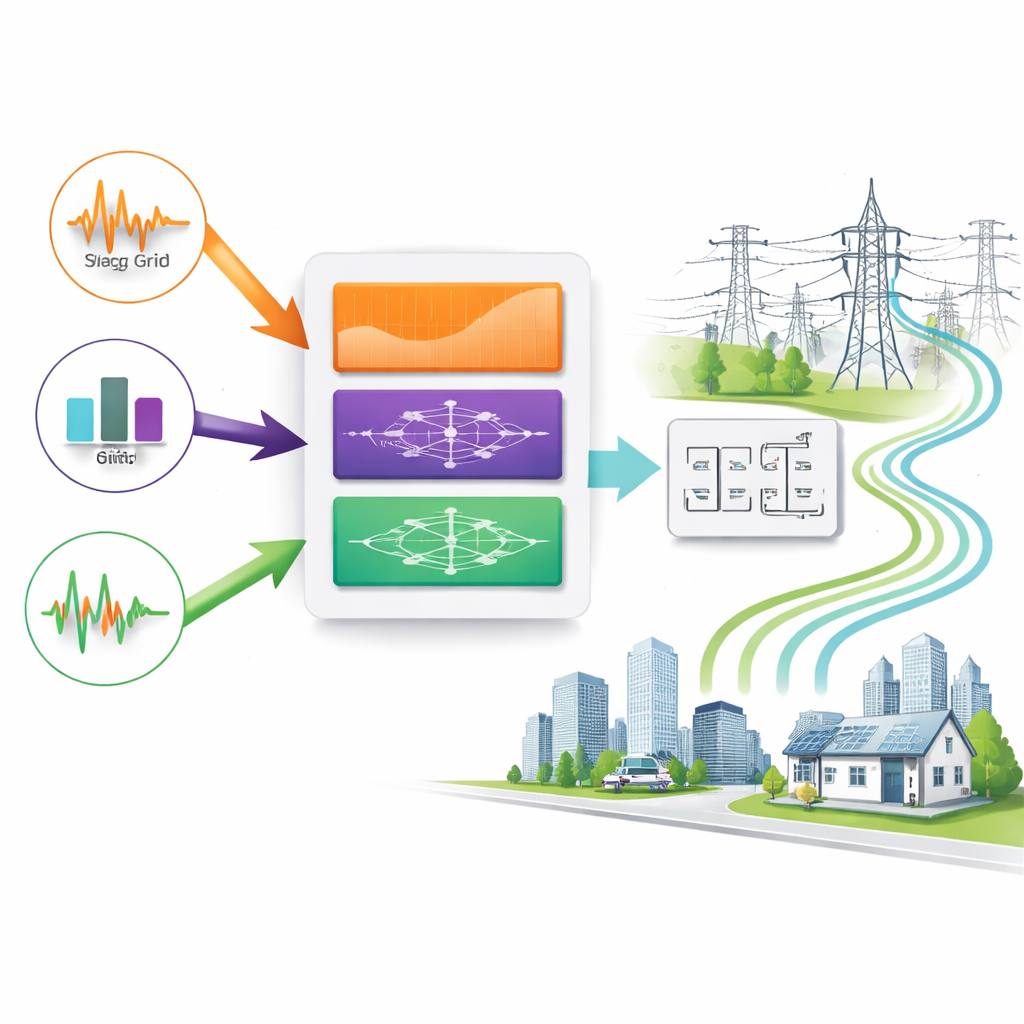
How modern grids turn DC into smooth AC
Most renewable sources and storage devices produce direct current (DC), but our homes and the grid use alternating current (AC). Grid-connected voltage source inverters act as the translators between these worlds. They rapidly switch electronic components on and off, shaping DC into AC. To smooth out the switching, engineers add filters made of coils and capacitors. While effective, these filters can resonate and interact badly with changing grid conditions, leading to unwanted harmonics, distorted waveforms, and sensitivity to unknown or shifting loads. Traditional control methods that once worked well now struggle when the grid impedance varies, loads are unbalanced, or the voltage itself is distorted.
Blending prediction, learning, and robustness
The authors propose a hybrid control system that combines three powerful ideas: prediction, machine learning, and a robust safety layer. First, a model predictive controller (MPC) is used offline to compute the best possible switching decisions under many operating scenarios. This predictive method is accurate but too computationally heavy to run directly in real time for fast inverters. Second, these optimal decisions are used to train a recurrent neural network (RNN), a form of artificial intelligence that can remember past behavior. Once trained, the RNN can mimic the MPC’s decisions with far less computation, making it suitable for real-time use. Third, on top of this learned controller, the authors add an adaptive “barrier” super-twisting sliding mode controller—essentially a robust supervisory layer that quickly corrects errors when conditions deviate from what the RNN has seen before.
How the hybrid controller keeps its footing
In operation, the system works in two layers. Offline, the detailed mathematical model of the inverter and its filter is used to simulate the device under many grid and load conditions. The MPC generates optimal switching trajectories that form the training data for the RNN. The gains of the robust sliding controller are tuned using an optimization approach inspired by the hunting behavior of grey wolves, which searches for parameters that minimize tracking error over time while avoiding excessive control effort. Online, during real operation, the RNN quickly chooses switching patterns that closely follow voltage and current references. In parallel, the adaptive sliding controller watches the difference between desired and actual currents, boosting or relaxing its influence through a barrier function whenever the system approaches critical limits. A mathematical stability analysis using Lyapunov theory shows that tracking errors are driven to zero in finite time and remain bounded even when the grid is noisy or the model is imperfect.
Putting the controller to the test
The researchers validated their approach both in detailed computer simulations and in hardware-in-the-loop experiments using an industrial microcontroller. They compared three control strategies: standalone MPC, standalone RNN, and the full hybrid approach with the adaptive sliding layer. Under a variety of conditions—simple resistive loads, nonlinear loads like diode rectifiers, weak-grid operation with higher grid impedance, unbalanced phase loads, and injected harmonic distortion—the hybrid controller consistently produced the cleanest waveforms. Total harmonic distortion dropped to around 0.4–0.5%, far below that of MPC or RNN alone, and the system settled to stable operation faster, with smaller overshoot. At the same time, the RNN reduced computational burden by almost 80% compared to pure MPC, confirming that the scheme is practical for high-speed control. 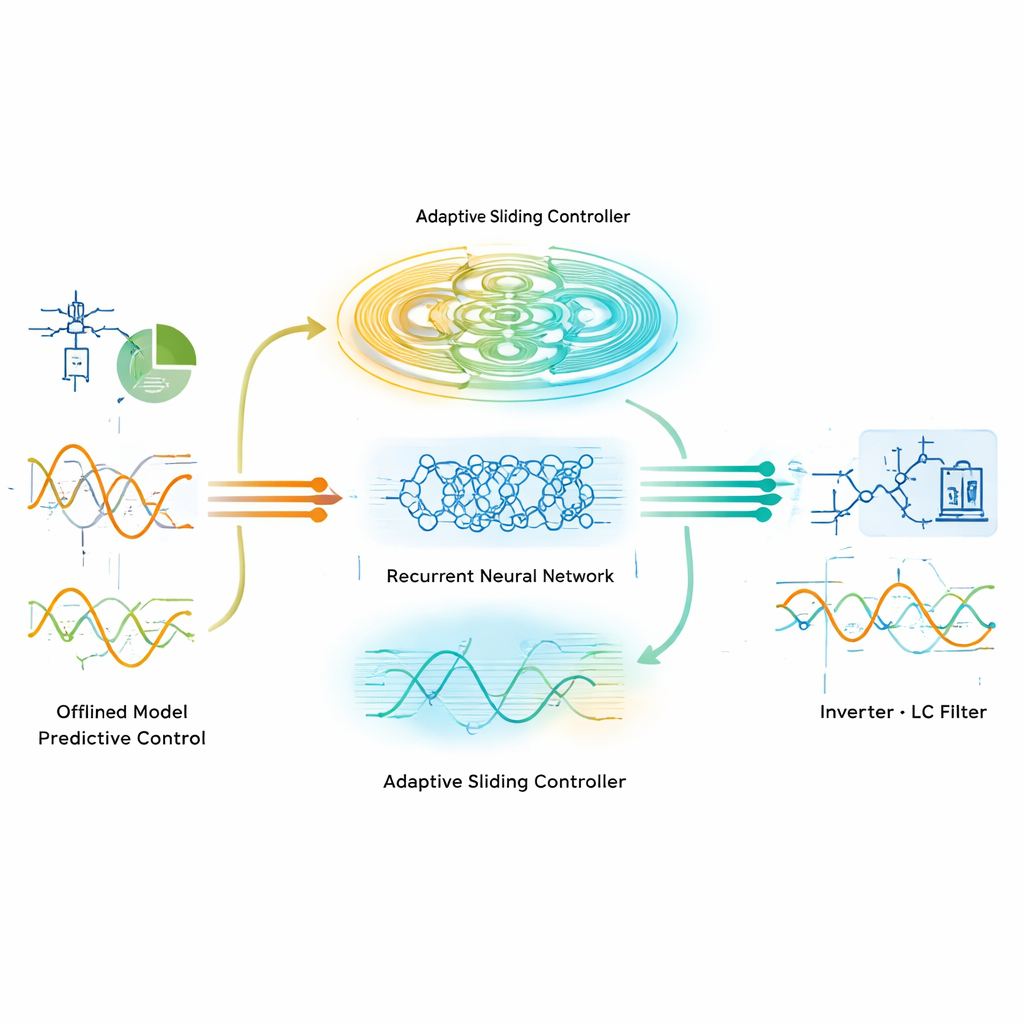
What this means for future smart grids
For a non-specialist, the key message is that this work shows how combining prediction, machine learning, and a robust safety layer can make power electronics both smarter and more reliable. The proposed controller allows inverters that link renewables and storage to the grid to deliver very clean, low-distortion power even when the grid is weak, the loads are uneven, or unexpected disturbances occur. This improves energy efficiency, protects equipment, and makes it easier to integrate large amounts of renewable generation. The authors suggest that similar hybrid strategies could be extended to solar inverters, wind systems, electric vehicle chargers, and other advanced power electronics, helping the future grid stay stable as it becomes cleaner and more complex.
Citation: Zeb, O., Rehman, A., Sultan, N. et al. Smart grid inverter control: integrating RNN, model predictive, and adaptive sliding mode controller for optimal harmonic mitigation. Sci Rep 16, 13700 (2026). https://doi.org/10.1038/s41598-026-42010-3
Keywords: smart grid, power inverter control, harmonic mitigation, neural network control, sliding mode control