Clear Sky Science · en
Autonomous berthing path tracking of a 4-DOF ship under nonlinear model predictive control
Why safe docking matters
Every large ship must eventually do something surprisingly delicate: slide up to a crowded pier and stop within a few dozen centimeters, often in rough weather and tight spaces. Today this is mostly done by skilled crews and tugboats, but future unmanned or highly automated ships will need to berth themselves safely and smoothly. This study explores how advanced control algorithms can guide a ship into port with high precision, even when wind and waves are doing their best to push it off course.
Challenges of guiding a ship to the pier
Berthing is far more complicated than simply slowing down and stopping. A ship must follow a planned path, keep its bow pointed the right way, and manage gentle contact with the quay, all while currents, gusts, and waves change from moment to moment. Traditional control methods rely on fixed rules or hand-tuned settings, which can struggle in crowded harbors or bad weather. Earlier research divided berthing into stages and improved motion models, but many approaches still had trouble dealing with strong, time-varying disturbances and with the subtle sideways and rolling motions that dominate at low speeds near a pier.
Looking at ship motion in more detail
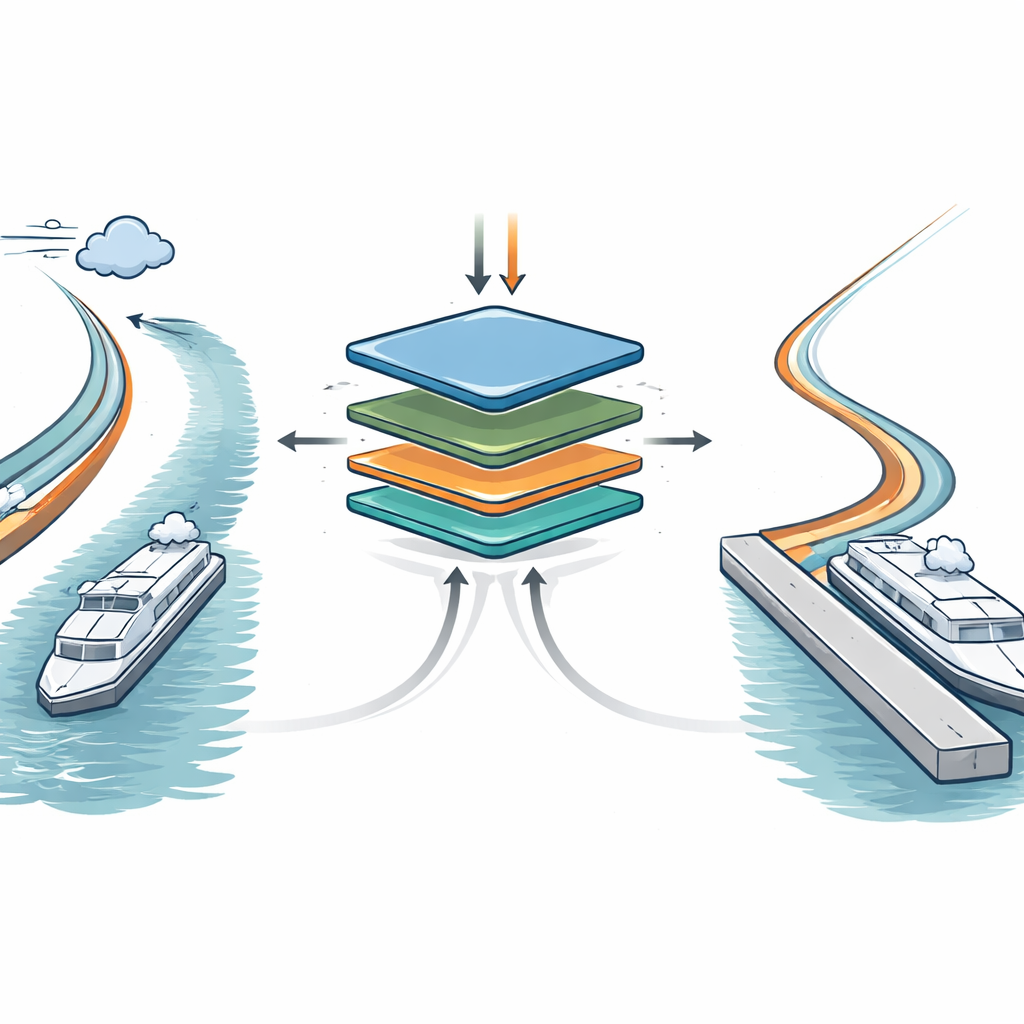
The authors focus on a more complete description of how a ship moves as it approaches a berth. Instead of only tracking forward motion and heading, they use a four-degree-of-freedom model that also includes sideways drift and rolling. This framework, known in naval engineering as a Fossen model, represents the ship as a rigid body acted on by forces from propellers, rudders, and the surrounding water, plus extra pushes from wind and waves. Two coordinate systems are used at the same time: one fixed to the Earth to describe the ship’s overall position, and another fixed to the hull to capture the local forces and speeds. This richer model captures the subtle but important effects that matter most when the ship is moving slowly and is close to structures.
A predictive "look-ahead" pilot
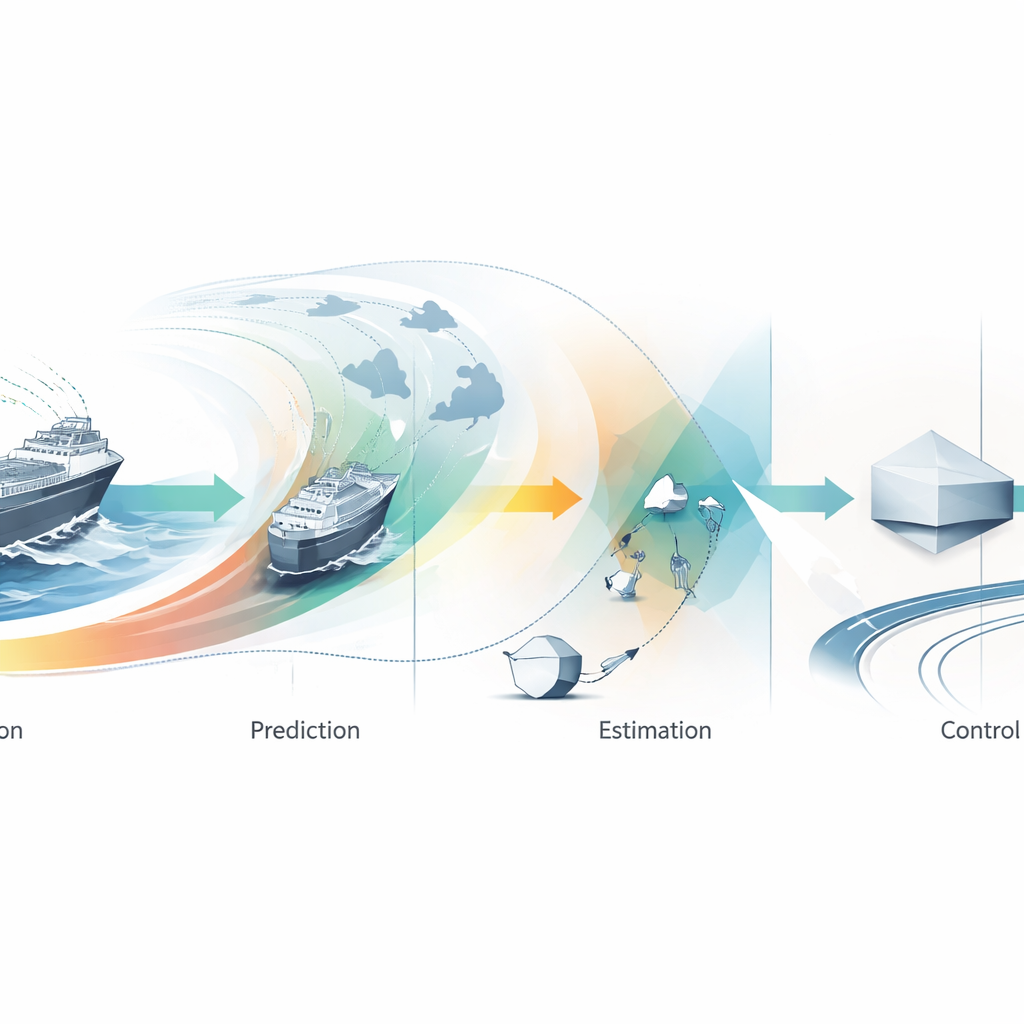
Building on this model, the study designs a nonlinear model predictive control system, which can be thought of as a digital pilot that constantly looks a short time into the future. At each instant, the controller uses the ship model to simulate many possible control actions—small changes to thrust and steering—and selects the combination that keeps the vessel closest to its planned path while respecting limits on speed and maneuvering power. Because sea conditions and sensor readings are never perfect, the authors pair this with an estimation method called moving horizon estimation. This method digests recent measurements of the ship’s position and motion, compares them with model predictions, and infers the most likely true state of the ship and the current strength of environmental disturbances.
Putting the smart pilot to the test
The combined control and estimation scheme is tested in a detailed computer simulation of an actual utility ship berthing in the Port of Hamburg. The virtual harbor includes realistic charts and intentionally harsh sea conditions, with strong winds and dynamically changing waves. The planned route into the port follows a smooth double-S curve that mimics a careful real-world approach. The controller must keep the ship on this route while starting and ending the maneuver at zero forward speed, as a real vessel would when leaving open water and finally touching the quay.
How well the system performs
Across these demanding simulations, the new method keeps the ship’s path error below about two meters during the maneuver and reduces the final miss distance at the berth to just 0.3 meters. That is substantially better than both a traditional proportional–integral–derivative controller and a predictive controller without the extra state-estimation layer, which show larger overshoots and less stable motion. The ship’s speeds remain low and well controlled, preventing hard impacts, and the required thrust and turning forces change smoothly rather than in abrupt bursts. Importantly, the system maintains performance even when the simulated wind and wave disturbances fluctuate within strong, real-world ranges.
What this means for future harbors
In everyday terms, the study shows that an unmanned ship can be guided to the dock with the care of an expert pilot by combining a realistic but compact motion model with a predictive, self-correcting control strategy. While the work is based on simulations rather than full-scale trials, it suggests a practical path toward safer, more reliable automated berthing, especially in busy ports and rough conditions. With further refinement and testing, such systems could reduce the need for tug assistance, cut human workload, and make the final, most delicate part of a voyage both safer and more efficient.
Citation: Song, ., Guo, . & Sui, J. Autonomous berthing path tracking of a 4-DOF ship under nonlinear model predictive control. Sci Rep 16, 12918 (2026). https://doi.org/10.1038/s41598-026-41980-8
Keywords: autonomous ships, berthing control, predictive control, harbor navigation, marine robotics