Clear Sky Science · en
Analyzing sustainable cotton production in Türkiye through the water energy carbon nexus framework
Why the Story of Cotton and Resources Matters
Cotton is woven into our everyday lives, from T-shirts to bedsheets. But behind each soft fiber lies a hidden story about how much water, energy, and climate-warming gases it takes to grow. This study looks at cotton production in Türkiye—a major global producer and importer—and asks a pressing question: how can the country continue to grow cotton without exhausting its rivers, overloading its power systems, or adding too much carbon dioxide to the atmosphere? By examining these three pressures together, the authors offer a roadmap for keeping cotton both profitable and sustainable in a warming, water‑stressed future.
Three Hidden Threads: Water, Energy, and Carbon
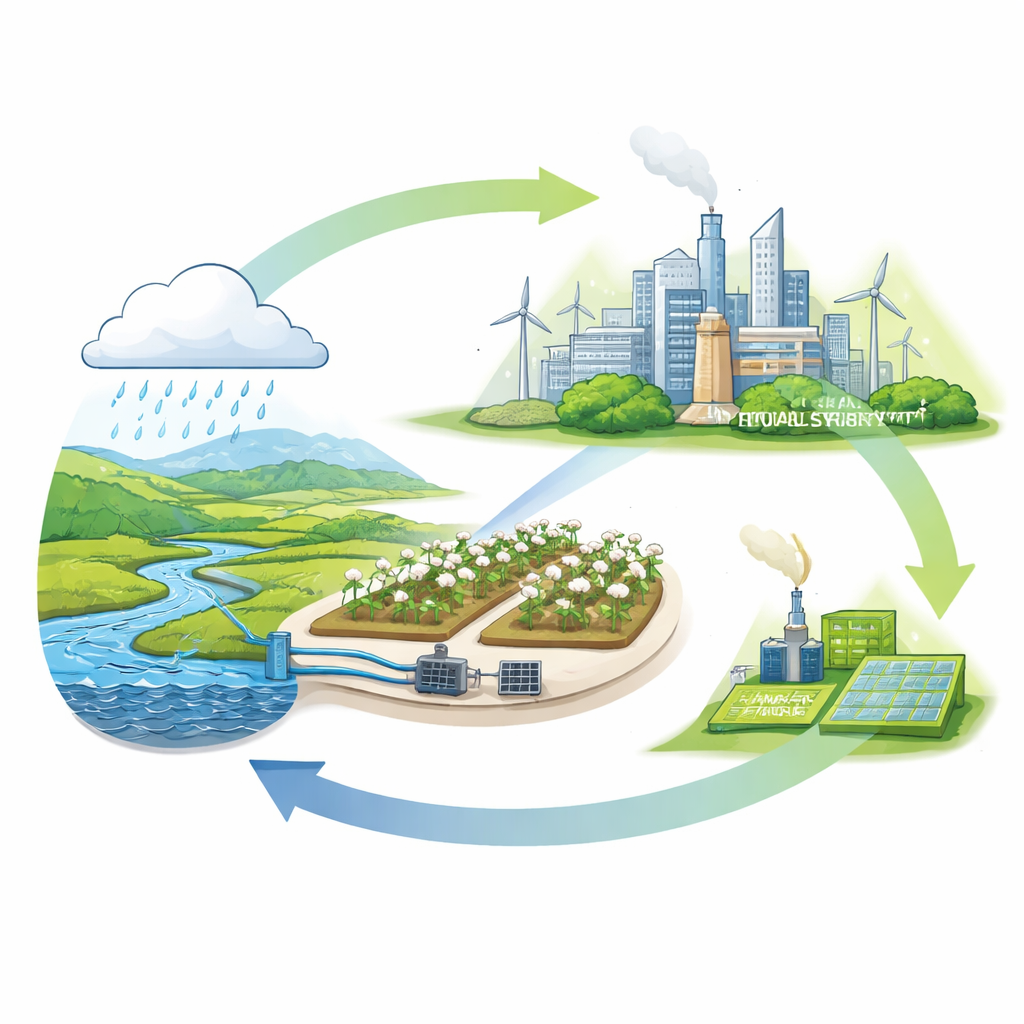
The researchers use what they call a Water–Energy–Carbon (WEC) nexus approach, which simply means they track how these three elements move together rather than one at a time. Water is divided into “green” water, which comes from rain stored in the soil, and “blue” water, which comes from rivers and underground sources pumped for irrigation. Energy is needed to run tractors, harvesters, pumps, and fertilizer production. Carbon emissions are then calculated from this energy use. Instead of treating carbon as another input, the study treats it as the consequence of water and energy choices, revealing how decisions in one area ripple into the others.
Measuring Today to Understand Tomorrow
To ground their analysis, the authors first mapped cotton production in 22 provinces across Türkiye for the year 2021. They estimated how much blue and green water was used, how much energy was needed for farm operations and irrigation, and how much carbon was released as a result. In that single year, Türkiye produced nearly one million tons of cotton lint, using just over five billion cubic meters of water and more than 16 petajoules of energy, which led to about 660,000 tons of carbon emissions. The province of Şanlıurfa alone accounted for roughly 40% of national cotton lint output, highlighting how strongly production—and resource demand—is concentrated in a few regions.
Exploring Futures Under a Changing Climate
With this baseline in place, the team then built future scenarios stretching to 2070. They varied three main factors: how much rainfall declines, how much land is planted with cotton, and how much of the energy used on farms comes from renewable sources such as solar and wind. Climate projections suggest that effective rainfall during the cotton growing season could fall by about 20% up to 2040 and by a total of 36% by 2070. Less rain means less green water in the soil and greater dependence on pumped blue water. The scenarios range from shrinking the cotton area to 350,000 hectares to expanding it to 550,000 hectares, while assuming that renewables will supply 15% of energy by 2040 and half by 2070.
What Happens When Cotton Fields Expand
The results show a clear pattern: as cotton fields expand, total water use, energy demand, and carbon emissions all rise. This is especially true after 2040, when drier conditions force farmers to rely more heavily on irrigation. In the largest expansion scenario, blue water needs grow sharply, requiring much more pumping and therefore more energy. Even though a higher share of renewable energy lowers the carbon released per unit of energy, it cannot fully counteract the effect of cultivating more land. In other words, cleaner energy helps, but it does not erase the climate impact of simply growing more cotton under water‑scarce conditions.
Turning Complex Numbers into a Simple Score
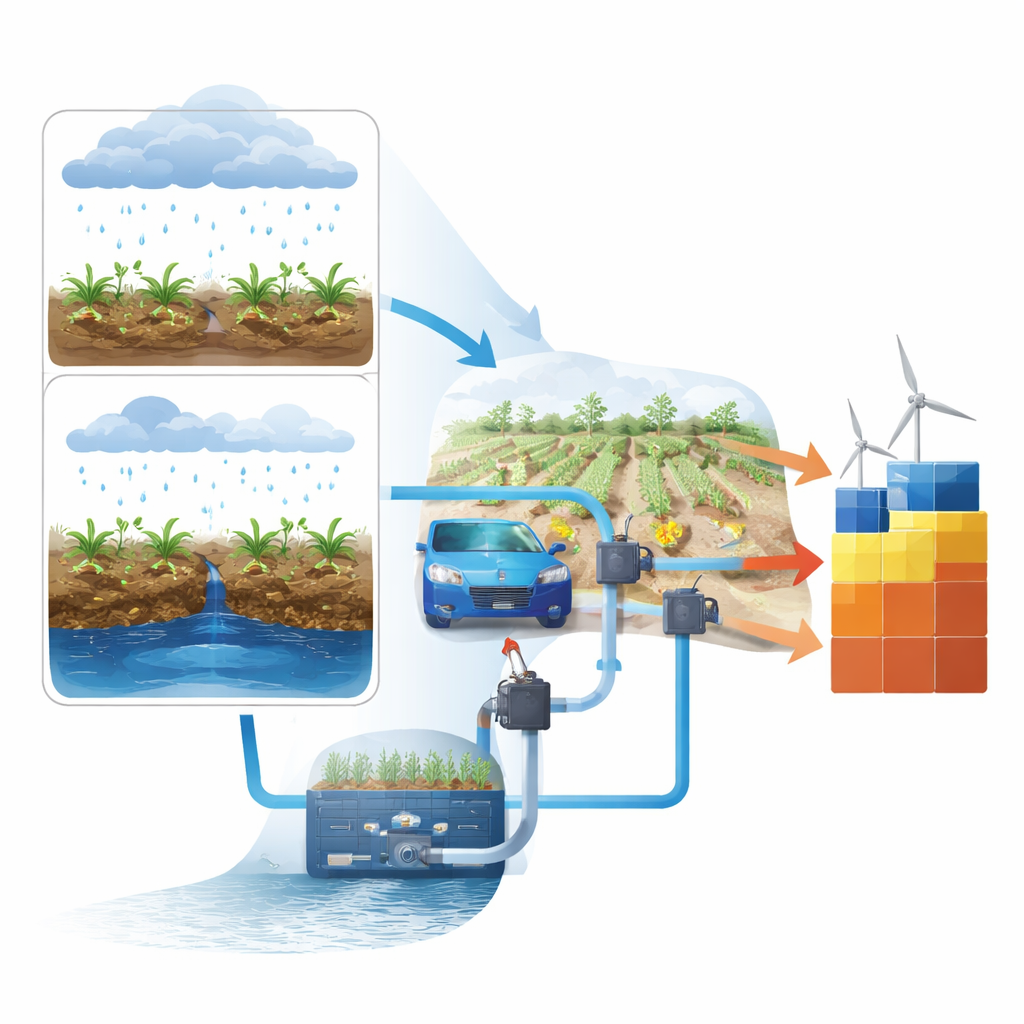
To compare all these futures in a straightforward way, the authors created a single WEC Index that combines normalized measures of water use, energy demand, and carbon emissions. Lower values on this index correspond to more sustainable outcomes. Using the current situation as a reference point, they show how different combinations of land area, rainfall, and energy mix push the index up or down. Scenarios with moderate or reduced cotton area generally perform better, while aggressive expansion under drying conditions leads to much worse scores—even when renewable energy targets are met—because the basic demands on water and energy grow too large.
What This Means for the Future of Cotton
For a non‑specialist, the message is straightforward: if Türkiye tries to grow ever more cotton while rainfall declines, the country will face mounting pressure on its water supplies, power systems, and climate goals. Shifting to renewable energy is essential, but not enough on its own. The study suggests combining careful land‑use planning with more efficient irrigation and farm practices so that each hectare of cotton uses less water and energy. By viewing water, energy, and carbon together rather than in isolation, policymakers can better judge how much cotton production the country can truly sustain without undermining its long‑term environmental and climate commitments.
Citation: Ertuğrul, Ö., Özgünaltay Ertuğrul, G., Değirmencioğlu, A. et al. Analyzing sustainable cotton production in Türkiye through the water energy carbon nexus framework. Sci Rep 16, 11388 (2026). https://doi.org/10.1038/s41598-026-41947-9
Keywords: sustainable cotton, water energy carbon nexus, irrigation and climate change, renewable energy in agriculture, Türkiye cotton production