Clear Sky Science · en
Dual-band patch antenna for 5G NR (n48, n46, n77, n78), Wi-Fi, and indoor wireless applications
Why smarter antennas matter at home and beyond
From streaming movies to running factory robots, modern life depends on fast, reliable wireless links. The latest 5G and Wi‑Fi standards promise higher speeds and more connected devices, but they also demand better hardware inside access points, routers, and gadgets. This paper presents a compact antenna that can handle two key frequency bands used by 5G and Wi‑Fi while sharply reducing interference between its own elements. In practical terms, that means smaller base stations and home routers that can move more data with fewer dropouts, all without cranking up transmit power.
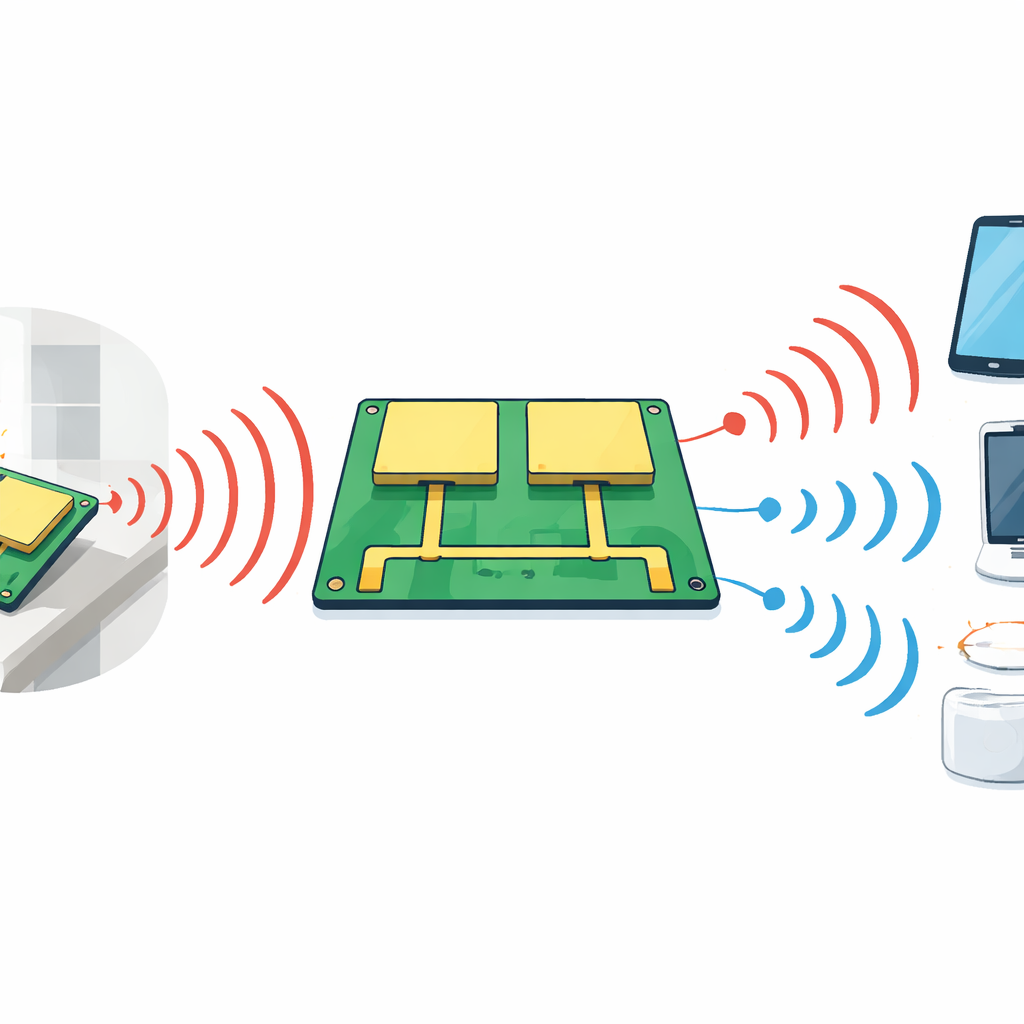
A tiny antenna built for crowded airwaves
The authors design a small "patch" antenna that operates in the so‑called sub‑6 GHz range, the workhorse spectrum for 5G New Radio and Wi‑Fi 6. Instead of one radiator, the device has two nearly identical elements placed side by side, forming a two‑port multiple‑input multiple‑output (MIMO) system. Each element is only 20 mm by 25 mm, and the full two‑port layout measures 50 mm by 25 mm, notably smaller than many comparable designs. The antenna covers two main frequency windows: roughly 3.5–3.7 GHz, used by several 5G mid‑band channels, and about 5.2–5.5 GHz, which serves both 5G and Wi‑Fi 6. Designing a single, compact structure that efficiently handles both ranges helps equipment makers support many services with fewer parts.
A simple shape with a clever underside
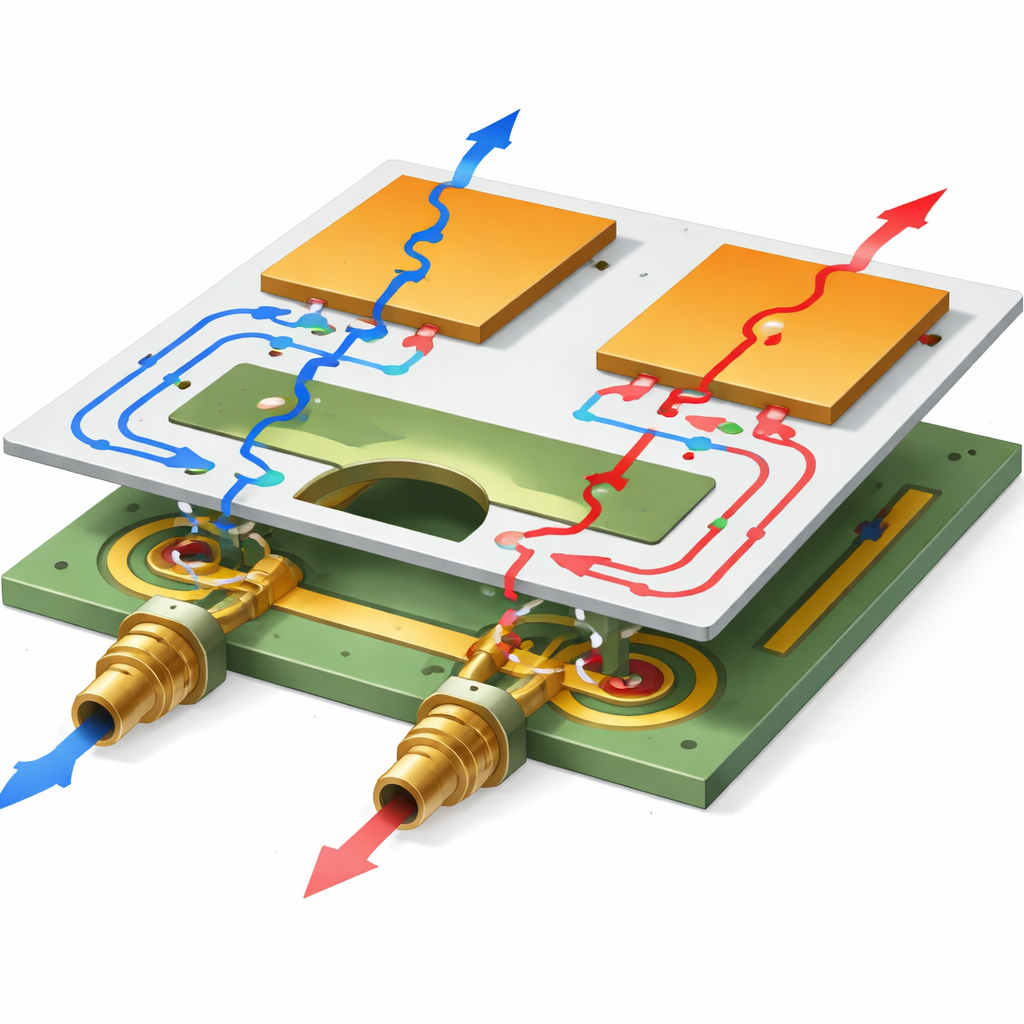
Seen from above, each element looks like a straightforward rectangular metal patch fed by a narrow strip. The real ingenuity lies on the reverse side, where the metal "ground" layer is deliberately cut away. The team carves a semi‑elliptical opening and adds a circular split‑ring slot underneath each patch. These shapes act like built‑in tuning features, encouraging the antenna to ring at two distinct frequencies, much like giving a bell both low and high tones. By carefully adjusting dimensions such as patch length and the size and position of the slots, the researchers dial in strong performance in both target bands without resorting to bulky add‑ons or complex three‑dimensional structures.
Keeping the twin antennas from fighting
When two antennas sit close together, they tend to disturb each other: energy that should be radiated or received leaks from one into the other, a problem known as mutual coupling. That interference can ruin the benefits of MIMO, which relies on antennas behaving as independently as possible. In this design, the two ground planes are deliberately connected by a pair of thin metal strips. At first glance, linking the grounds might seem like it would increase crosstalk, but the authors show the opposite: the strips provide a controlled path for surface currents, steering them in ways that cancel unwanted coupling. Simulations and measurements reveal that interference between the two ports is suppressed by about 24 dB in the lower band and 20 dB in the upper band—strong isolation for such a small footprint.
Putting numbers on reliable connections
To judge how well the antenna would perform in a real multi‑antenna system, the researchers look beyond simple gain and efficiency. They evaluate several widely used MIMO quality indicators derived from how the antenna reflects and transfers signals. The envelope correlation coefficient, which measures how similarly the two ports respond to the airwaves, stays below 0.002—far better than the usual upper limit of 0.5, indicating that each port effectively sees an independent channel. The diversity gain, a measure of how much signal reliability improves when combining the two ports, is close to the ideal 10 dB. At the same time, the estimated loss in data‑carrying capacity (channel capacity loss) remains under 0.2 bits per second per hertz, and the mean effective gain of each port sits near −3 dB, both within desirable ranges for robust links.
What this means for everyday wireless gear
By combining a compact footprint, dual‑band coverage, and strong isolation between its two elements, the proposed antenna offers a practical building block for 5G and Wi‑Fi devices in homes, offices, and other indoor spaces. It fits onto low‑cost circuit boards, works well in both key mid‑band and 5 GHz ranges, and maintains stable radiation patterns that suit modern MIMO receivers. For non‑specialists, the bottom line is that thoughtfully engineered metal shapes on a tiny board can translate directly into smoother video calls, quicker downloads, and more dependable connections for the growing number of wireless gadgets around us.
Citation: Singh, P.P., Sorathiya, V. & Al-zahrani, F.A. Dual-band patch antenna for 5G NR (n48, n46, n77, n78), Wi-Fi, and indoor wireless applications. Sci Rep 16, 14062 (2026). https://doi.org/10.1038/s41598-026-41860-1
Keywords: 5G antennas, MIMO, Wi-Fi 6, dual-band wireless, sub-6 GHz