Clear Sky Science · en
3D-printed core–shell scaffolds with a biphasic calcium phosphate core and GelMA hydrogel shell for bone tissue engineering
Helping Broken Bones Heal Better
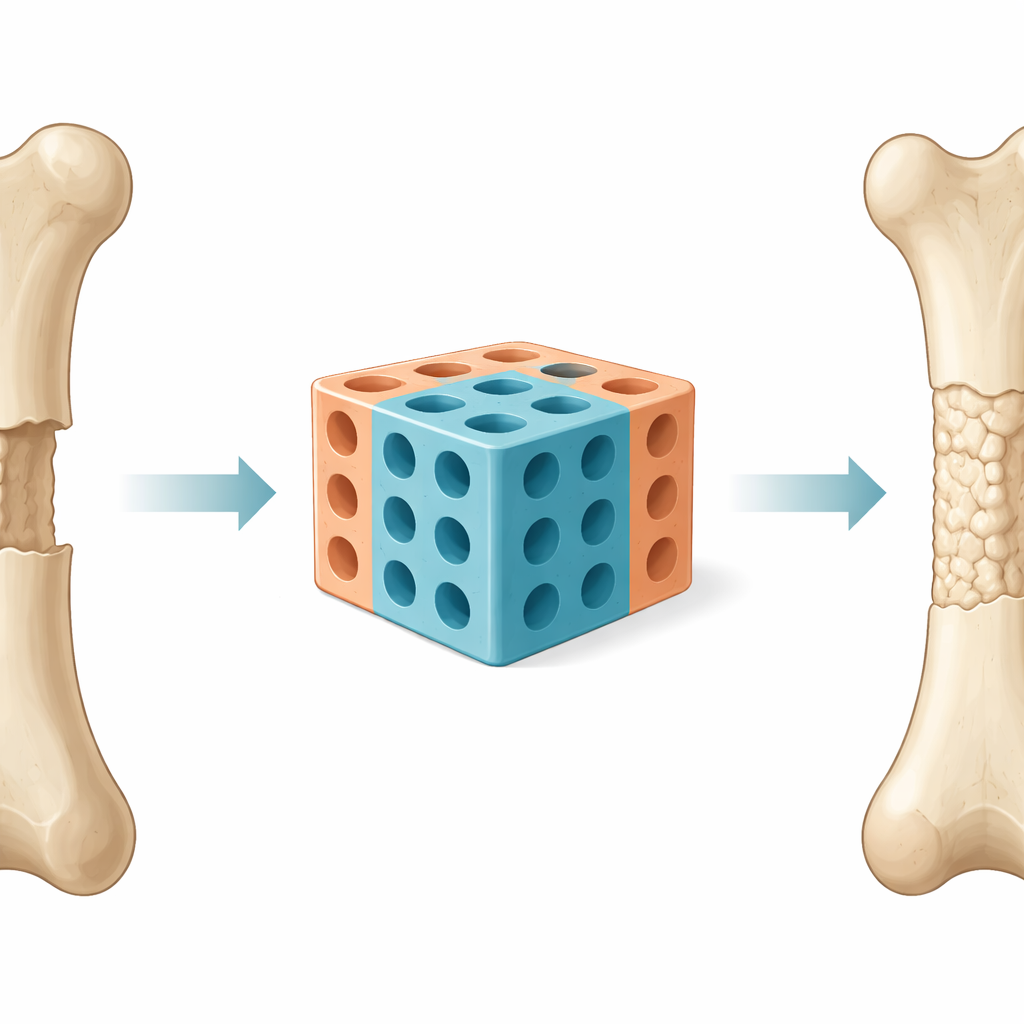
When a bone is badly damaged, surgeons often need more than a simple cast. Large gaps in bone are currently filled with grafts taken from a patient’s own body or from donors, but these options can be painful, limited in supply, and slow to heal. This study explores a new kind of 3D-printed implant, called a scaffold, designed to guide the body as it rebuilds missing bone. By combining a strong mineral-like core with a soft, bioactive outer layer, the researchers aim to create a “smart” temporary support that is both tough enough to hold its shape and friendly enough for new bone to grow into it.
A Building Frame for New Bone
The central idea of this work is to treat bone repair like constructing a house: you first need a sturdy frame that cells can climb on and around. The team used extrusion-based 3D printing to build lattice-like blocks with precisely controlled pores—tiny, regular openings in the range of about half a millimeter. These pores are large enough for cells, blood vessels, and nutrients to move through, but small enough to keep the structure solid. The printed core is made from alginate, a gel derived from seaweed, mixed with fine ceramic powders that imitate bone’s mineral content. By carefully tuning the printing recipe, the researchers produced scaffolds with well-defined architecture that do not collapse or deform during processing.
Combining Hard Mineral and Soft Gel
Real bone is a clever blend of hard minerals and flexible proteins, and the scaffolds in this study mimic that dual nature. The ceramic portion uses biphasic calcium phosphate, a mixture of hydroxyapatite and beta-tricalcium phosphate—materials already known to be similar to natural bone mineral. This mineral-rich core provides stiffness and helps the scaffold keep its shape. Around this core, the team added a thin shell of GelMA, a modified form of gelatin that can be hardened with light. This outer shell behaves more like soft tissue: it is water-rich, contains chemical groups that cells like to attach to, and can be adjusted to degrade slowly over time as new bone forms.
Testing Strength, Stability, and Growth Potential
To see whether their design could work inside the body, the researchers put the scaffolds through a series of lab tests. Mechanical compression tests showed that adding ceramic particles made the structures far stronger than those made from alginate alone. When the GelMA coating was added, stiffness more than doubled compared with the pure alginate version, meaning the scaffolds were better able to withstand squeezing forces similar to those bones experience. In salt-based solutions that mimic bodily fluids, the scaffolds slowly lost weight in a controlled way over several weeks, suggesting they would hold up long enough for new tissue to take over but not remain as permanent foreign objects.
Encouraging the Bone to Grow Back
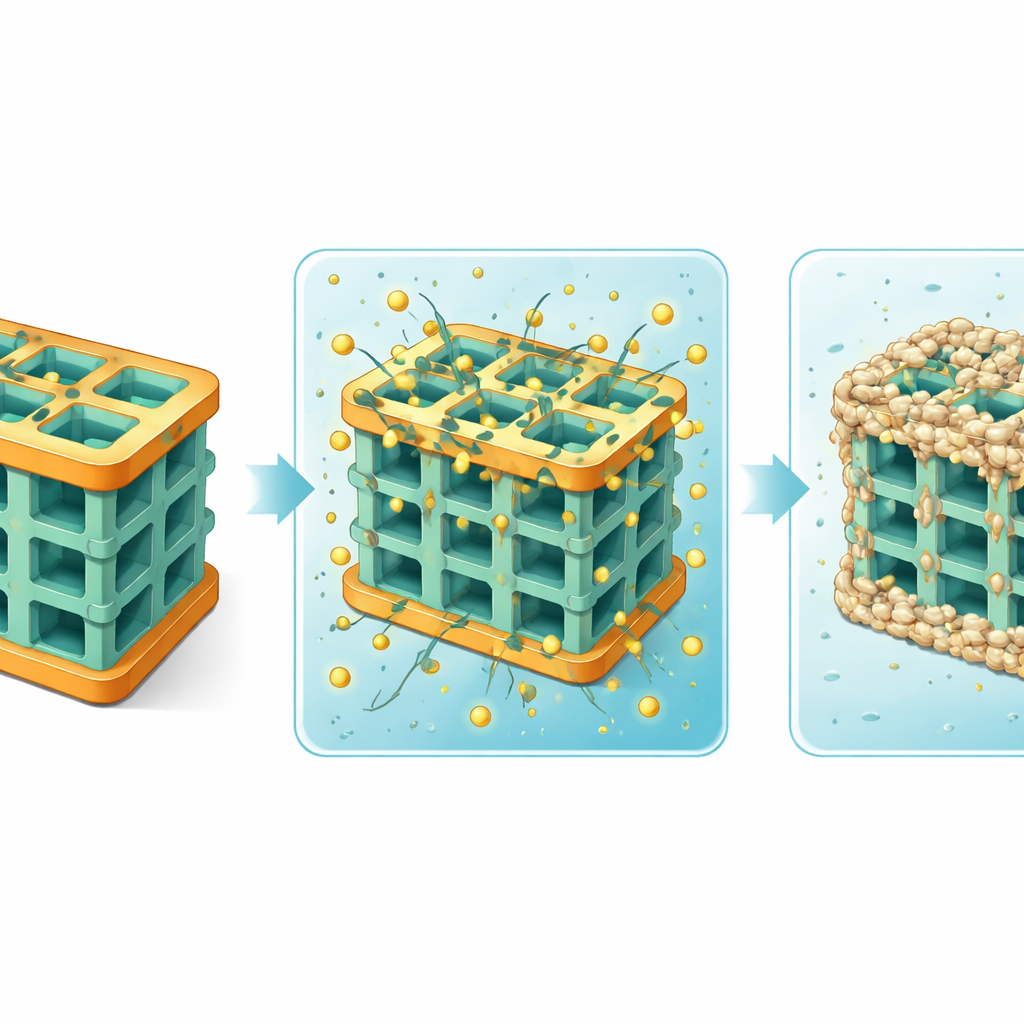
The most striking results came from experiments that tested how “bone friendly” the materials were. When the scaffolds were soaked in a liquid designed to imitate blood plasma, their surfaces gradually became coated with new mineral layers rich in calcium and phosphorus—the same elements found in bone. Microscopy and elemental analysis showed that mixtures with both types of calcium phosphate outperformed single-mineral versions, and that the GelMA-coated scaffolds did best of all. The soft outer shell offered extra landing spots for ions in the fluid, which kicked off the growth of a bone-like layer without adding any cells or growth factors. This suggests that once placed in the body, such scaffolds could naturally attract bone-forming activity at their surfaces.
What This Could Mean for Patients
Overall, the study shows that a 3D-printed “core–shell” scaffold—built from a strong ceramic–polymer lattice wrapped in a bioactive GelMA gel—can combine mechanical strength, gradual breakdown, and strong attraction for bone minerals in one design. For patients, this could one day translate into custom-shaped implants that snugly fit complex defects, bear loads without collapsing, and actively encourage the body to rebuild solid bone through and around them. While further animal and clinical studies are still needed, this work points toward a new generation of bone substitutes that function less like passive fillers and more like guided scaffolding for the body’s own repair crew.
Citation: Shadi, A., Mostafapour, A., Asghari, B. et al. 3D-printed core–shell scaffolds with a biphasic calcium phosphate core and GelMA hydrogel shell for bone tissue engineering. Sci Rep 16, 11451 (2026). https://doi.org/10.1038/s41598-026-41802-x
Keywords: bone tissue engineering, 3D-printed scaffolds, biphasic calcium phosphate, GelMA hydrogel, bone regeneration