Clear Sky Science · en
Estimation of electrical conductivity for polymer composites with carbon black nanoparticles by interphase depth, tunneling characteristics and network percentage
Why smarter plastics matter
From phone casings to car parts, plastics are everywhere—but most of them do a terrible job of carrying electricity. Engineers get around this by mixing in tiny conductive particles, turning everyday plastics into materials that can dissipate static, block electromagnetic noise, or act as flexible sensors. This paper tackles a practical question at the heart of that effort: how can we reliably predict and tune the electrical conductivity of plastics filled with carbon black nanoparticles, so that manufacturers can design these materials rather than relying on trial and error?
Building a connected pathway
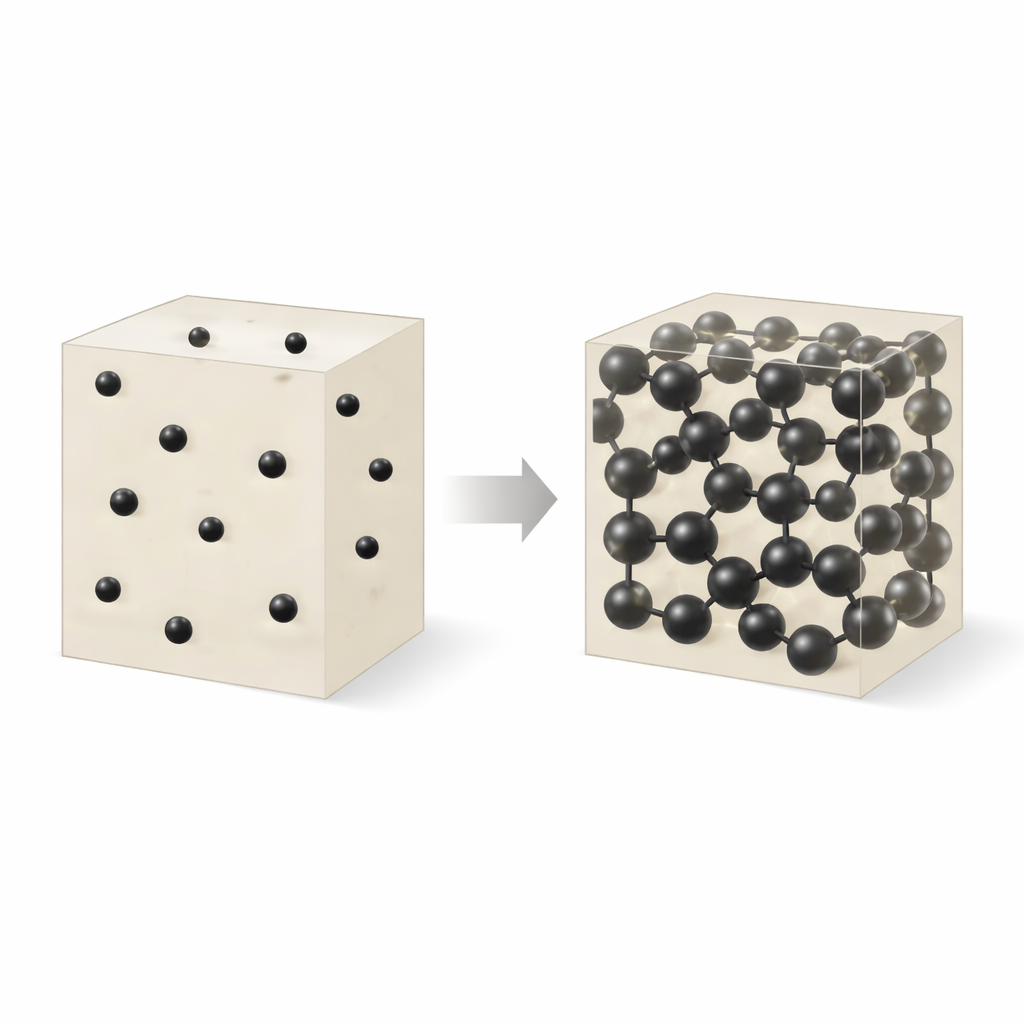
The authors focus on polymer composites that contain carbon black, a form of nearly pure carbon made of nanometer‑scale particles. On their own, these particles are excellent conductors. But when they are scattered through a plastic, the whole material remains an insulator until enough particles touch or almost touch to form a continuous, sample‑spanning network. This turning point is called the percolation threshold: below it, electrons have no continuous path; above it, they can snake through a web of particles. The team notes that this threshold depends not only on how much carbon black is added, but also on particle size, how evenly the particles are dispersed, and how they interact with the surrounding polymer.
Hidden zones and tiny gaps
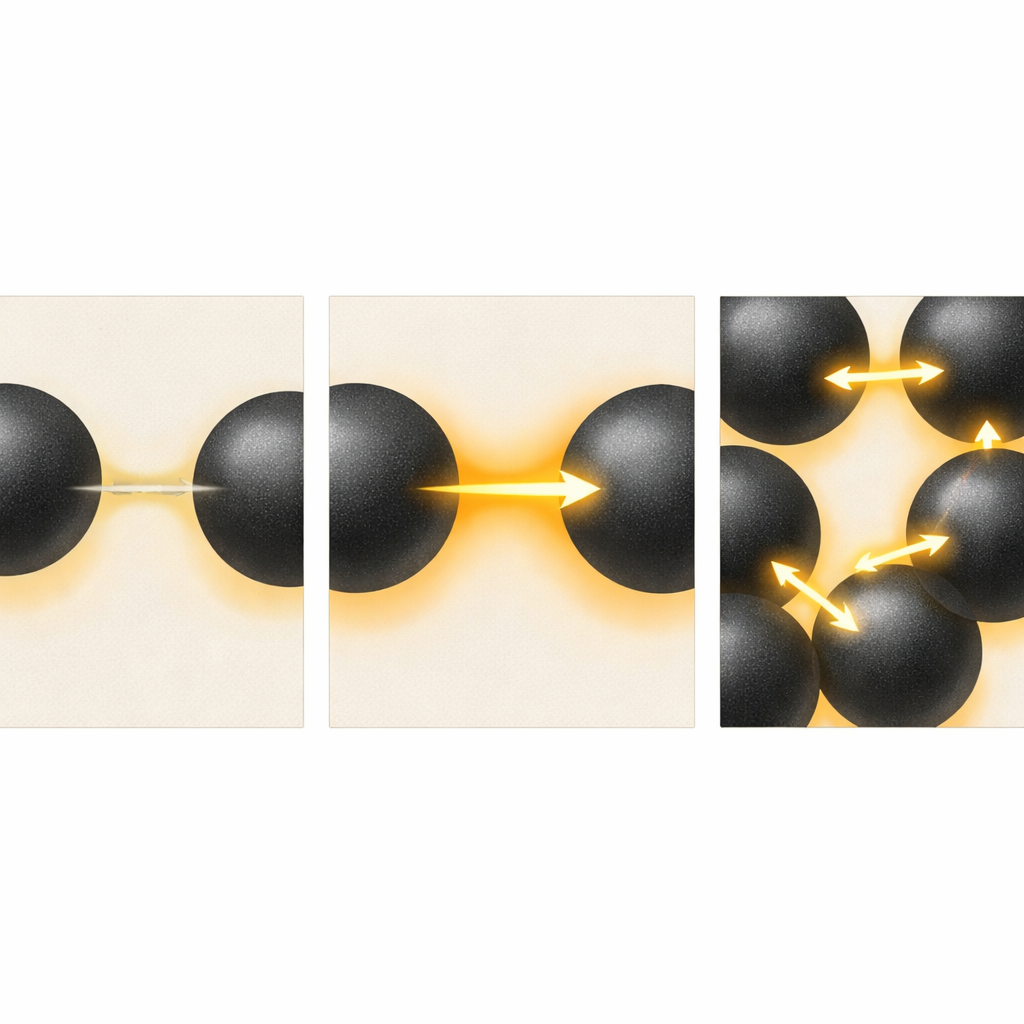
Two less obvious features turn out to be crucial. First is the "interphase"—a thin shell of polymer around each nanoparticle whose properties differ from the bulk plastic because it interacts strongly with the particle surface. These shells can effectively enlarge each particle and help bridge gaps, making it easier to form a continuous network at lower filler loadings. Second is electron tunneling: even when particles do not quite touch, electrons can jump across the nanometer‑scale gaps between them. The probability of such jumps depends on the separation distance, the size of the contact region, and how resistive the polymer in that gap is. Earlier models largely ignored either the interphase, the tunneling region, or both, limiting their accuracy.
A single equation tying everything together
To overcome those gaps, the authors propose a compact mathematical model that links the composite’s conductivity to physically meaningful design knobs. Their formula weaves together particle radius, interphase thickness, the surface energies of the polymer and carbon black, the size and distance of tunneling gaps, the overall fraction of particles that belong to the connected network, and the percolation threshold itself. In simple terms, conductivity rises when more of the carbon black belongs to the network, when interphase regions are thicker, when tunnels between particles are short and wide, and when the polymer in those tunnels offers low resistance. By contrast, larger particles, thin interphase layers, long tunneling gaps, and high tunnel resistivity all make the material behave more like an insulator.
What the model reveals about design choices
Using their equation, the researchers systematically vary each parameter to see how it changes the predicted conductivity. They find that the best performance comes from small carbon black particles wrapped in relatively thick interphase layers, which together create a dense network. Short tunneling distances of around two billionths of a meter and wide contact regions between particles can boost conductivity dramatically, whereas gaps longer than about five nanometers or very small contact areas leave the composite insulating. Surface energies matter too: a lower surface tension for the polymer and a higher one for the carbon black encourage particles to cluster and touch, which strengthens conductive pathways, even though it might sound counterintuitive to traditional ideas about good dispersion.
Putting theory to the test
To see if the model reflects reality, the team compares its predictions with published measurements from six different carbon black–plastic combinations, ranging from everyday polyethylene to more specialized polymers. For each system, they adjust a few hard‑to‑measure tunneling parameters until the calculated conductivities line up with the experimental curves across different filler loadings. The agreement is strong, and the extracted tunneling distances and contact sizes fall within reasonable nanometer‑scale ranges. This suggests the model captures the essential physics while still being simple enough to use as a design tool.
What this means for everyday technology
In practical terms, the study offers a roadmap for engineers who want plastics that are just conductive enough for a given job—whether that is gently bleeding off static charge, shielding electronics from interference, or acting as responsive sensing layers. Instead of guessing how much carbon black to add or repeatedly testing new formulations, designers can use the model to choose particle size, surface treatments, and processing conditions that control the network, the interphase, and the tiny tunneling gaps. For non‑specialists, the key message is that the electrical behavior of these nanocomposites is not a black box: it can be predicted and tuned by understanding and manipulating structure at the scale of billionths of a meter.
Citation: Zare, Y., Munir, M.T., Choi, JH. et al. Estimation of electrical conductivity for polymer composites with carbon black nanoparticles by interphase depth, tunneling characteristics and network percentage. Sci Rep 16, 11023 (2026). https://doi.org/10.1038/s41598-026-41789-5
Keywords: conductive polymers, carbon black nanocomposites, percolation threshold, electron tunneling, interphase effects