Clear Sky Science · en
Microplastics Interception from Riverine Ecosystems and Translocation to Fish Internal Organs
Plastic Dust in Our Rivers and in Fish
Plastic waste does not just float as bottles and bags on the water’s surface. Over time it breaks into tiny pieces, called microplastics, that are small enough to drift with river currents – and to be swallowed by fish. This study looks at how these particles move from an urban river into a common freshwater fish and then into its internal organs. Because many animals, including people, depend on river fish for food, understanding where these particles end up inside fish helps us gauge hidden risks to wildlife and to human health.
A Busy City River as a Plastic Highway
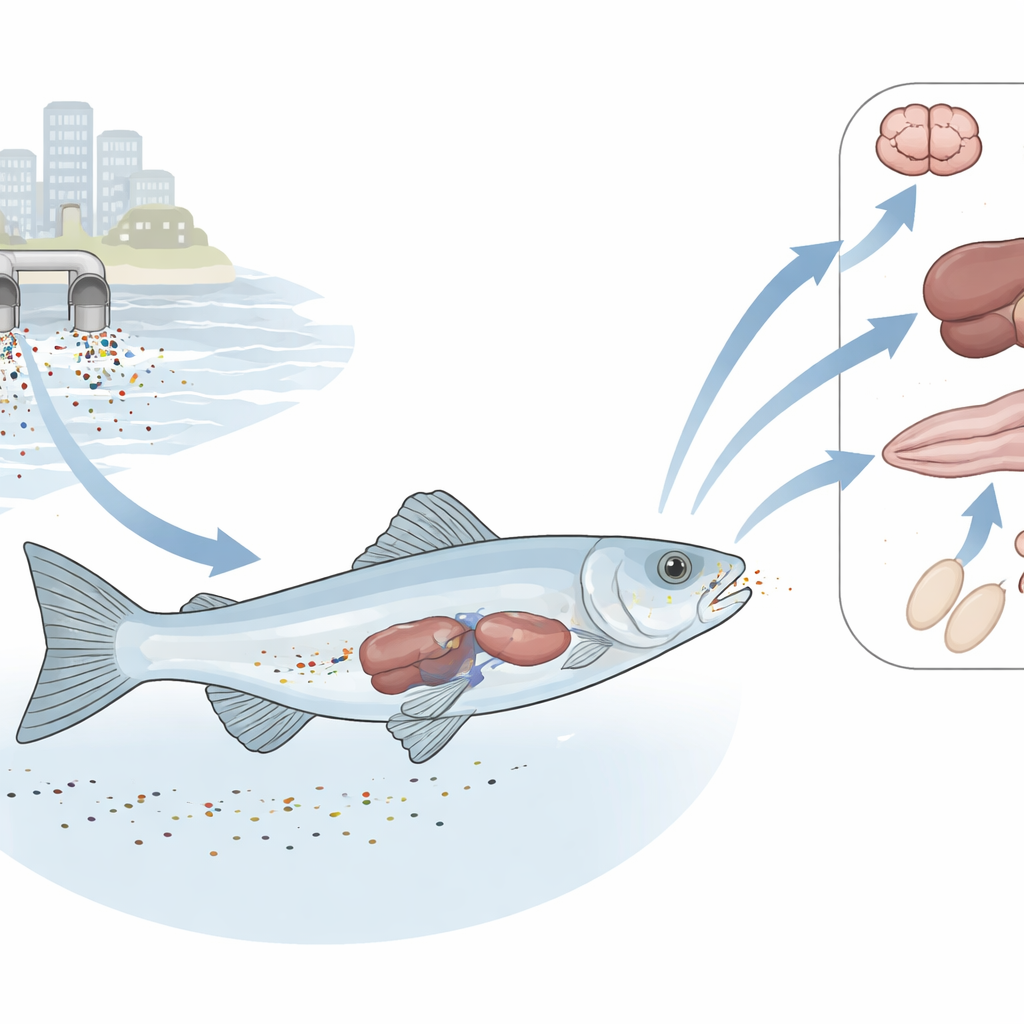
The researchers focused on the lower stretch of the Tiber River as it leaves Rome, a densely populated city with major wastewater treatment plants upstream. They used a pump system to filter large volumes of water at the depth where a small fish called the bleak usually feeds. This allowed them to capture microplastics from a wide range of sizes and shapes, rather than just the larger floating pieces often caught by nets. They found that the river carried several hundred microplastic particles per cubic meter, with broken fragments and thin fibers as the most common forms and many pieces far smaller than a grain of sand.
A Sentinel Fish and Its Daily Meal
The bleak is a planktivorous fish, meaning it feeds mainly on tiny drifting organisms in the water column. Because it is widespread and spends its life in the same part of the river where microplastics were sampled, it serves as a useful indicator of local contamination. The team collected 56 bleak from the same stretch of river and carefully dissected them. They examined not only the stomach and intestines but also five internal organs: liver, kidney, muscle, brain, and reproductive glands. By digesting away the soft tissue and staining the remaining particles, they could photograph and measure each piece of plastic.
From Gut to Organs: The Hidden Journey
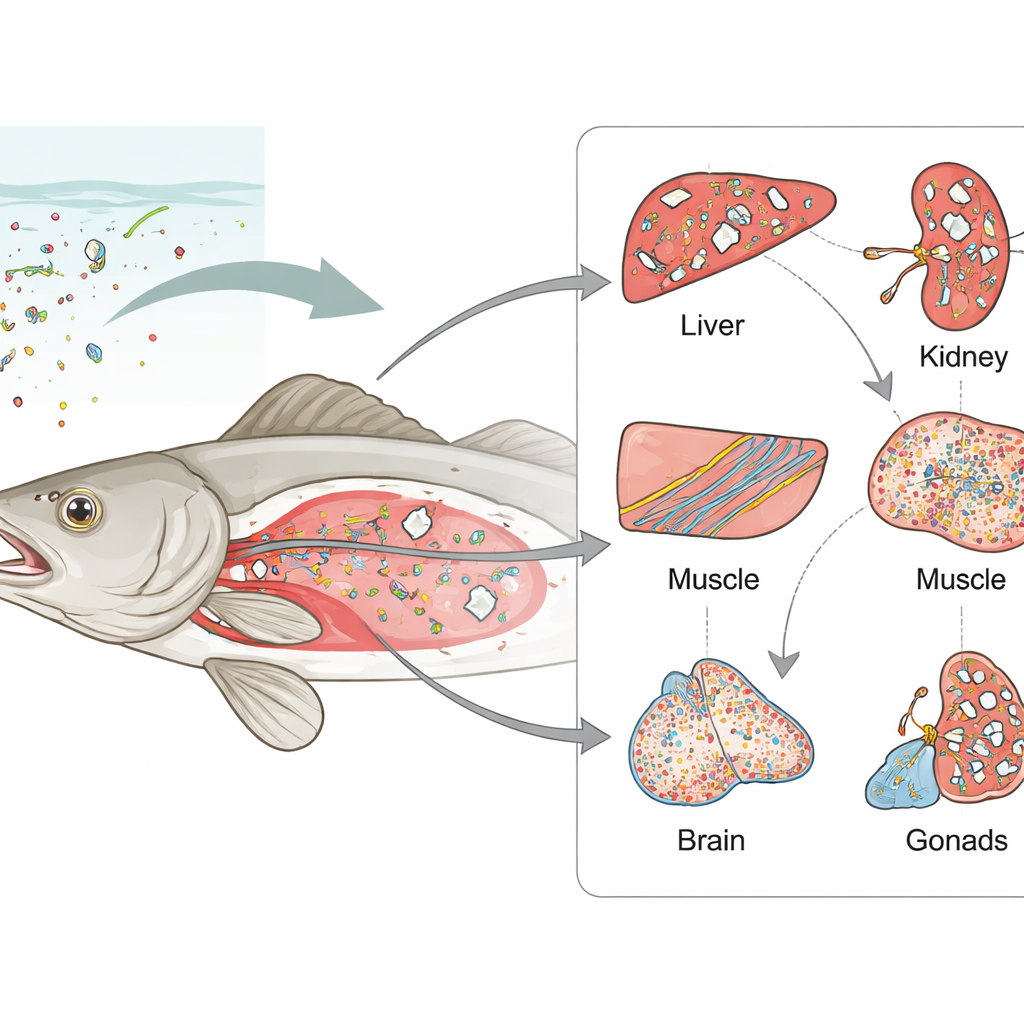
Microplastics were found in the vast majority of fish. About 84 percent of bleak had plastic in their digestive tract, which held the highest concentrations of all tissues. Yet plastic was also present in every type of internal organ examined. The liver and kidney, which filter and process blood, contained the highest average loads, while the brain, muscle, and gonads also showed frequent contamination. When the researchers compared the river water, the gut, and the organs, they saw a clear pattern: particles tended to become smaller and differently shaped as they moved inward. Larger pieces were more common in the water, mid-sized ones dominated the gut, and the smallest particles accumulated inside organs.
Why Shape and Size Matter Inside the Body
The team showed that not all microplastics behave the same inside fish. Long fibers were especially abundant in muscle, suggesting that thread-like particles travel or lodge along muscular tissue. Irregular fragments showed up strongly in the kidney, while tiny spherical particles dominated in the brain. Most of these brain particles were only a few micrometers across, small enough to slip through fine biological barriers. This suggests that the tiniest and smoothest particles can cross protective walls such as the blood–brain barrier more easily than larger, jagged pieces. Overall, more than 95 percent of plastics found in organs were under half a millimeter in size.
What This Means for Rivers, Fish, and People
By tracking plastic from the river water into multiple fish organs, this study provides a rare, real-world picture of how microplastics move through freshwater ecosystems. It shows that urban rivers can be heavily contaminated, that planktivorous fish actively and indirectly collect these particles through their feeding, and that the smallest pieces can migrate into sensitive organs including the brain and reproductive tissues. For a layperson, the takeaway is that plastic pollution is not just an eyesore; it quietly infiltrates animal bodies in ways that depend on particle size and shape. These results underscore the need to focus on tiny, often invisible plastic particles when assessing environmental risk and to reduce plastic inputs into rivers if we want to protect aquatic life and, ultimately, our own food supply.
Citation: Papini, G., Boglione, C. & Rakaj, A. Microplastics Interception from Riverine Ecosystems and Translocation to Fish Internal Organs. Sci Rep 16, 10824 (2026). https://doi.org/10.1038/s41598-026-41784-w
Keywords: microplastics, river pollution, freshwater fish, bioaccumulation, environmental health