Clear Sky Science · en
Effect of air and fuel injection pressure variation on torque and fuel economy in spark-ignition engines
Why this matters for everyday drivers
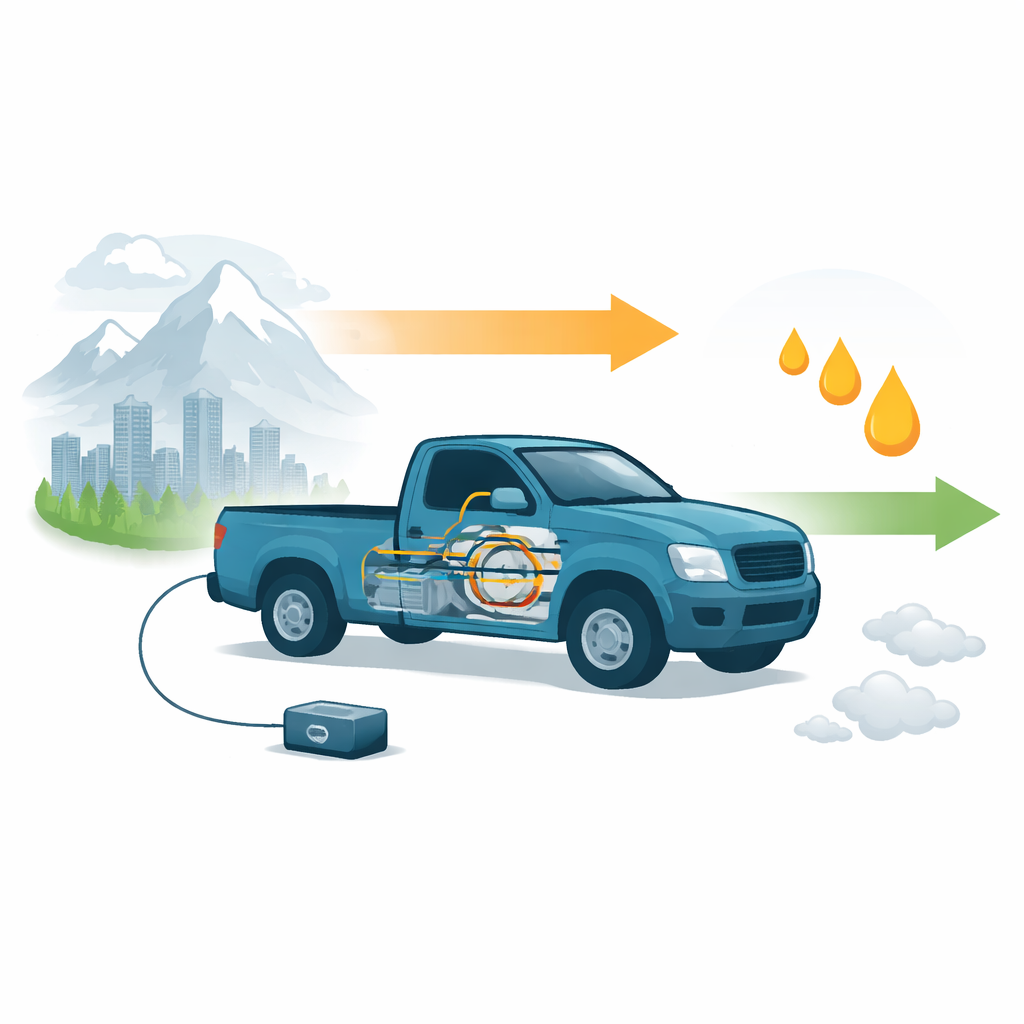
For people who live or work in mountain cities, driving often feels sluggish and thirsty on fuel. This study looks at a simple, low-cost tweak to a gasoline pickup truck that was tested in Quito, Ecuador—nearly three kilometers above sea level. By carefully changing how hard fuel is pushed through the injectors, and slightly "tricking" the engine’s air sensor, the authors explore whether an ordinary work truck can use much less fuel and still pull its load in thin air.
Engines in the thin air of the Andes
At high altitude, the air is less dense, so every engine gulp brings in fewer oxygen molecules. Modern gasoline engines respond by adjusting fuel and spark, but many common vehicles—especially older or simpler models—are not fully optimized for these conditions. The result can be weak acceleration, higher fuel use and more pollution. In Ecuador, where many people depend on pickup trucks for work and electric vehicles are still rare and expensive, even modest improvements in fuel economy could save money and cut emissions. The researchers chose a popular Great Wall Wingle 5 pickup as a test bed, because it represents a large share of the country’s working fleet.
A gentle nudge to the fuel and air systems
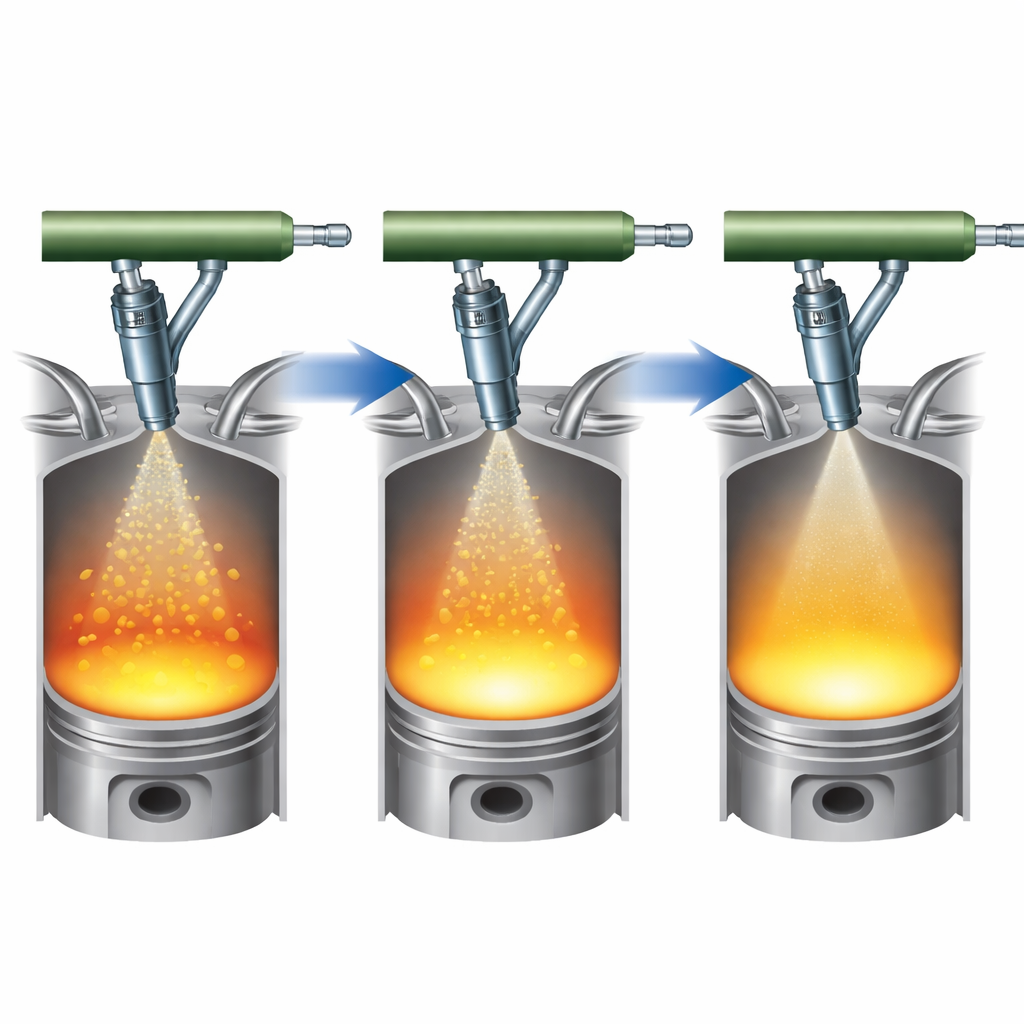
Instead of reprogramming the factory computer, the team added two inexpensive pieces of hardware: an adjustable fuel-pressure regulator and an Arduino-based electronic board that slightly alters the signal from the engine’s manifold absolute pressure (MAP) sensor. Together, these allow the fuel rail pressure to be raised from the stock 3.2 bar up to 4.0, 4.5 and 5.0 bar, while making the engine “think” it is seeing a different intake pressure. Higher fuel pressure helps break the gasoline into finer droplets, which can burn more completely. The modified air signal encourages the engine computer to shorten the time that injectors stay open, nudging the system toward leaner, more efficient combustion—all without permanently changing the original control software.
Real-world tests on city streets and mountain highways
To see how these adjustments behave outside the lab, the truck was driven repeatedly on two demanding routes around Quito: a congested urban corridor with constant stop‑and‑go traffic, and a hilly arterial highway with long climbs and descents. For each route, the researchers ran the truck at the original pressure and then at 4.0, 4.5 and 5.0 bar, carefully measuring fuel use with an external tank and balance, and logging engine data through the diagnostic port. This setup allowed them to track how fuel consumption, torque behavior, and injector pulse times changed under real driving conditions, including heavy loads and steep grades that are typical for local commercial vehicles.
What changed when the pressure went up
Across both routes, raising fuel pressure consistently shortened the injector pulses and improved fuel economy. In city driving, the pickup improved from about 7.2 kilometers per liter at the original setting to 13.5 kilometers per liter at 5.0 bar—an increase of roughly 87 percent under the specific test conditions. On the highway, consumption improved from about 9.2 to 12.9 kilometers per liter at the highest pressure, a gain of about 40 percent. Drivers reported that the truck climbed hills more briskly and finished each run a bit faster, suggesting stronger torque on grades. However, at the very highest pressure there were small downsides: in slow, heavy traffic and at low engine speeds, the truck occasionally felt a bit weaker or less smooth, a sign that combustion was becoming very lean in those moments.
Balancing savings, smoothness and long-term use
Because of these trade‑offs, the authors note that 4.5 bar offered a practical middle ground. At this setting, fuel economy was still much better than stock on both routes, but the engine’s response and injector signals were more stable, which is important for everyday drivability and possible long‑term reliability. They also observed that, in the mid‑pressure range, exhaust measurements hinted at cleaner combustion, with lower levels of carbon monoxide and unburned hydrocarbons. Still, the work was done on only one vehicle, over limited routes, and without long‑term wear or full tailpipe‑pollutant testing. The authors stress that while careful fuel‑pressure tuning appears to be a promising, affordable way to cut fuel use and carbon emissions in high‑altitude fleets, it should be validated on more vehicles and under regulated test conditions before being widely adopted.
Take‑home message for mountain drivers
For drivers and fleet operators in high‑altitude cities, this research suggests that meaningful fuel and emissions savings may be possible without buying new vehicles or complex technology. By modestly increasing fuel pressure and using a smart interface on an existing sensor, a common work truck in Quito used far less fuel in both city traffic and highway climbs, while mostly preserving its pulling power. If future studies confirm these results across more engines and ensure that emissions and durability remain acceptable, such low‑cost tweaks could become a useful bridge solution—helping make current gasoline fleets cleaner and cheaper to run while societies gradually transition to more advanced transport options.
Citation: Rojas-Reinoso, E.V., Masaquiza, S., Calderón, D. et al. Effect of air and fuel injection pressure variation on torque and fuel economy in spark-ignition engines. Sci Rep 16, 11955 (2026). https://doi.org/10.1038/s41598-026-41765-z
Keywords: spark ignition engines, fuel injection pressure, high altitude driving, fuel economy, sustainable mobility