Clear Sky Science · en
Study on inter-segment interference mechanisms and patterns between horizontal well sections in a combined well pattern of horizontal and vertical wells in offshore oilfields
Why this matters for offshore oil
Offshore oil fields that have produced for decades face a stubborn problem: most of the easily recovered oil is gone, but a large amount still clings to the rock in hard‑to‑reach pockets. In China’s Bohai Sea, engineers use networks of vertical and long horizontal wells to push water through the reservoir and sweep out more oil. Yet as fields age and water makes up almost all of the produced fluid, guessing where the remaining oil sits becomes risky and expensive. This study shows, with carefully scaled laboratory models and computer simulations, how different parts of a horizontal well interfere with one another and how that shapes where the last recoverable oil hides—and how to design well layouts to reach it.
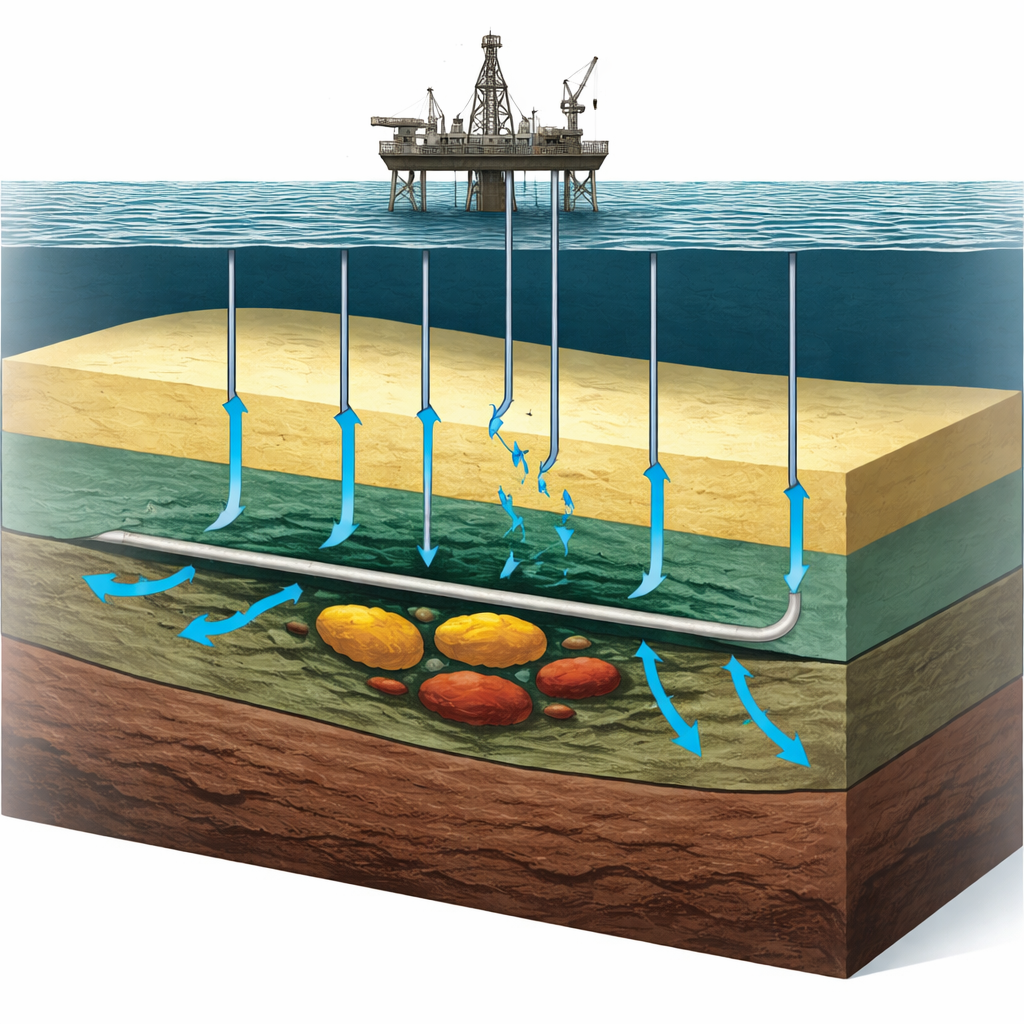
How water flooding shapes the last drops
The researchers focused on a real heavy‑oil reservoir in the Bohai Oilfield that is already in an “ultra‑high water cut” stage, meaning that more than 90% of the produced fluid is water. In such fields, water injected through some wells pushes oil toward producing wells in a complex underground maze. Because the rock varies in how easily fluids flow through it, water prefers high‑permeability zones and can race ahead, leaving oil stranded in tighter zones. When horizontal wells are combined with vertical or directional wells, different sections of the long horizontal borehole tap layers with different flow properties, and these sections can effectively steal pressure and flow from one another. The study set out to understand these inter‑section interferences and how they control the distribution of the remaining oil.
Building a miniature offshore reservoir
To capture this behavior, the team built a three‑dimensional physical model based on the geometry and rock properties of a Bohai block called QHD32‑6. They assembled a 60 cm by 60 cm by 10 cm plate filled with rock cores representing low‑, medium‑, and high‑permeability layers and embedded both horizontal and vertical wells. After carefully saturating the model first with water and then with heavy oil that mimicked the real crude, they ran water‑flood experiments at controlled temperature and flow rates. Electrical resistivity sensors across the model allowed them to track how the mix of oil and water changed at many points, revealing how quickly each segment gave up its oil as more water was pumped through.
What the lab and computer agreed on
In the experiments, high‑permeability segments yielded oil quickly and achieved recovery factors approaching 50%, while low‑permeability segments lagged far behind, rarely exceeding about 30% even after large water volumes. When the outlet from the most permeable section was deliberately shut off, more of the injected water was forced into the medium‑permeability zone, which then showed a sharp jump in recovered oil. Even so, the tightest zones remained stubbornly under‑swept. Numerical simulations that scaled this physical model up to full field size reproduced the same patterns: early rapid gains followed by slowing recovery, strong dependence on permeability contrast, and a characteristic build‑up of residual oil in the central part of the reservoir, between injection and production wells. This agreement gave confidence that the simulations could be used to explore many more scenarios than could be tested in the lab.
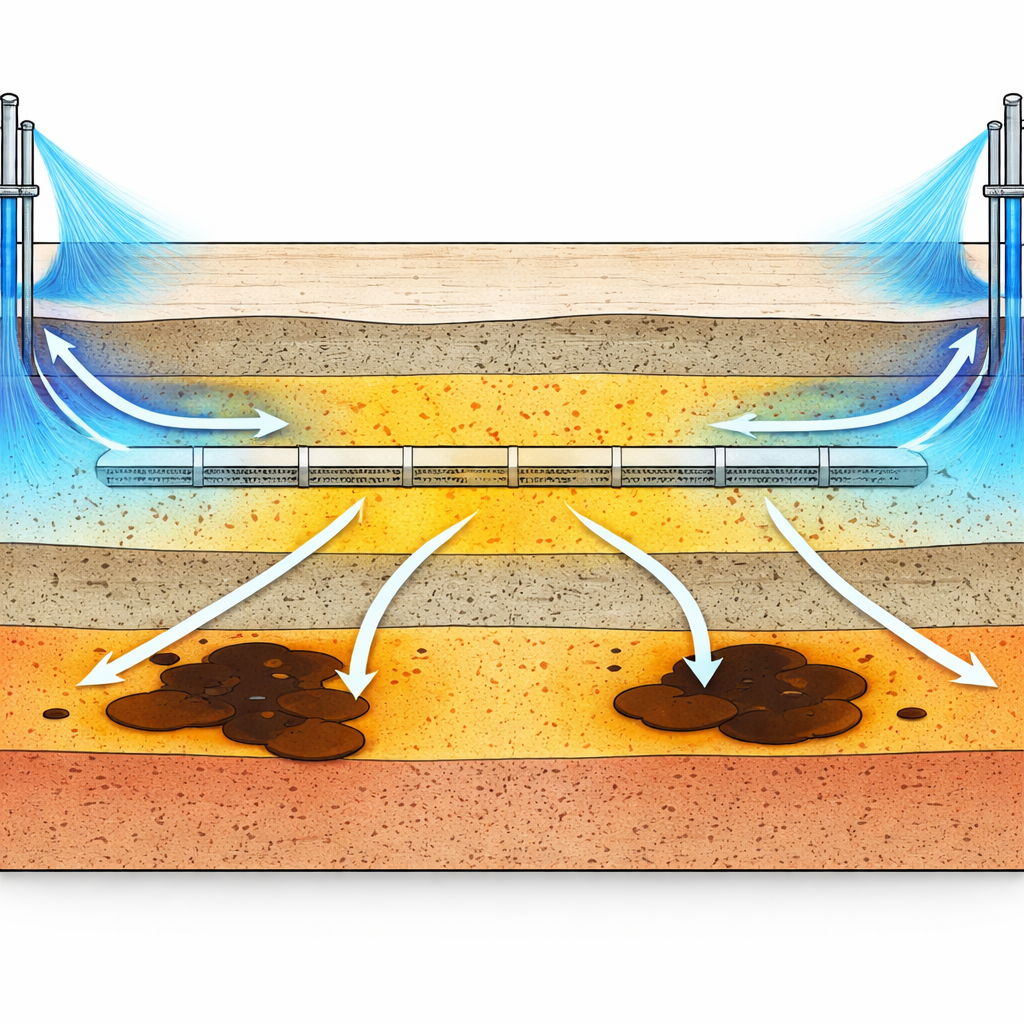
Where the remaining oil hides and why
By varying rock permeability, layer thickness, water content, and pressure differences between injection and production wells in the simulations, the authors identified clear thresholds beyond which the system behaves badly. If the permeability contrast between the easiest‑ and hardest‑flowing zones grew beyond about three to one, water overwhelmingly favored the most permeable layer, short‑circuiting to the producers and starving tighter zones of flow. Similarly, if the pressure contrast between segments exceeded roughly a factor of two, or if the difference in water saturation between segments became too large, interference intensified and overall recovery dropped. Across multiple flow patterns, a consistent picture emerged: the middle region of the horizontal section, which lacks its own injector, tended to accumulate residual oil because it depended entirely on water pushed in from the ends.
A new yardstick for well design
To turn these insights into practical guidance, the team combined their physical and numerical results into an empirical formula that calculates an “interference coefficient” for different segments of a horizontal well. This index links how strongly segments compete with one another to measurable field parameters such as permeability contrast, water‑cut contrast, pressure difference, and layer thickness. In effect, it provides a quick way for engineers to gauge whether a proposed well pattern will drive water evenly through all target zones or leave large pockets of oil untouched. The model also highlights which knobs—reducing permeability contrasts through targeted treatments, moderating pressure differences, or adjusting which segments remain open—are most effective for improving the sweep.
What this means for aging offshore fields
For non‑specialists, the central message is that in mature offshore oilfields, the challenge is less about drilling new holes and more about gently steering water through a very uneven underground landscape. This study shows that the way different sections of a long horizontal well interact can either help or hinder that steering. By identifying safe ranges for contrasts in rock quality, water content, and pressure, and by providing a practical formula to diagnose interference, the work offers operators a roadmap to tap previously bypassed oil with fewer new wells. In the long run, such smarter water‑flood design can stretch the useful life of existing offshore fields while reducing wasteful water handling and environmental impact.
Citation: Kuiqian, M., Zhang, Z., Lilei, W. et al. Study on inter-segment interference mechanisms and patterns between horizontal well sections in a combined well pattern of horizontal and vertical wells in offshore oilfields. Sci Rep 16, 11583 (2026). https://doi.org/10.1038/s41598-026-41737-3
Keywords: offshore oilfield, horizontal wells, water flooding, reservoir heterogeneity, remaining oil