Clear Sky Science · en
Assessing antitumor effects of plasma-activated phosphate buffered saline in breast cancer cell 2D and 3D models
New Ways to Tackle Tough Breast Tumors
Many women with breast cancer benefit from today’s drugs, yet some tumors either resist treatment from the start or learn to fight back over time. This study explores an unusual, electricity-based approach that turns a simple salt solution into a potential cancer-fighting liquid. The work looks at how this "plasma-activated" saltwater harms both ordinary and drug‑resistant breast cancer cells grown in the lab, raising the possibility of a new option for patients whose tumors no longer respond to standard chemotherapy.
Turning Simple Saltwater into an Active Treatment
The researchers began with phosphate‑buffered saline, a plain, body‑friendly salt solution often used in biology labs. They exposed this liquid to a cold electrical discharge, a type of non‑thermal plasma that does not heat or burn. This process filled the solution with reactive oxygen and nitrogen species—high‑energy forms of oxygen and nitrogen that can damage cells. The longer the liquid was exposed to the plasma, the more of these reactive molecules built up, and their levels stayed largely stable for at least a day at body temperature, suggesting that such a liquid could be prepared in advance for medical use. 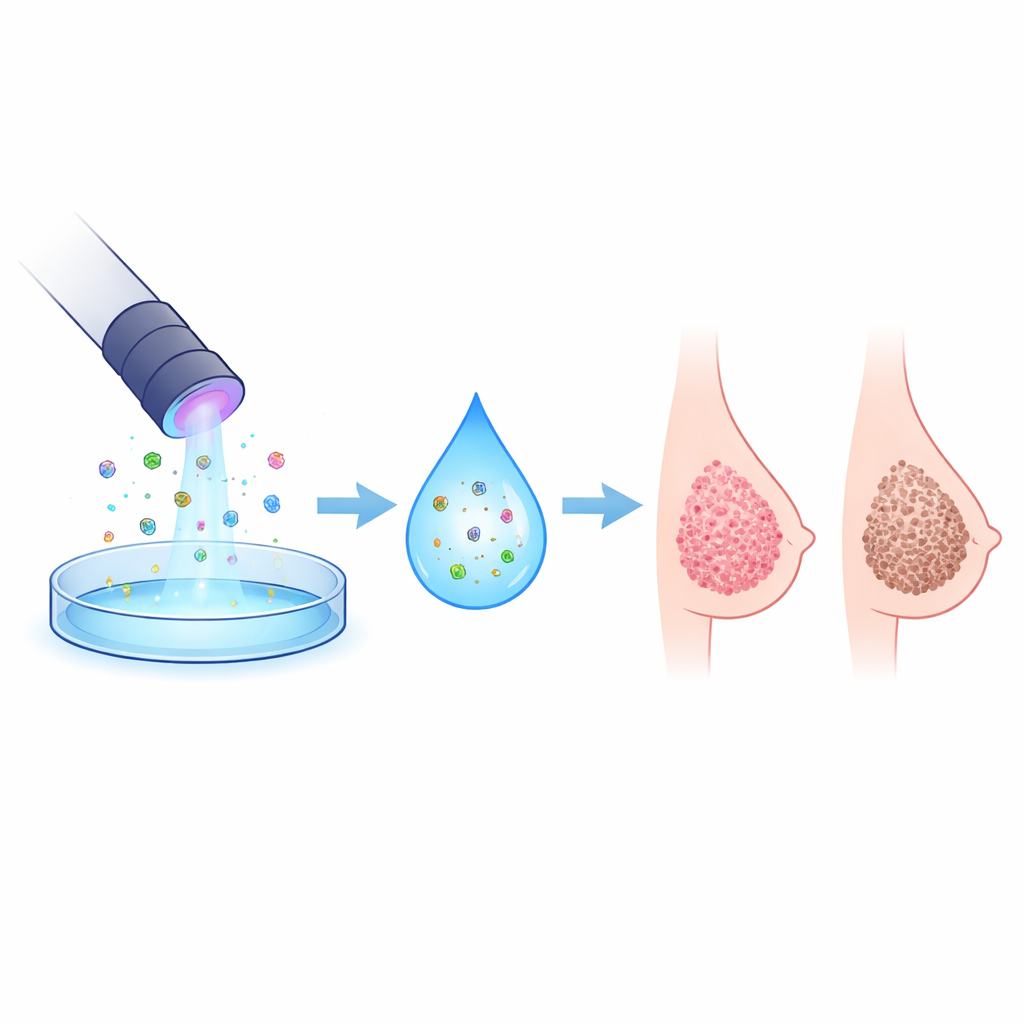
Testing on Flat Cell Layers and Mini-Tumors
To see whether this activated liquid could harm cancer, the team tested it on two closely related human breast cancer cell lines: one sensitive to the chemotherapy drug paclitaxel (MCF‑7) and a sister line that had been made strongly resistant to it (MCF‑7/PAX). In standard flat (2D) cultures, a one‑hour exposure to plasma‑treated saline strongly reduced cell survival in both lines in a dose‑dependent way—the more intense the plasma treatment of the liquid, the fewer cells remained alive after three days. Under the microscope, treated cells lost their normal shape and grip on the dish and showed classic signs of programmed cell death rather than sudden bursting.
How the Liquid Pushes Cancer Cells Toward Death
Flow‑cytometry measurements—an approach that counts and categorizes individual cells—confirmed that the main effect of the plasma‑activated saline was to trigger apoptosis, a controlled form of cell suicide. As the plasma treatment time of the liquid increased, the share of living cells dropped while the share of early and late apoptotic cells rose, in both the drug‑sensitive and drug‑resistant lines. Importantly, ordinary, untreated saline did not show this effect, pointing to the reactive molecules created by the plasma as the true cause. Previous work with similar liquids has shown that combinations of hydrogen peroxide and nitrogen‑based species act together to push cancer cells beyond their already stressed limits, while healthy cells tolerate these levels better.
Attacking 3D Tumor-Like Spheroids
Because real tumors are three‑dimensional, the researchers also formed compact balls of cancer cells called spheroids, which better mimic the structure and behavior of tumors in the body. These spheroids were exposed to plasma‑treated saline for either one hour or twenty‑four hours. In both drug‑sensitive and drug‑resistant spheroids, higher plasma doses led to either growth slowing or visible shrinkage over the following six days. Spheroids treated with the strongest dose became smaller, less compact, and surrounded by cellular debris, signs of severe damage. Notably, the drug‑resistant spheroids were often even more affected than the sensitive ones, with very high doses leading to an almost complete loss of viability. 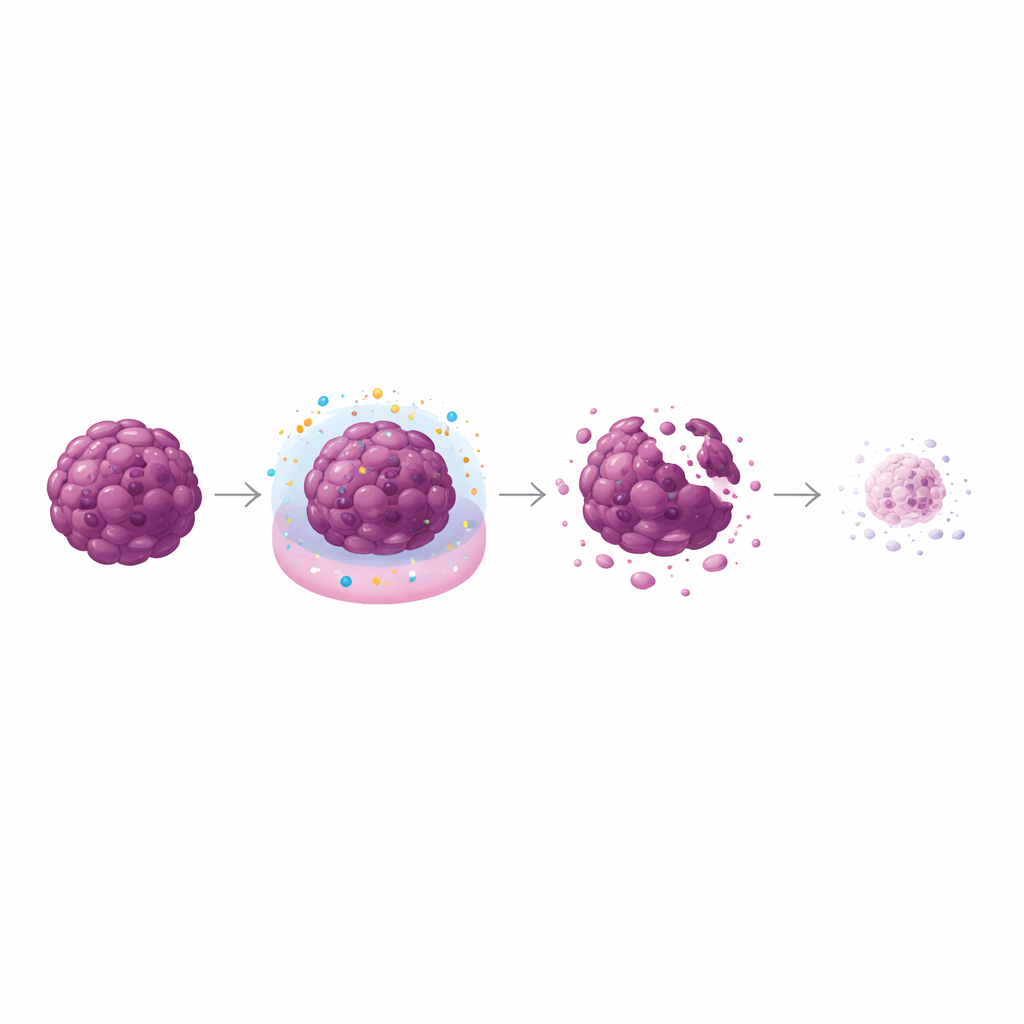
What This Could Mean for Future Cancer Care
Taken together, the findings suggest that plasma‑activated saline can kill breast cancer cells grown in both simple layers and more realistic 3D mini‑tumors, and can do so even when those cells have become resistant to a major chemotherapy drug. Because the active molecules in the liquid are stable for many hours and the base solution itself is simple and safe, such a treatment might one day be delivered by direct injection into tumors or used alongside existing drugs. While these are still lab‑based experiments and much work remains before any patient use, the study points to a promising future in which a carefully energized salt solution helps disarm some of the most stubborn breast cancers.
Citation: Kužmová, D., Gbelcová, H. & Machala, Z. Assessing antitumor effects of plasma-activated phosphate buffered saline in breast cancer cell 2D and 3D models. Sci Rep 16, 13299 (2026). https://doi.org/10.1038/s41598-026-41704-y
Keywords: breast cancer, cold plasma, drug resistance, plasma-activated saline, 3D tumor models