Clear Sky Science · en
Analytic solutions for Euler–Bernoulli beams with axial compression resting on a nonlinear elastic foundation using MADM
Why bending beams still matter
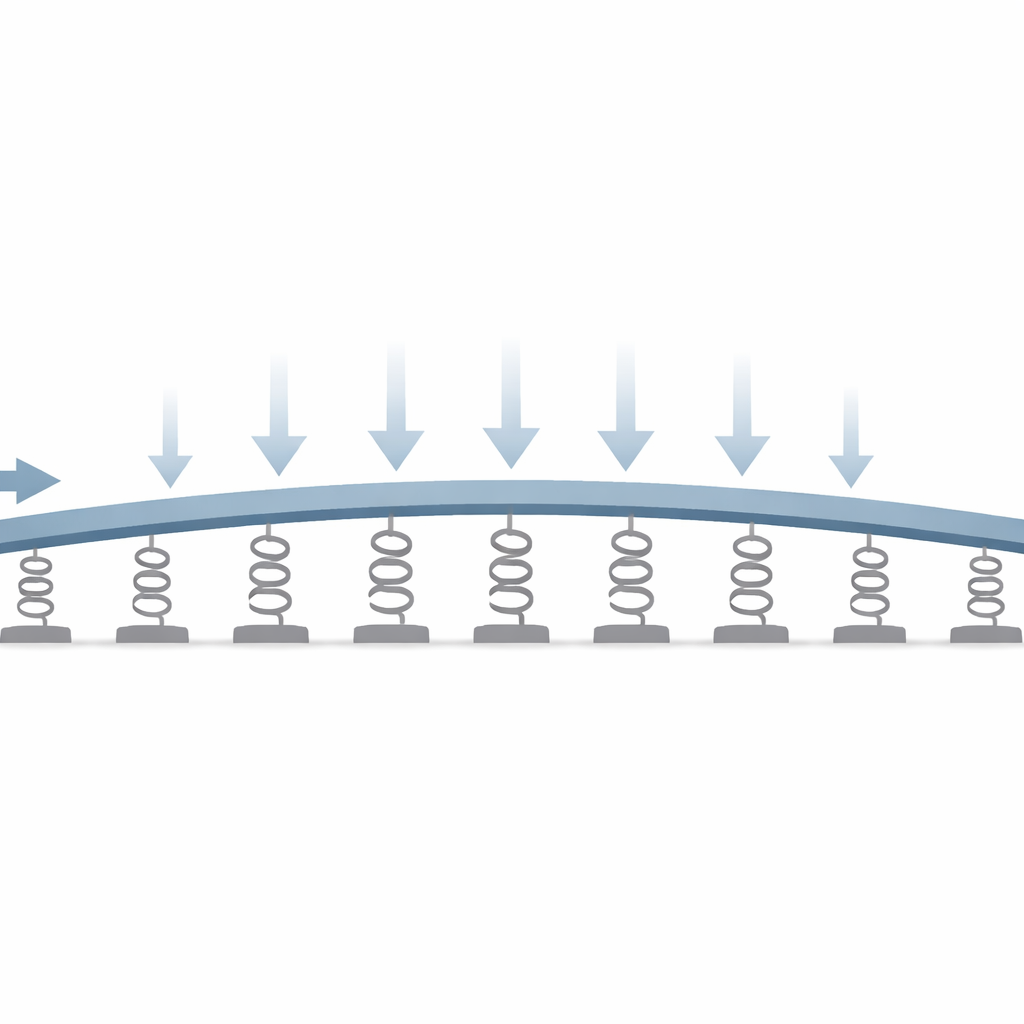
From high‑speed trains and bridges to turbine blades, many everyday technologies rely on long, slender beams that must bend safely under load. These beams are often anchored to soil, rubber pads, or other supports that do not behave in a perfectly simple, spring‑like way. This article explores a new analytical technique for predicting how such beams bend when they are pushed along their length and rest on foundations that respond in a nonlinear fashion, helping engineers design lighter, safer, and more efficient structures.
Beams, supports, and hidden complexity
In structural engineering, beams on elastic foundations are a classic model for things like railway tracks on sleepers, bridge decks on bearings, or pipelines resting on soil. Traditional theories assume both the beam and its supporting foundation respond in a straightforward, proportional way to loads. Real foundations, however, often stiffen or soften as they deform, and beams may be squeezed by forces along their length. These effects interact and can drastically change how much a beam sags or vibrates. Capturing this interplay accurately is critical because excessive bending can shorten service life or even cause failure, while overly conservative designs waste material and cost.
A smarter way to solve tough equations
The core of the study is a refined mathematical technique called the Modified Adomian Decomposition Method (MADM). Instead of turning the beam problem into a huge system of equations for a computer to crunch, MADM represents the unknown beam deflection as a series of simple polynomial pieces. The governing equation includes terms for the beam’s stiffness, the axial push or pull, and both linear and nonlinear parts of the foundation’s reaction. By carefully choosing how to split the equation into “easy” and “difficult” parts, the method builds up the solution term by term, using special combinations called Adomian polynomials to handle the nonlinear contribution of the foundation without approximating it as weak or minor.
Checking the method against known behavior
To test whether this approach truly works, the authors first construct an artificial but fully solvable example in which the applied load and resulting deflection are low‑order polynomials. In that case, the exact bending shape of the beam can be written down explicitly. Applying MADM to this setup, they show that the method reproduces the exact solution using a finite number of series terms, verifying that the recursion rules and boundary conditions are implemented correctly. This step is important because it confirms the technique is mathematically sound before it is used on more realistic, less tidy problems.
How nonlinear supports and axial forces change deflection
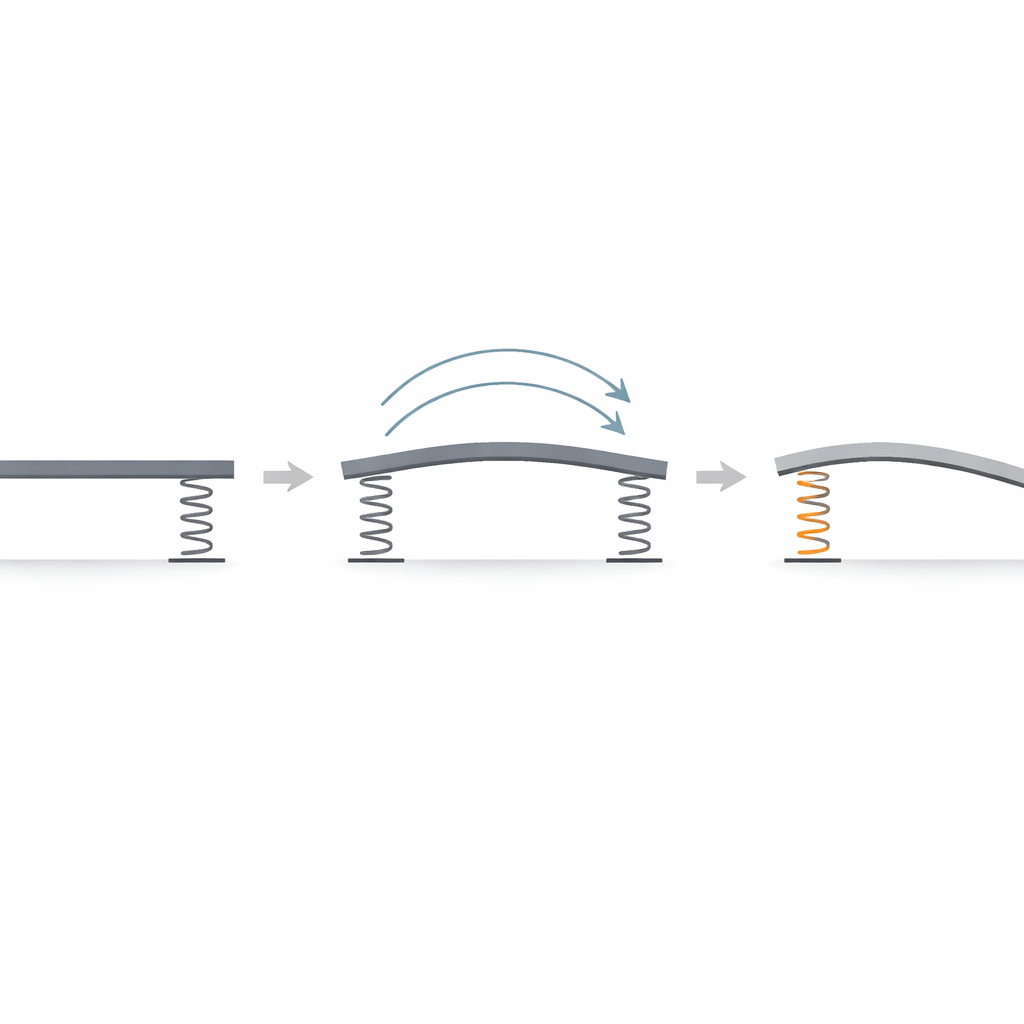
Next, the study tackles more practical scenarios where the foundation’s stiffness depends on how much it is compressed and where the beam experiences a constant push along its length. Here, the MADM results are compared with earlier solutions based on perturbation theory, which assumes the nonlinearity is small. The new method agrees well when the nonlinear effects are mild, but remains stable and accurate as the nonlinearity grows, while perturbation solutions start to diverge and even predict physically impossible negative deflections. Systematic parameter studies show clear trends: as the uniform load increases, the beam bends more; increasing the linear or nonlinear stiffness of the foundation reduces deflection; and moderate axial compression can reduce sagging in the pre‑buckling range, whereas axial tension tends to amplify it. The nonlinear foundation is particularly effective at limiting large deflections because its restoring force grows faster than linearly with displacement.
Why fast and stable convergence matters
A key practical advantage of MADM is how quickly its series solution converges. By monitoring the difference between successive approximations, the authors show that only a modest number of terms are needed to reach very high accuracy. They also find that including axial compression can smooth out irregularities in the convergence pattern, effectively stabilizing the numerical behavior of the series. This means that engineers can obtain reliable predictions of beam deflection without resorting to heavy numerical simulations or vast training data, while still retaining clear links between the governing physics and the calculated response.
What this means for real structures
In simple terms, the article demonstrates that the modified decomposition method offers a fast, robust way to predict how beams bend when they are pressed along their length and supported by foundations that do not behave like simple springs. It handles strong nonlinearities directly, stays accurate where older approximation methods fail, and provides insight into how load, axial force, and foundation properties work together to control deflection. This makes it a valuable analytical tool for designing rails, bridge components, machine parts, and other beam‑like elements that must remain safe and stable under complex support conditions.
Citation: Chou, LK., Lin, MX. Analytic solutions for Euler–Bernoulli beams with axial compression resting on a nonlinear elastic foundation using MADM. Sci Rep 16, 13059 (2026). https://doi.org/10.1038/s41598-026-41700-2
Keywords: beam deflection, nonlinear foundation, axial compression, semi-analytical methods, structural mechanics