Clear Sky Science · en
Discordance in gender role attitudes between spouses and its relationship with the risk biomarkers of cardiovascular diseases: a couple-level analysis
Why What Happens at Home Matters for the Heart
Many of us know that smoking, diet, and exercise affect heart health. But what about the unspoken rules at home—who earns the money, who does the chores, and whether partners agree on these roles? This study looks at older married couples in rural South Korea and asks a surprisingly simple question with big consequences: when husbands and wives disagree about what men and women “should” do, does it quietly wear down the wife’s heart and blood vessels over time?

Different Views Under One Roof
The researchers focused on “gender role attitudes,” meaning beliefs about whether men should mainly earn money and women should mainly care for the home, or whether both should share these responsibilities. On a spectrum from very traditional to very egalitarian, each spouse placed themselves by answering a single, widely used question. The key idea was not just who was traditional or egalitarian, but whether the two spouses matched or clashed in their views. A couple in which both partners were traditional or both egalitarian was considered aligned, while a couple in which one was strongly traditional and the other strongly egalitarian was highly mismatched.
Measuring Silent Signals in the Blood
To see how these differences might show up in the body, the study drew on detailed health data from 308 older married couples—616 people—living in two farming villages. Participants had their blood pressure measured several times and gave blood samples. From these, the researchers tracked several early warning signs related to cardiovascular disease: systolic blood pressure (the pressure when the heart beats), levels of triglycerides (a type of fat in the blood), levels of “good” HDL cholesterol, and the ratio of triglycerides to HDL, which is a strong long-term risk marker. They also measured an inflammation marker called high‑sensitivity C‑reactive protein. At the same time, the team gathered information on age, education, income, work, smoking, drinking, body weight, medications, symptoms of depression, and how each spouse rated the quality of the marriage.
When Disagreement Hits Wives Harder
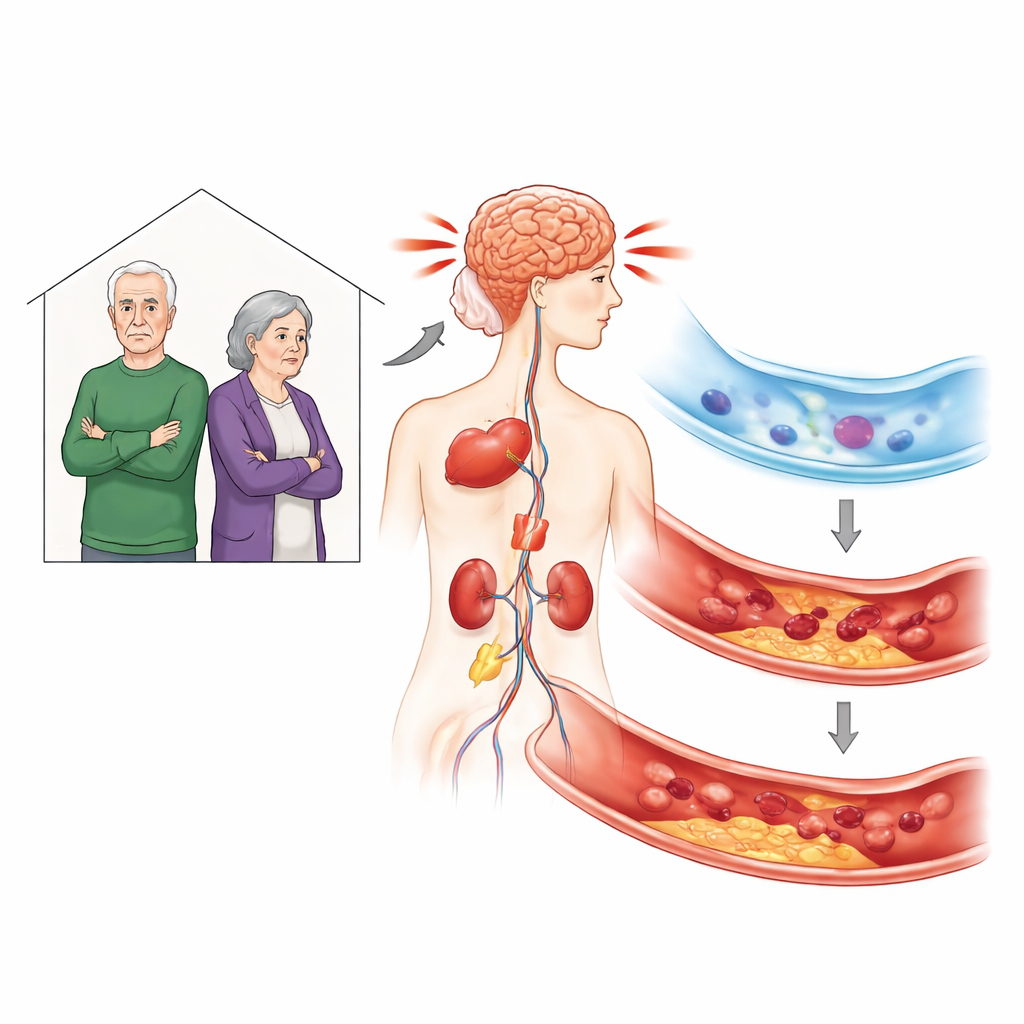
Using a couple-level statistical approach that treats spouses as interconnected rather than isolated individuals, the researchers found a striking pattern: it was not each person’s attitude on its own that mattered most, but the mismatch between the two. Wives had higher systolic blood pressure, higher triglycerides, a worse triglyceride‑to‑HDL ratio, and lower HDL when their views on men’s and women’s roles were far from their husbands’—especially when one spouse was very traditional and the other very egalitarian. In contrast, wives in couples where both partners shared either traditional or egalitarian views tended to have more favorable heart‑related markers. Importantly, these links remained even after taking into account marital satisfaction, negative interactions, health behaviors, mood, and other standard risk factors.
Why Husbands Seem Less Affected
The same patterns did not appear for husbands. Their early cardiovascular markers did not change significantly with agreement or disagreement about gender roles. The authors argue that this difference reflects how daily life is organized in older rural Korean marriages. Even when women hold egalitarian ideals, they are often still expected to carry most of the housework and caregiving, while men retain more decision power and are less pressured to change their routines. This means that mismatched expectations may translate into heavier strain, frustration, and a sense of thwarted purpose for wives, but not necessarily for husbands. Over time, this quiet, chronic strain may promote harmful stress responses and less healthy habits, nudging wives’ blood pressure and blood fats in an unfavorable direction.
What This Means for Aging Couples
For a general reader, the takeaway is clear: how couples negotiate “who does what” is not only a matter of fairness or happiness—it may also be a matter of long‑term heart health, especially for older wives. The study suggests that two groups of women may be at particular risk: traditional wives married to egalitarian husbands, and egalitarian wives married to traditional husbands. While the research cannot yet prove cause and effect, it highlights that health care providers and community programs might want to pay attention to couples’ role expectations, not just individual habits. Helping partners talk through and better align their views—and easing the resulting stress—could become another tool in protecting the aging heart.
Citation: Sung, K., Kim, J., Park, YR. et al. Discordance in gender role attitudes between spouses and its relationship with the risk biomarkers of cardiovascular diseases: a couple-level analysis. Sci Rep 16, 11881 (2026). https://doi.org/10.1038/s41598-026-41697-8
Keywords: marriage and heart health, gender roles in couples, cardiovascular risk in older adults, stress in long-term relationships, rural aging and health