Clear Sky Science · en
Ultra-high-speed holographic data storage system based on extending data page size
Why faster data matters
From streaming movies to training AI, our world is generating more information than today’s hard drives and optical discs can comfortably handle. Much of this “cold” archival data is now being accessed more often, turning it unexpectedly “hot” and putting pressure on storage systems to move data far more quickly. This paper explores a promising alternative to conventional storage: a holographic system that writes and reads vast blocks of information with light, and demonstrates a way to push its data rate beyond 20 gigabits per second.
Storing information in light patterns
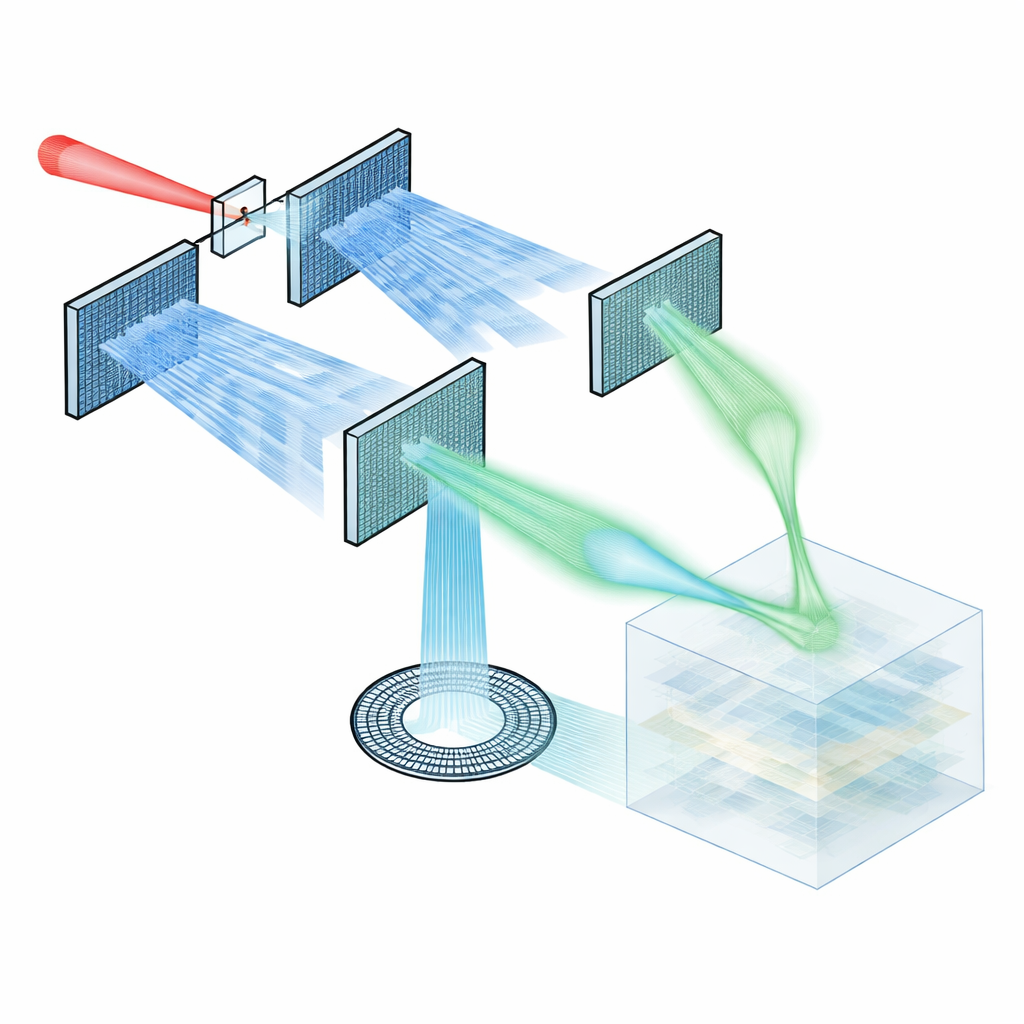
Unlike familiar storage devices that write bits one after another along a track, holographic data storage records whole pictures of data at once. Each “page” is a two‑dimensional pattern of bright and dark pixels that encodes digital information. When this patterned signal beam meets a second, cleaner reference beam inside a special medium, their interference pattern is recorded in three dimensions, like a frozen ripple field. Because entire pages are written and read in a single shot, this approach can, in principle, move data orders of magnitude faster than bit‑by‑bit methods.
The bottleneck: tiny mirrors, limited area
To turn electronic data into light patterns, engineers use spatial light modulators—chips that can switch hundreds of thousands of tiny elements on and off. A leading version, the digital micromirror device (DMD), uses an array of microscopic tilting mirrors that can flip at tens of thousands of times per second, making it ideal for high‑speed operation. But physics and manufacturing constraints limit how small each mirror can be and how many can fit on one chip. Traditional holographic setups ask a single DMD to handle both the data‑carrying signal beam and the reference beam, forcing the chip to share its precious mirror area between them. That shrinking real estate sharply caps how much information can be written in each page.
Doubling up and freeing space
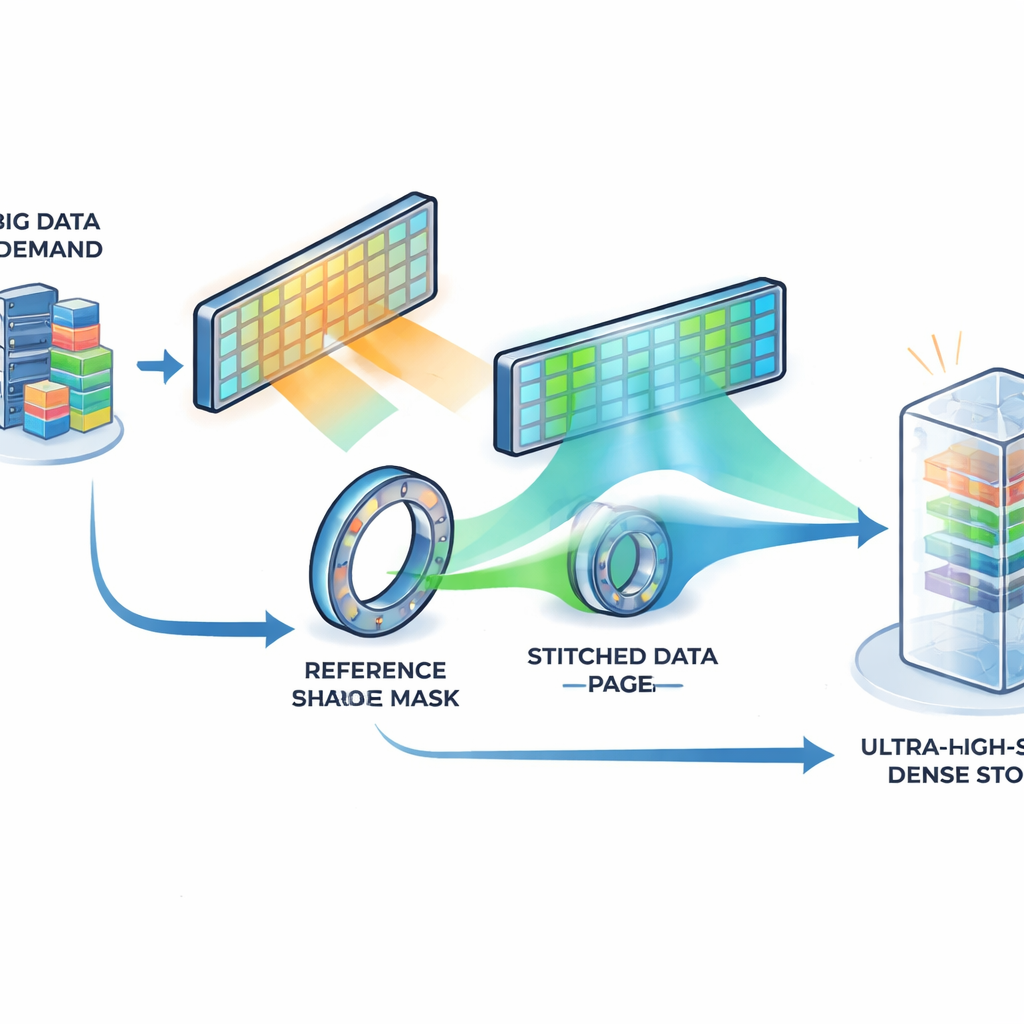
The researchers tackle this limitation on two fronts. First, they split the signal beam across two DMD chips instead of one. Each chip encodes half of the data page; an optical system then “stitches” the upper and lower halves back together into one large, seamless pattern on the recording plane. This effectively extends the data page size to the combined area of both devices without needing smaller mirrors. Second, they no longer burden the DMDs with shaping the reference beam. Instead, a specially fabricated ring‑shaped mask imprints the required pattern onto a separate beam, mimicking the grating‑like structure of the DMD without consuming any of its pixels. Together, these steps dedicate almost the entire DMD area to carrying useful information.
Smarter coding for each tiny patch
Beyond making the light canvas larger, the team also packs more meaningful information into every small patch of that canvas. They divide the page into many tiny 4‑by‑4 pixel blocks and use a constant‑weight scheme where exactly five pixels in each block are bright and the rest are dark. By carefully choosing which five are on, each block represents one of 4,096 possible patterns—enough to encode 12 bits of data in an area only 16 pixels wide. Compared with an earlier scheme that stored 8 bits per block, this denser coding substantially boosts the payload per page while preserving reliable separation between “on” and “off” states. Tests of the stitched signal patterns show low error rates and healthy signal‑to‑noise levels, confirming that the more crowded pages remain readable.
Pushing toward ultra‑fast storage
To see what their design could achieve in practice, the authors replaced the holographic medium with a mirror and used a high‑speed camera to capture the encoded pages, isolating the performance of the optical front end. With the dual‑DMD setup running near 28,000 frames per second and each extended page carrying about 770,000 bits, the system reaches a writing data rate of 20.06 gigabits per second. In principle, with future cameras and photoelectric converters fast enough to keep up, the same architecture could support reading rates well above 100 gigabits per second—far beyond today’s mainstream optical discs. While fully realizing this promise will require advances in the recording materials and system stability, this work shows a clear path toward holographic storage that can keep pace with the data‑hungry age.
Citation: Lin, Y., Ke, S., Xu, X. et al. Ultra-high-speed holographic data storage system based on extending data page size. Sci Rep 16, 12100 (2026). https://doi.org/10.1038/s41598-026-41672-3
Keywords: holographic data storage, high speed optical storage, digital micromirror device, big data archiving, data page encoding