Clear Sky Science · en
Dual-band graphene-assisted metamaterial absorber with machine learning integration for high-sensitivity THz biosensing
New ways to spot disease with invisible light
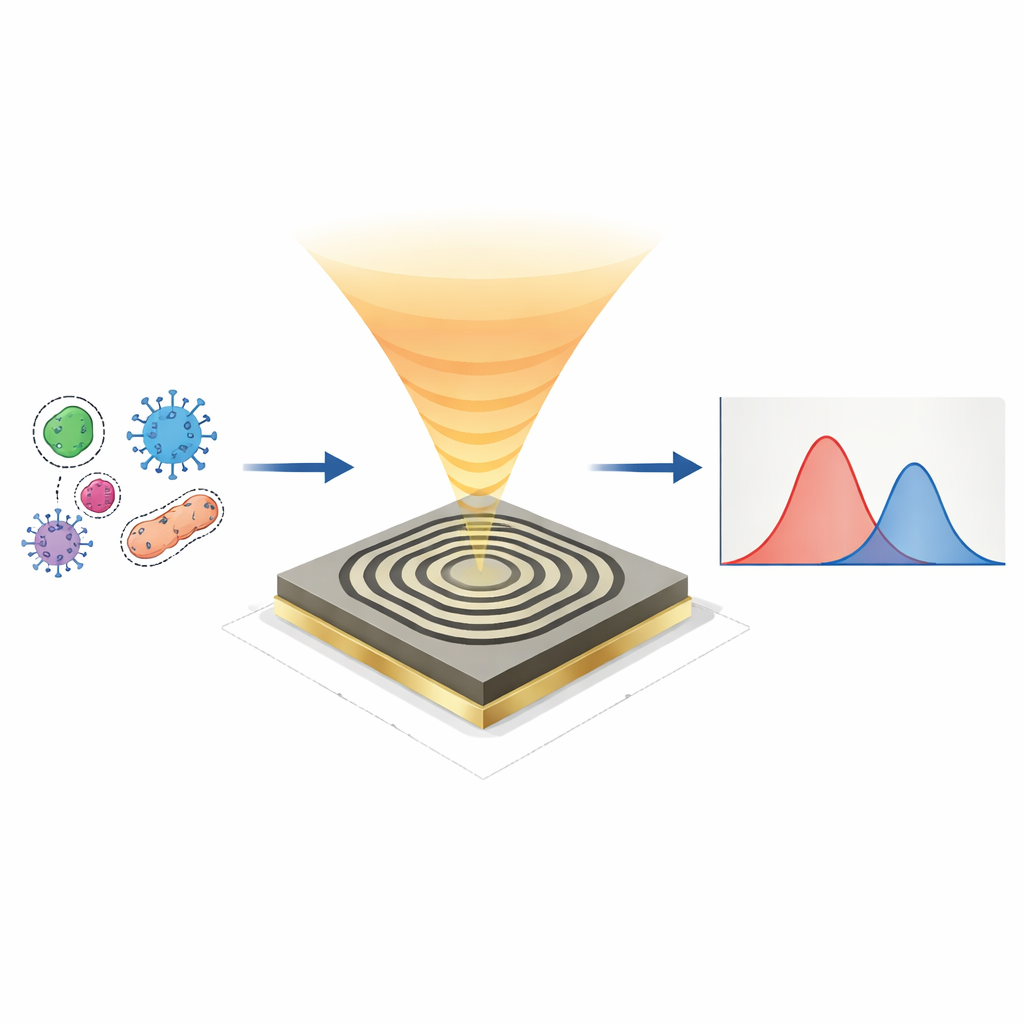
Terahertz waves sit between microwaves and infrared light and can slip through clothing, plastics, and thin layers of tissue. Scientists are eager to use them to spot early signs of disease, such as cancer cells or viruses, without cutting into the body. This article describes a tiny, carefully patterned chip that soaks up terahertz waves at two precise colors and uses both advanced materials and machine learning to turn those absorptions into a powerful, highly sensitive biosensor.
A tiny tile built to catch invisible waves
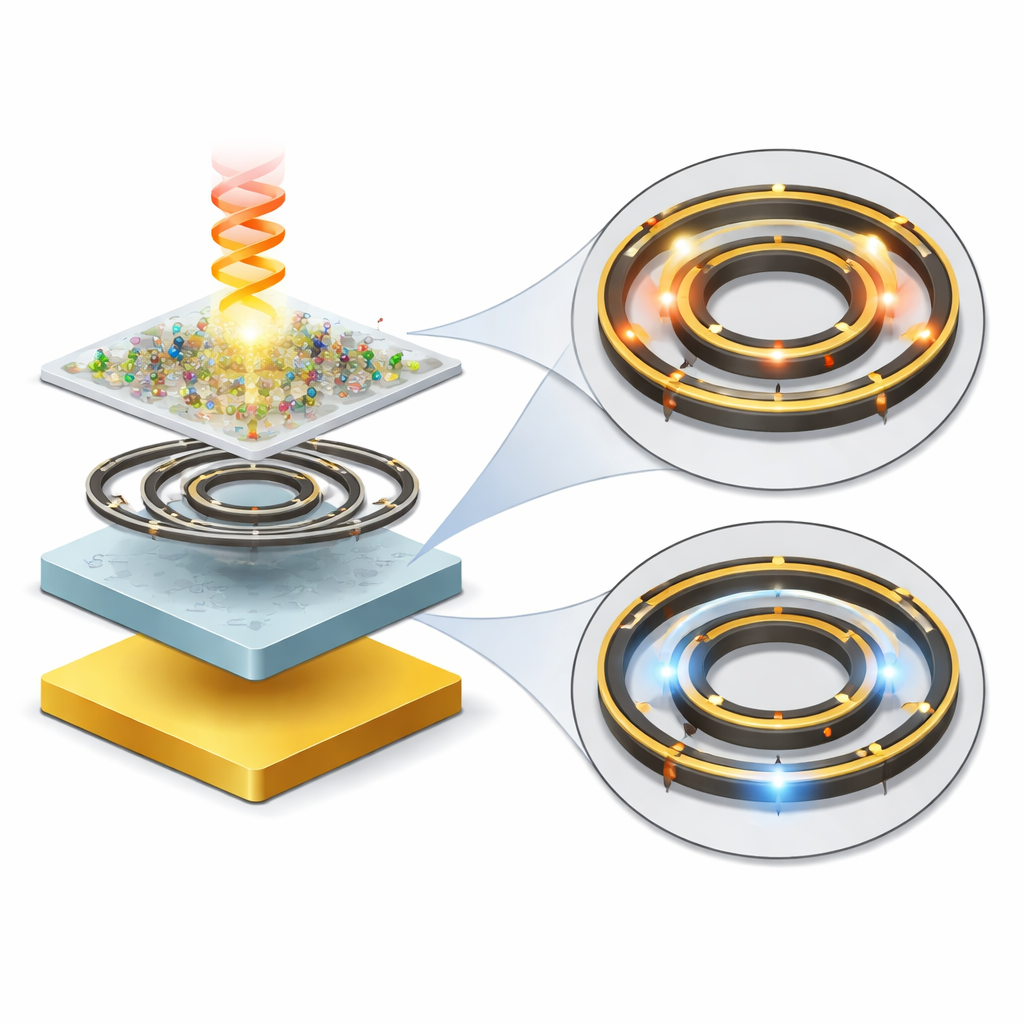
At the heart of the study is a flat square tile, only tens of micrometers across, repeated in an array to form the sensor. Each tile contains four nested octagonal rings: two made of gold and two made of graphene, all resting on a thin glass-like layer above a solid gold backing. When terahertz waves hit this structure, the gold rings act like tiny antennas that naturally vibrate at two specific frequencies, or “bands.” The gold backing reflects any waves that are not absorbed, so energy is either trapped in the structure or bounced away. By carefully choosing the ring sizes and spacing, the researchers force the device to soak up nearly all the incoming wave energy at two terahertz colors while ignoring others.
Graphene gives the sensor a smart, tunable core
Graphene, a one-atom-thick sheet of carbon, plays a crucial supporting role. Though nearly weightless, it conducts electricity extremely well and responds strongly to electric signals. In the new design, the graphene rings sit next to the gold rings and act like finely adjustable resistors and inductors. By changing a small control voltage, the team can shift the electrical behavior of graphene and gently tune how strongly the device absorbs terahertz waves and at exactly which frequencies. This tuning sharpens the absorption peaks and pushes them close to “unity,” meaning almost every photon at those frequencies is captured. Because the surrounding material—such as a drop of blood or a thin film of cells—directly touches the graphene, even tiny changes in that material leave a fingerprint in the absorption spectrum.
Reading tiny changes to identify cells and viruses
To turn the tile into a biosensor, the researchers coat it with a very thin layer of sample, such as viral particles or cancer cells suspended in fluid. The terahertz waves interact with this layer before they reach the rings. Different biological mixtures slightly change how easily the waves travel, which alters the effective optical environment above the rings. That, in turn, nudges the two absorption peaks to slightly different frequencies. The team shows that their device can track such shifts with remarkable precision: the main band responds strongly to small refractive index changes, while the second band provides very sharp, narrow peaks. Together, these features yield high sensitivity, excellent figures of merit, and clean, repeatable signals suitable for distinguishing between multiple disease-related samples.
Letting algorithms guide the sensor’s performance
Designing this kind of structure usually requires thousands of heavy numerical simulations, each testing a slightly different geometry or biological sample. To speed this up, the authors train several machine learning models to predict how the absorber will behave. For the device geometry, non‑linear ensemble models such as gradient boosting and random forests learn the complex links between ring sizes and absorption strength, allowing rapid exploration of new designs. For biosensing tasks, a simpler linear model performs best, because the relationship between the sample’s optical properties and the measured response is almost straight‑line. These trained models then help classify and quantify changes caused by different viruses and cancer cells, reducing the need for repeated full‑wave simulations.
Toward smarter, more practical terahertz testing
Overall, the study shows that combining a dual‑band metamaterial absorber with graphene and machine learning can deliver a compact, easy‑to‑fabricate terahertz biosensor that is both highly sensitive and flexible. To a non‑specialist, this means a chip smaller than a grain of dust can strongly “listen” to two colors of invisible light and translate subtle shifts into clear signals about what kind of cells or particles are present. Such devices could one day enable fast, non‑invasive screening for diseases, helping doctors detect problems earlier and with greater confidence.
Citation: Gupta, S., Gosi, V.C., Pareek, P. et al. Dual-band graphene-assisted metamaterial absorber with machine learning integration for high-sensitivity THz biosensing. Sci Rep 16, 12997 (2026). https://doi.org/10.1038/s41598-026-41667-0
Keywords: terahertz biosensing, graphene sensor, metamaterial absorber, dual-band detection, machine learning diagnostics