Clear Sky Science · en
A neutrosophic clustering approach to handle recommendation uncertainty for gray sheep users
Why some people get weird recommendations
Streaming sites and shopping platforms often feel like they “know” us, but for many people the suggestions still miss the mark. This paper looks at a tricky group of users whose tastes don’t fit the crowd and shows how embracing uncertainty—rather than ignoring it—can dramatically improve what these people are recommended.
The users who confuse recommendation engines
Most recommender systems learn from patterns in crowds: “people like you also liked these movies, books, or songs.” That works well when your tastes are similar to a large group of others. But some people, called “gray sheep” users, like a mix of mainstream and unusual items that doesn’t clearly match any single group. Their ratings are scattered, the system can’t find reliable neighbors, and the resulting suggestions are often inaccurate or inconsistent. The problem is made worse by sparse data: in a typical movie dataset, more than 90% of all possible user–movie pairs have no rating at all, so gray sheep users effectively disappear in the noise.
Turning uncertainty into a useful signal
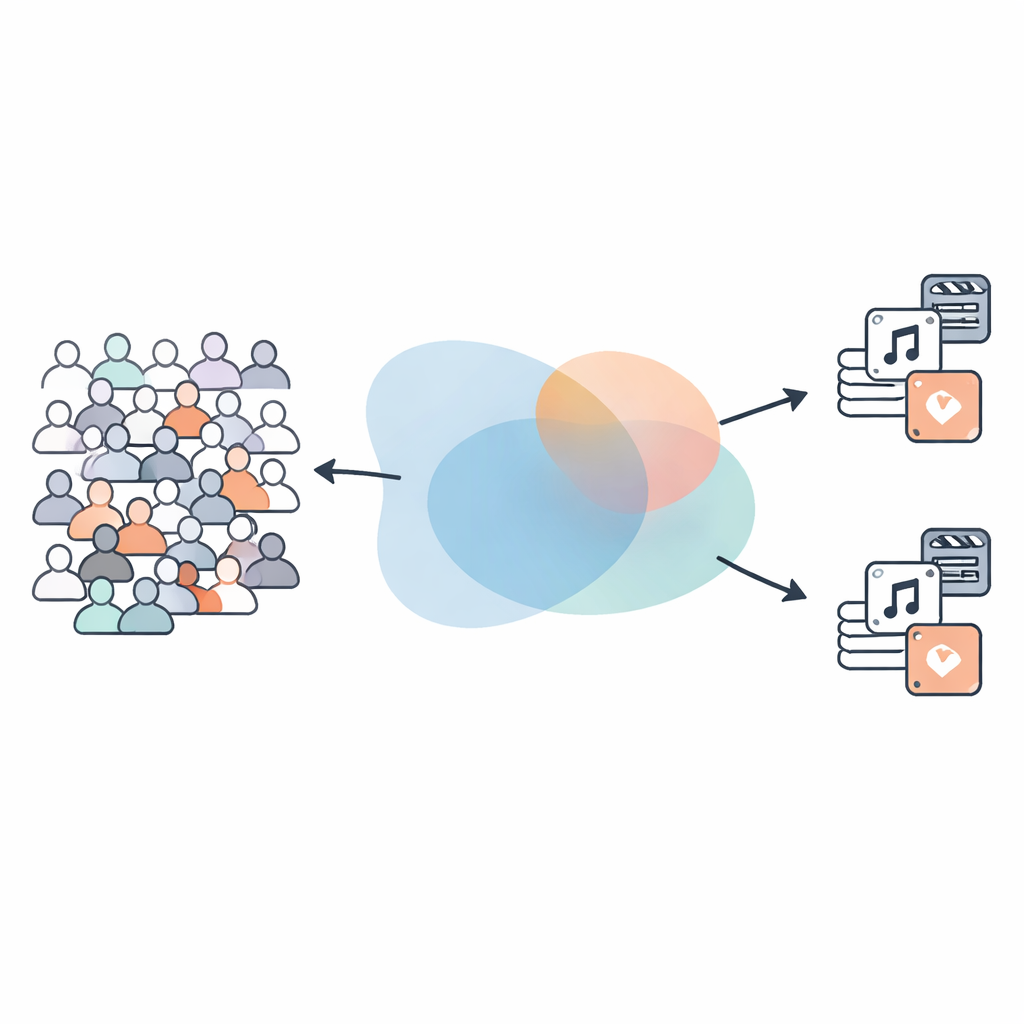
The authors propose handling this confusion head‑on by explicitly modeling uncertainty in user behavior. They use a logic framework called “neutrosophic” reasoning, which represents each user’s fit to a cluster in three parts: how well they match (truth), how unclear the match is (indeterminacy), and how clearly they do not belong (falsity. Instead of forcing every person into a single clean group, their neutrosophic k‑means clustering lets users have partial and even ambiguous memberships. The cluster with the highest overall ambiguity becomes the “gray sheep” group: people whose tastes are hard to pin down but important not to ignore.
A two-lane path for recommendations
Once users are split into mainstream and gray sheep clusters, the system treats them differently. For typical users, a standard item‑based collaborative filtering method is used: items are compared to one another based on how people have rated them, and a user gets recommendations that resemble what they already like. For gray sheep users, the same item‑based method is applied, but only after they have been carefully isolated by the uncertainty‑aware clustering step. This extra layer makes sure that when the system looks for patterns, it compares each gray sheep user with items and rating patterns that reflect their unique, scattered preferences, instead of averaging them away inside the majority. Experiments keep the recommendation settings constant, so any gains can be traced to better identification of gray sheep users, not to tuning tricks.

How much better does it really get?
The authors test their framework on well‑known datasets for movies (MovieLens 100K and 1M), and then extend it to books (Book‑Crossing) and music (Last.fm). Compared with a popular soft‑clustering method (fuzzy c‑means) and several advanced clustering hybrids, their neutrosophic approach consistently achieves lower prediction errors and higher success in picking items that gray sheep users actually like. For example, on the MovieLens 100K dataset, precision and recall for the gray sheep cluster reach about 89% and 91%, with noticeably smaller rating errors. The method also outperforms several deep learning recommenders when evaluated specifically on gray sheep users, despite using a simpler, more transparent architecture. The key advantage is not brute computational power, but the explicit treatment of uncertainty as a first‑class signal.
What this means for everyday users
In simple terms, this work shows that recognizing “I’m not sure about this user” can be more powerful than pretending the uncertainty doesn’t exist. By carving out a dedicated path for people whose tastes don’t fit standard molds, the proposed system recovers a neglected audience and serves them with recommendations that are more accurate, diverse, and satisfying. While the current study focuses on ratings rather than rich content like text or images, and mainly on gray sheep rather than all users, it offers a practical recipe: build recommendation pipelines that detect ambiguity, treat it explicitly, and use it to guide how suggestions are made. For anyone who has ever thought, “these recommendations aren’t really me,” that shift could make future systems feel far more personal and fair.
Citation: Samir, D., El Reheem, E.A., Darwish, S.M. et al. A neutrosophic clustering approach to handle recommendation uncertainty for gray sheep users. Sci Rep 16, 9663 (2026). https://doi.org/10.1038/s41598-026-41651-8
Keywords: recommender systems, gray sheep users, uncertainty modeling, neutrosophic clustering, collaborative filtering