Clear Sky Science · en
Adaptive intelligent controller for a lower limb rehabilitation robot using QAOA-based online membership optimization
Helping People Walk Again
For people recovering from stroke, spinal cord injury, or other movement disorders, powered leg braces—known as lower-limb rehabilitation robots—can be the difference between sitting and walking. Yet getting these machines to move in sync with a fragile, changing human body is very hard. This study introduces a new way to make such robots smarter and safer by borrowing ideas from emerging quantum computing to fine‑tune how the robot reacts in real time.
Why Controlling Rehab Robots Is So Hard
A rehabilitation robot must guide a patient’s hip, knee, and ankle through natural walking motions while also yielding to their own efforts. The joints influence one another in complex ways, patients differ from day to day, and outside pushes or sensor noise constantly disturb the system. Traditional controllers, such as simple PID schemes, often struggle in this messy environment: they need a lot of manual tuning, and they can become unstable or jerky when the motion changes quickly. Fuzzy logic controllers—which mimic expert rules like “if the error is small, respond gently”—handle uncertainty better, but only if their internal settings, called membership functions, are carefully chosen. In practice those settings are usually hand‑tuned offline, which can leave performance far from ideal.
Blending Fuzzy Rules With Quantum-Inspired Tuning
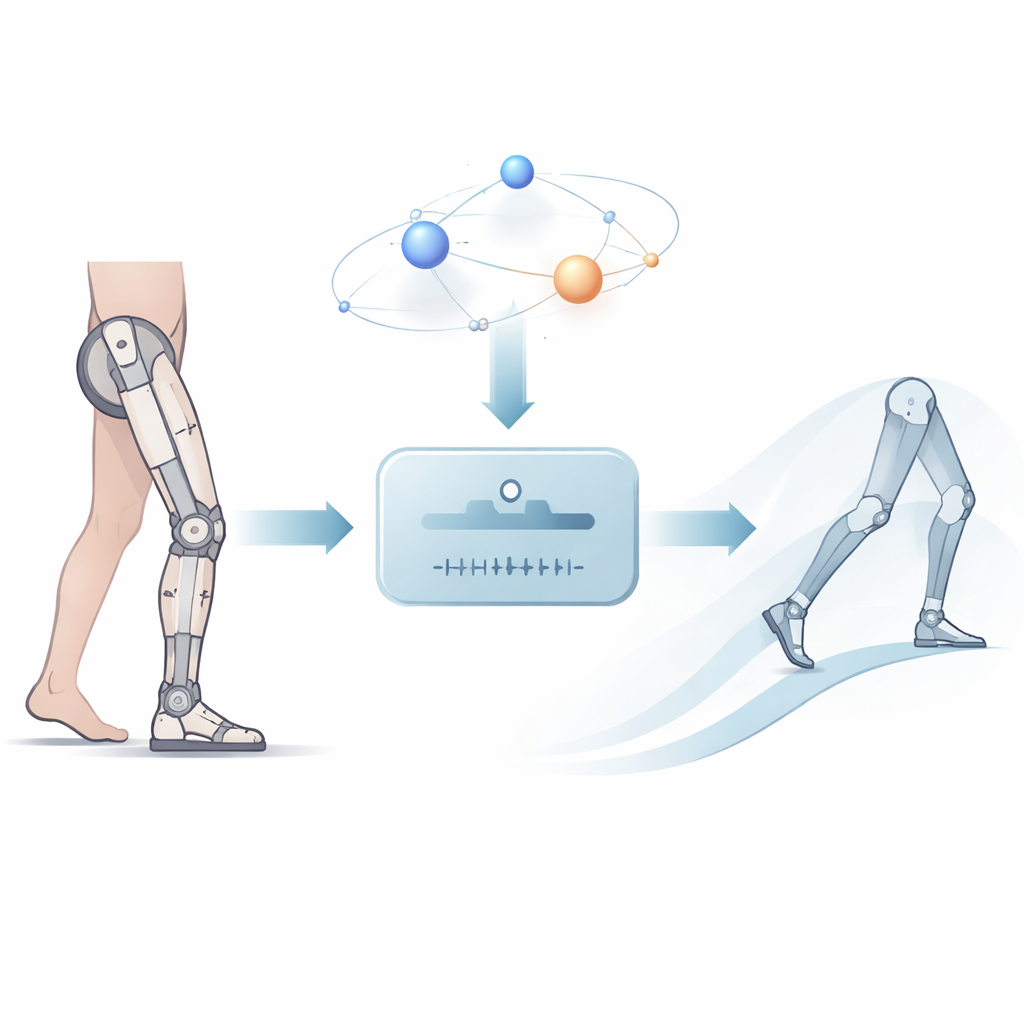
The authors propose a hybrid “quantum‑inspired” controller for a three‑joint leg exoskeleton. At its core is a fuzzy logic controller that takes in how far each joint is from its desired angle and how quickly that error is changing, then outputs the motor torques needed to guide the leg. Around this, they wrap an optimization layer based on the Quantum Approximate Optimization Algorithm (QAOA), a method originally designed for quantum computers but here implemented in a classical, simulated form. QAOA treats the fuzzy membership settings as a large search space and explores many combinations in parallel using an abstract quantum model. Its goal is simple: minimize the integral of squared error, a measure that rewards precise, smooth tracking of the desired gait.
How the New Controller Learns on the Fly
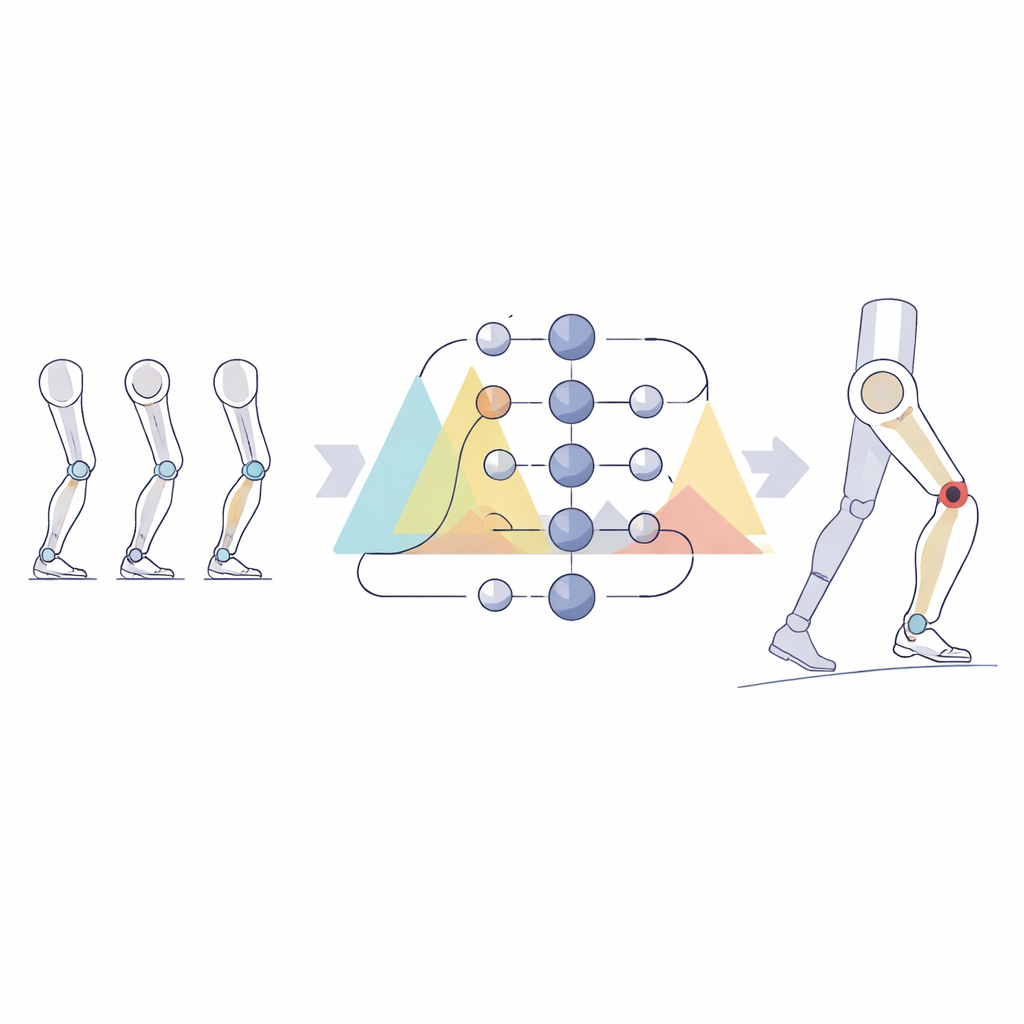
Instead of fixing the fuzzy settings once and for all, the system updates them online while the robot “walks” through simulated therapy sessions. Reference hip, knee, and ankle motions are taken from a detailed musculoskeletal model of human walking, so the test signals resemble real clinical exercises. Every few control cycles, the QAOA layer evaluates how well the robot followed these paths, encodes candidate fuzzy settings in binary form, and searches for combinations that reduce tracking error. When it finds a better set, it shifts the triangular membership functions that define what counts as “low,” “medium,” or “high” error, thereby reshaping how strongly each fuzzy rule fires. Careful stability analysis using energy methods and Lyapunov theory shows that, even with this ongoing adjustment, the overall system remains mathematically stable and its total mechanical energy dies out over time.
Performance Under Stress and in Real Hardware Loops
To see whether these theoretical benefits matter in practice, the team compared their QAOA‑tuned controller with a standard fuzzy controller across many tests. Under ideal conditions, the new method cut tracking error by about 96–99%, reduced overshoot by roughly three‑quarters, and shortened settling time by more than half for all three joints. When sudden extra torques—simulating a patient’s unexpected push or weight shift—were applied at 20% and 40% of normal joint load, the optimized controller brought the leg back on track quickly and with far less oscillation. It also proved remarkably tolerant of sensor noise, keeping errors small even when measurements were heavily corrupted. Finally, using hardware‑in‑the‑loop tests with microcontroller boards connected to a detailed robot model, the authors showed that the approach still worked in real‑time conditions that include delays, quantization, and electronic ripple.
What This Means for Future Rehab Devices
From a lay perspective, the message is straightforward: by letting the controller continuously retune itself using quantum‑inspired search, the robot can guide the leg more smoothly, waste less energy, and better withstand surprises, all while remaining stable. That could translate into safer, more comfortable therapy sessions, with motions that feel closer to natural walking and place less strain on healing muscles and joints. While this work is still at the simulation and hardware‑in‑the‑loop stage, it suggests a path toward next‑generation rehabilitation robots that combine human‑like rule systems with powerful optimization tools, and it sets the stage for testing similar ideas in more complex full‑body exoskeletons and eventually with real patients.
Citation: Abd-Elhaleem, S., El-Garawany, A.H. & El-Brawany, M. Adaptive intelligent controller for a lower limb rehabilitation robot using QAOA-based online membership optimization. Sci Rep 16, 10400 (2026). https://doi.org/10.1038/s41598-026-41647-4
Keywords: rehabilitation robotics, lower-limb exoskeleton, fuzzy control, quantum-inspired optimization, gait therapy