Clear Sky Science · en
Transcriptional remodeling of cardiomyocytes and fibroblasts during post-myocardial infarction recovery
Why Heart Healing After a Heart Attack Matters
When someone has a heart attack, the drama does not end in the emergency room. In the weeks that follow, the heart must rebuild itself while still beating, and how its cells respond can determine whether a person recovers well or slowly drifts toward heart failure. This study peered inside individual heart cells from mice after a heart attack to see how they rewire their inner machinery over time. By tracking these changes cell by cell, the researchers reveal how the heart’s pumping cells and its scar‑forming support cells coordinate both damage and repair—and where new treatments might intervene.
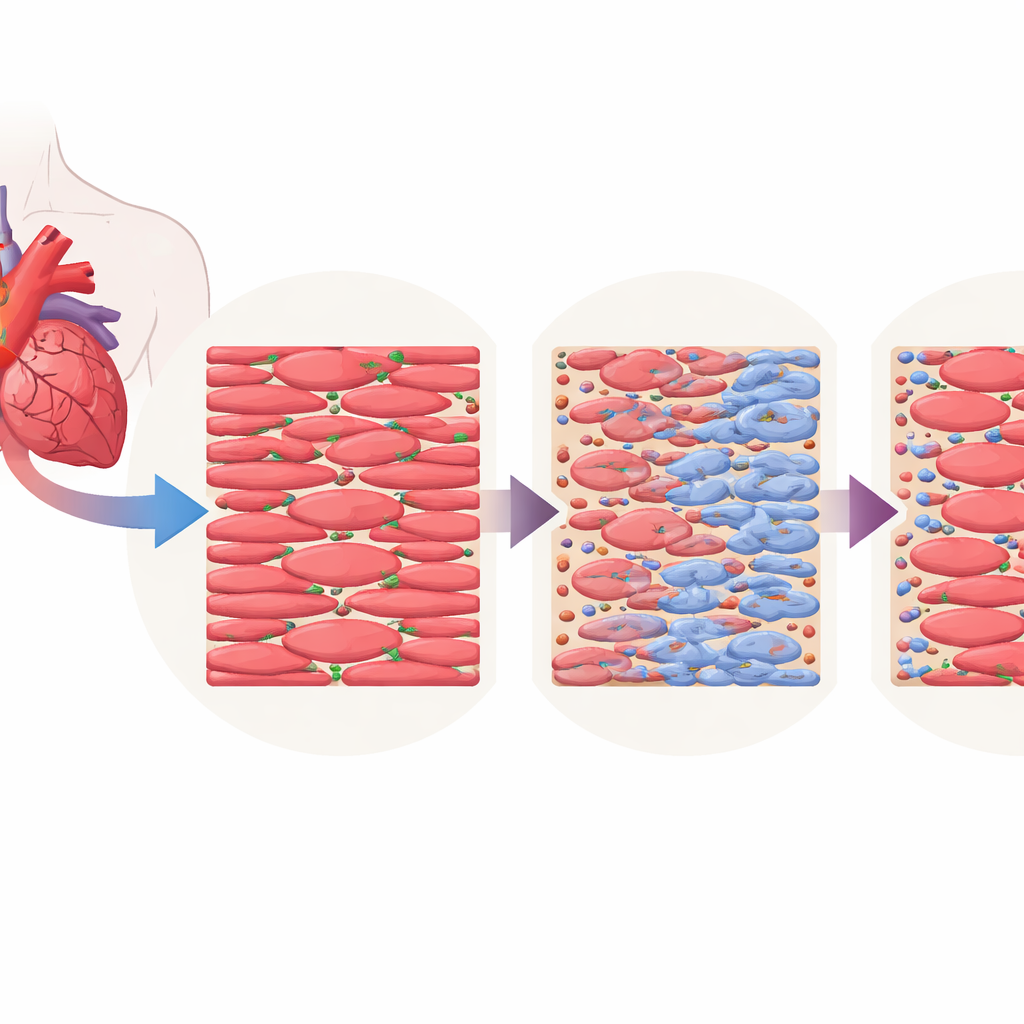
What Happens in the Heart After an Attack
A heart attack cuts off blood flow to part of the heart muscle, killing many of the cells that normally generate each heartbeat. The dead region is gradually replaced by scar tissue, which is strong but cannot contract, so the surviving muscle has to work harder. In this mouse study, the team permanently tied off a major coronary artery and then measured heart function and structure at one and four weeks afterward. As expected, the injured hearts showed thinner walls, larger chamber size, weaker pumping ability and clear scar regions. These functional losses set the stage for a deeper question: what exactly are the remaining cells doing as they struggle to adapt?
Listening to Thousands of Individual Heart Cells
To answer that, the scientists used single‑nucleus RNA sequencing, a technique that reads out which genes are switched on inside thousands of individual cells at once. They focused on the left ventricle, the main pumping chamber, and compared healthy hearts to hearts one week and four weeks after a heart attack. The analysis sorted the cells into nine major types, including beating cardiomyocytes and structural fibroblasts, and then into more fine‑grained subgroups. After injury, the proportion of beating cells dropped, while fibroblasts and immune cells expanded, reflecting the immediate repair and cleanup response. Within both cardiomyocytes and fibroblasts, new gene-expression “states” emerged that were largely absent in healthy hearts, revealing how each cell type shifts identity during recovery.
How Heart Muscle Cells Adapt and Strain
The surviving heart muscle cells underwent a striking makeover. One week after the attack, they showed strong signs of stress and enlargement, consistent with trying to compensate for lost neighbors. Genes linked to hypertrophy—cells growing bigger and thicker—were more active, and this pattern became even stronger by four weeks. At the same time, these cells temporarily turned down genes that support their normal, oxygen‑hungry energy factories in mitochondria. Instead, they appeared to rely more on less efficient, emergency energy pathways suited to low oxygen. By four weeks, many of these mitochondrial and energy genes had partially rebounded, suggesting a natural, though incomplete, recovery of their power supply even as the cells remained pathologically enlarged.
How Scar‑Forming Cells Shape Repair
The fibroblasts, which help form scar tissue, also changed in two distinct phases. Early on, at one week, they ramped up genes that build and organize collagen and other matrix proteins, rapidly stiffening and stabilizing the damaged region to prevent the heart wall from rupturing. Later, by four weeks, their gene activity shifted toward more specialized, muscle‑like and cartilage‑related programs, indicating a move from fast patchwork to longer‑term remodeling and stiffening of the scar. Some fibroblasts even began expressing genes usually associated with heart muscle, hinting that they adopt hybrid identities that could influence how the injured tissue behaves mechanically and electrically.
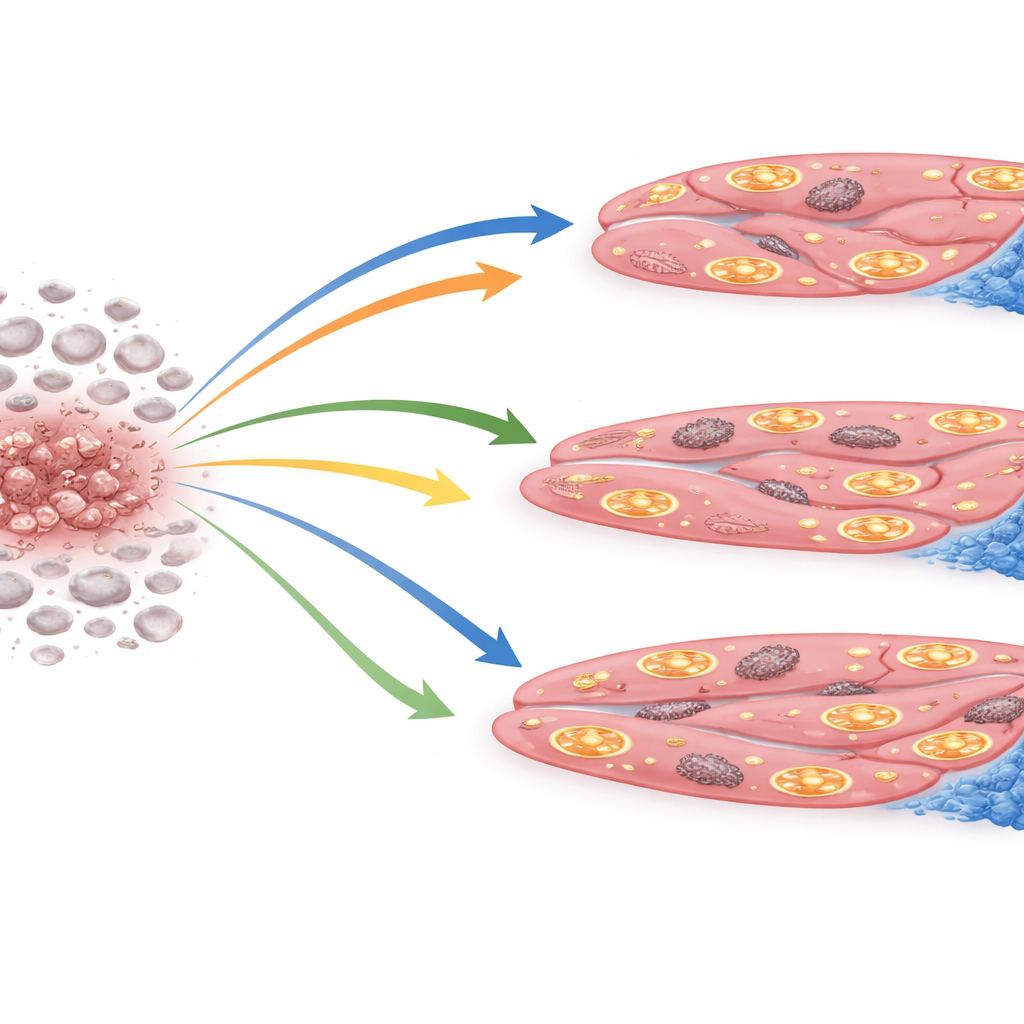
Silent Conversations Between Cell Types
The study also mapped the “conversations” between different cell types by looking for matching pairs of signaling molecules and their receptors. After the heart attack, fibroblasts became much more talkative, sending out chemical signals not only to other cell types but also to themselves. During the first week, several key growth‑factor signals from fibroblasts to cardiomyocytes appeared to be especially active. These signals, including ones known to promote cell survival, energy use and blood vessel growth, may help stressed heart muscle cells endure the initial injury. By the fourth week, fibroblasts also sent signals linked to new blood vessel formation toward the cells lining blood vessels and heart chambers, potentially supporting longer‑term vascular repair, even though the vessel cells themselves showed relatively modest gene changes.
What This Means for Future Heart Treatments
Overall, this work paints a detailed picture of how different heart cells respond in the weeks after a heart attack. Pumping cells sacrifice efficiency to survive low oxygen, grow larger to make up for lost neighbors, and only partially restore their normal energy systems. Fibroblasts quickly lay down a protective scar and later shift into more specialized, stiffening roles, all while sending chemical cues that may help heart muscle cells cope and encourage blood vessels to recover. For a layperson, the takeaway is that the heart is not simply damaged or healed—it is constantly negotiating a trade‑off between stability and flexibility. By pinpointing the genes and signals involved in this negotiation, the study suggests new ways future therapies might ease harmful scarring, boost healthy energy use in heart muscle cells and support better long‑term recovery after a heart attack.
Citation: Dholaniya, P.S., Islam, H., Alvi, S.B. et al. Transcriptional remodeling of cardiomyocytes and fibroblasts during post-myocardial infarction recovery. Sci Rep 16, 12120 (2026). https://doi.org/10.1038/s41598-026-41631-y
Keywords: heart attack recovery, cardiomyocytes, cardiac fibroblasts, single-cell sequencing, cardiac remodeling