Clear Sky Science · en
Permeability of silty clay and its prediction model based on NMR T2 double cutoff value
Why this matters for tunnels and trains
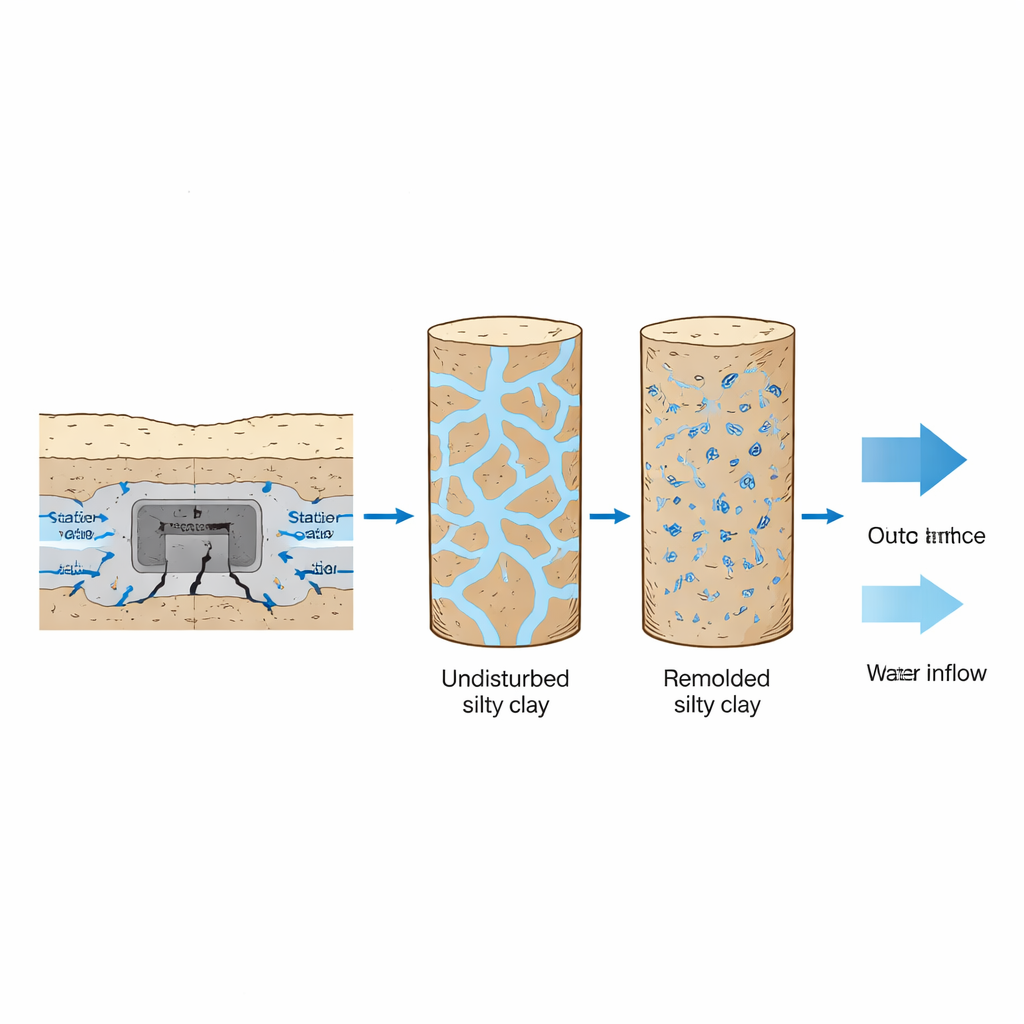
When engineers dig deep pits for subway lines or tunnels, they are not just cutting through solid ground – they are opening the door for groundwater to rush in. In Jinan, China, a new metro line ran into serious water seepage when workers excavated through a layer of silty clay that was supposed to be relatively tight. This study explores why some clays let far more water through than expected, and introduces a new way to predict how easily water can move through them using a medical-style scanning technique called nuclear magnetic resonance (NMR).
Digging into a leaky layer of ground
The researchers focused on a silty clay layer beneath a subway station in Jinan where heavy seepage had disrupted construction. Traditionally, engineers rely on basic soil properties like grain size and the amount of empty space between particles (the void ratio) to estimate how easily water can flow through the ground. But experience and earlier studies have shown that two soils with almost identical void ratios can differ in permeability by as much as a hundredfold. This study compares two versions of the same soil: naturally deposited “undisturbed” silty clay taken from the excavation, and “remolded” silty clay that was broken up and compacted again in the lab to match the same density and water content.
Hidden channels inside the soil
Using a triaxial test system, the team squeezed both types of clay under increasing pressure, measured how much they compressed, and recorded how fast water could pass through them. Despite having the same overall looseness at the start, the undisturbed soil let more than sixty times as much water through as the remolded soil. Photographs revealed large visible pores in the undisturbed samples that were absent in the remolded ones. As the pressure increased, both soils became less permeable, but their behavior diverged: the remolded clay followed a neat, predictable trend, while the undisturbed clay showed a sharp change once its natural structure began to collapse. This highlighted that not just pore volume, but the shape and connectivity of pores, strongly control seepage.
Seeing water-filled pores with NMR
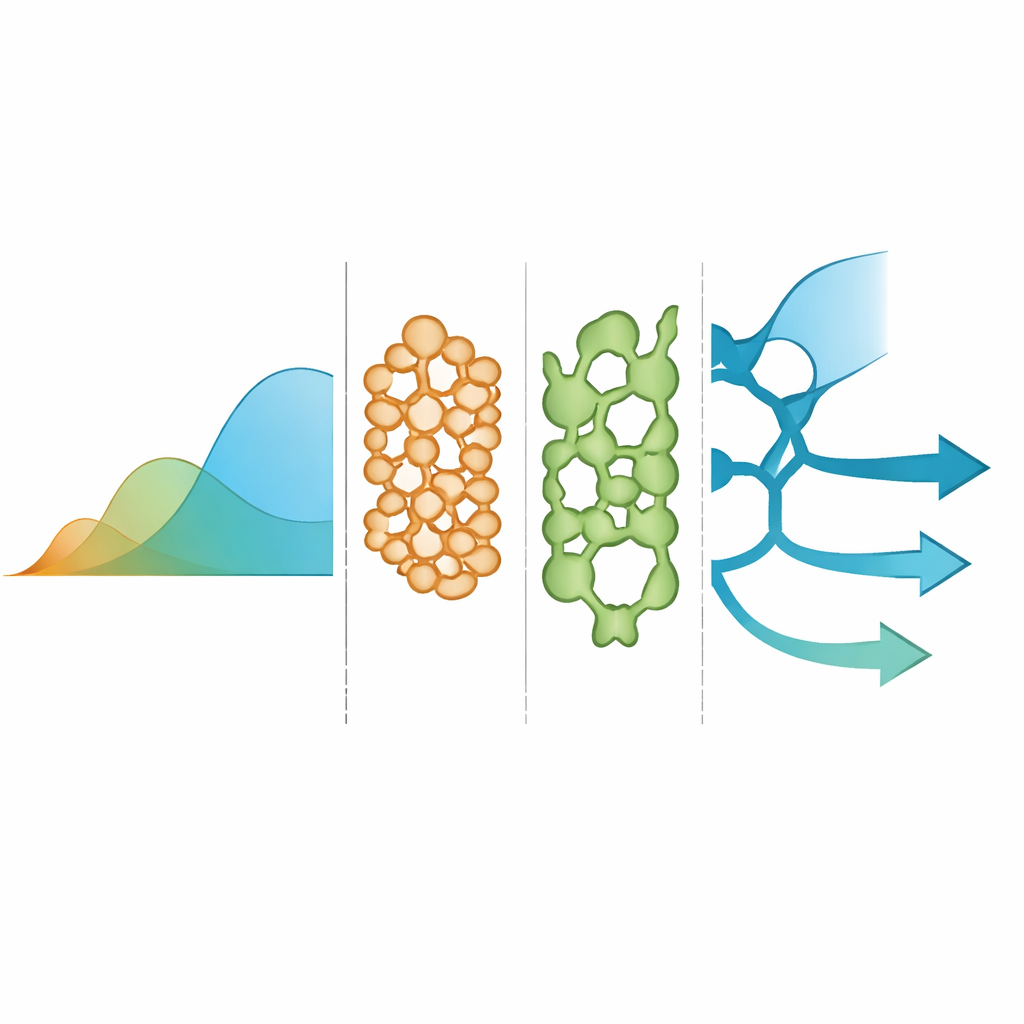
To peer inside the pore network without destroying the samples, the researchers turned to low-field NMR, a technique that tracks how hydrogen atoms in water respond in a magnetic field. The resulting T2 spectrum acts like a fingerprint of the pore system: shorter times indicate tiny, tightly bound pores, while longer times signal larger, freer-flowing spaces. Both undisturbed and remolded clays showed multiple peaks in their spectra, corresponding to different groups of pore sizes. The undisturbed soil had an extra long-time peak, revealing macropores that serve as preferential flow channels. By watching how these peaks shifted and shrank under higher pressure, the team could see large pores being squeezed shut, which lined up with the observed drop in permeability.
Sorting pores into three classes
Existing NMR-based models for predicting soil permeability typically treat all connected pores together and often use a single cutoff time to split water into “mobile” and “immobile” categories. This oversimplifies reality, where water in very small pores hardly moves, water in intermediate pores moves somewhat, and water in large pores dominates the flow. To capture this, the authors adopted a “double cutoff” approach: the T2 spectrum is divided into three zones that correspond to micropores, mesopores, and macropores. Each zone is linked to a different style of water behavior, from tightly bound to fully mobile. They combined this three-part view with capillary flow theory and a measure of how tortuous, or winding, the flow paths are inside the soil.
A sharper tool for predicting seepage
Building on these ideas, the authors proposed a new prediction model that calculates hydraulic conductivity from the NMR T2 spectrum while treating medium and large pores separately and accounting for the crooked pathways water must follow. When they tested this model against laboratory measurements, it outperformed several widely used NMR-based formulas, especially for soils dominated by small and medium pores. For engineers, the takeaway is clear: two clays that look similar in a standard lab test may behave very differently underground, and NMR offers a powerful way to see the internal channels that control seepage. By better predicting how water will move through silty clay around tunnels and deep excavations, this method can help design safer, more cost-effective underground projects.
Citation: Zhao, X., Chen, C. & Wang, X. Permeability of silty clay and its prediction model based on NMR T2 double cutoff value. Sci Rep 16, 11810 (2026). https://doi.org/10.1038/s41598-026-41616-x
Keywords: silty clay, soil permeability, groundwater seepage, nuclear magnetic resonance, underground construction