Clear Sky Science · en
Exploring the overdoping effects in Transient Liquid Assisted Grown YBa $$_2$$ Cu $$_3$$ O $$_{7-\delta }$$ superconducting films
Why better power cables need cold science
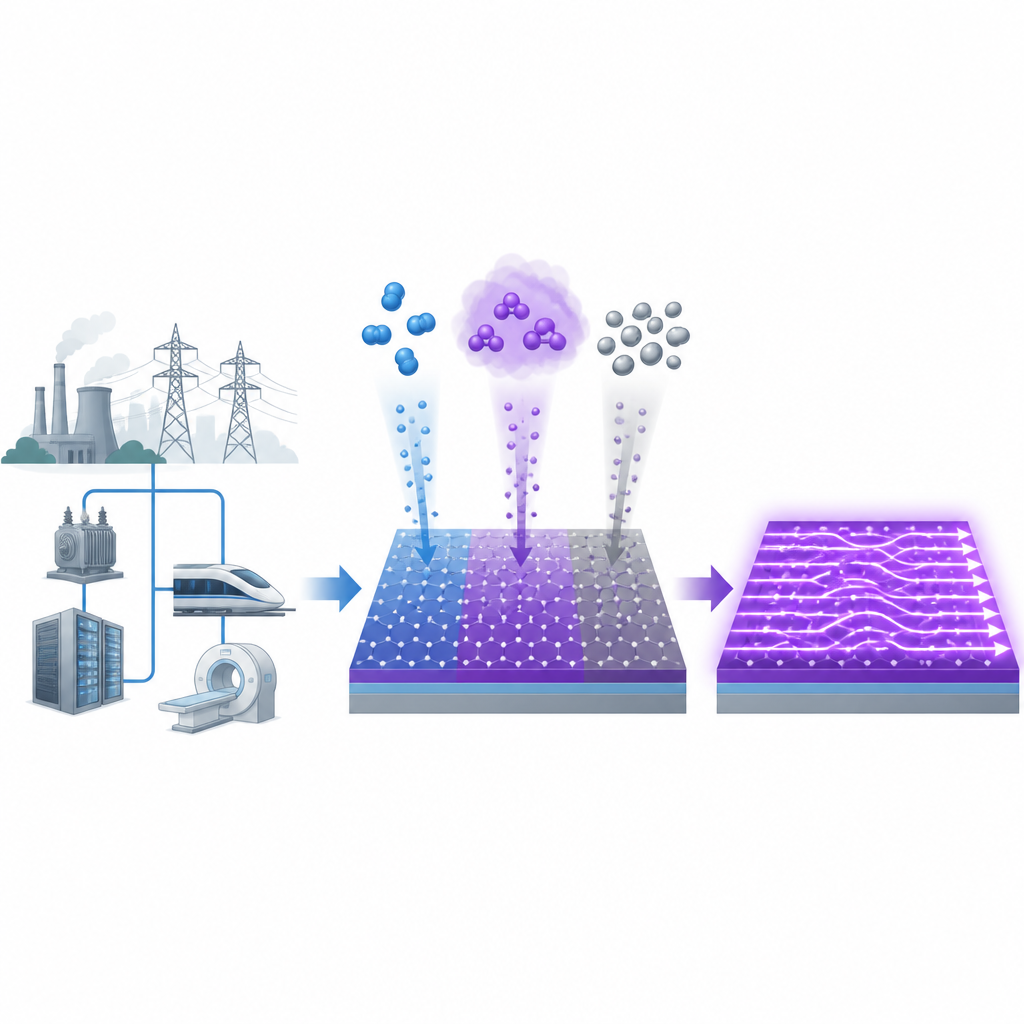
Modern society runs on electricity, and moving huge amounts of power efficiently is a growing challenge. High-temperature superconductors can carry current with almost no loss, but only if their atomic structure is tuned just right. This study explores how to fine-tune a key superconductor, YBCO, using a fast growth method and different oxygen treatments so that it can carry even more current for future power grids, magnets, and other large-scale technologies.
How a superconductor gets its strength
In copper-oxide superconductors like YBCO, the ability to carry current depends on how many electric charges, or “holes,” move in special layers inside the material. These charges are controlled mainly by how much oxygen is built into the crystal. At an intermediate “optimal” level, the material reaches its highest transition temperature, where it becomes superconducting. But theory and earlier work suggest that adding a bit more oxygen beyond this point, called overdoping, can increase the energy that holds the superconducting state together and push the current-carrying capacity closer to its fundamental limit.
A fast way to grow films and three paths to add oxygen
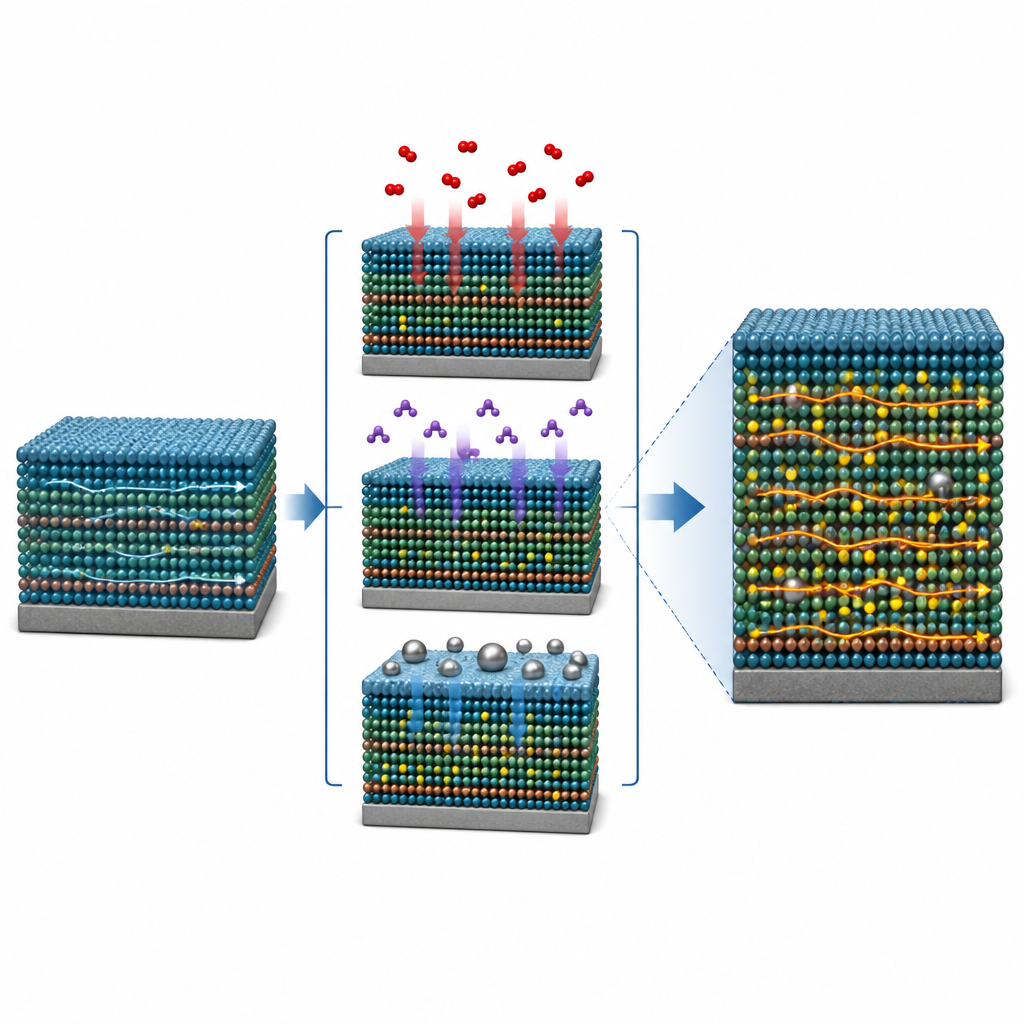
The team studied thin YBCO films grown by Transient Liquid Assisted Growth, a solution-based process in which a fleeting liquid phase helps the crystal form extremely quickly. This method already produces high-quality coated conductors at very high growth rates, which is attractive for reducing manufacturing costs. After growth, the films still need extra oxygen to reach the desired electronic state. The researchers compared three oxygenation approaches: conventional heating in oxygen gas, heating in a mixed oxygen–ozone flow, and adding tiny silver islands on the film surface before oxygen treatment, which are known to help split oxygen molecules and speed up their entry into the crystal.
Finding the sweet spot for ozone and silver
Because oxygen entry is controlled by surface reactions and diffusion, the researchers systematically varied temperature, treatment time, and ozone concentration. For ozone, they found an optimal, narrow range of low concentration and moderate temperature where the films gained a high density of charge carriers and strong superconducting currents without structural damage. Too little ozone left the films underdoped, while too much or too hot treatment created defects, including chlorine-rich planar faults introduced from the gas line, which degraded performance. Silver decoration, in contrast, helped oxygen get in more quickly at higher temperatures without the same level of damage, and both oxygen-only and silver-assisted methods produced broad temperature windows with good current flow.
Proving the films are truly overdoped
To check the doping state, the authors combined several measurements: the superconducting transition temperature, the spacing between atomic layers along one crystal axis, the density of mobile charge carriers, and how electrical resistance changed with temperature above the transition. Together, these indicators showed that TLAG-grown films could be pushed from underdoped through optimal and into the overdoped regime, approaching a critical doping level where the electronic structure of the material changes. In this overdoped range, the current carried within individual grains rose as expected, although structural imperfections in the TLAG films limited how close they could get to the record currents seen in more mature pulsed-laser-grown films.
Boosting performance with built-in nano obstacles
The study also tested overdoping in nanocomposite films where tiny particles and defects act as obstacles that pin magnetic vortices, which otherwise cause energy loss. When these nanoengineered TLAG films were overdoped using oxygen and silver, they achieved higher grain currents than plain TLAG films at similar charge densities. This suggests that combining fast growth, controlled overdoping, and engineered nanoscale pinning centers may be a powerful route to stronger superconducting wires.
What this means for future technology
In simple terms, the work shows that TLAG-grown YBCO can be “tuned past optimal” with carefully chosen oxygen treatments, especially with help from ozone or silver, to carry more current. Although these fast-grown films do not yet match the very best conventional films, the ability to reach the overdoped state while keeping high growth speeds and adding nano pinning sites points toward scalable, more efficient superconducting tapes for energy and magnet applications.
Citation: Kethamkuzhi, A., Saltarelli, L., Gupta, K. et al. Exploring the overdoping effects in Transient Liquid Assisted Grown YBa\(_2\)Cu\(_3\)O\(_{7-\delta }\) superconducting films. Sci Rep 16, 15607 (2026). https://doi.org/10.1038/s41598-026-41613-0
Keywords: YBCO superconductors, overdoping, oxygenation, coated conductors, nanocomposites