Clear Sky Science · en
Development of a scalable production bioprocess for HIV-1 virus-like particles coupling continuous VLP harvesting with end-to-end downstream processing
Turning Safe Viral Shells into Scalable Vaccines
Many modern vaccines are moving away from using whole live or killed viruses and instead rely on tiny, non-infectious shells called virus-like particles. This paper describes how researchers built a more efficient, factory-style process to make such particles based on HIV-1, not as a cause of disease, but as a flexible platform to carry vaccine ingredients against many illnesses. Their work shows how to produce these particles continuously, clean them up, and dry them into a stable form that could make future vaccines cheaper and easier to distribute worldwide.
Why Empty Viral Shells Matter
Virus-like particles, or VLPs, look like real viruses on the outside but contain no genetic material inside, so they cannot replicate or cause infection. The HIV-1 Gag protein naturally assembles into such shells, which can be decorated with many different disease-related molecules on their surface. That makes them attractive as a modular vaccine platform: the same basic particle can, in principle, be adapted to target influenza, coronavirus, rabies, cancer markers, and more. However, producing these particles at industrial scale has been difficult. Traditional methods use short-term gene delivery to cells in simple batch cultures, which limits productivity, drives up costs, and complicates consistent manufacturing.
From Batch Runs to a Continuous Production Line
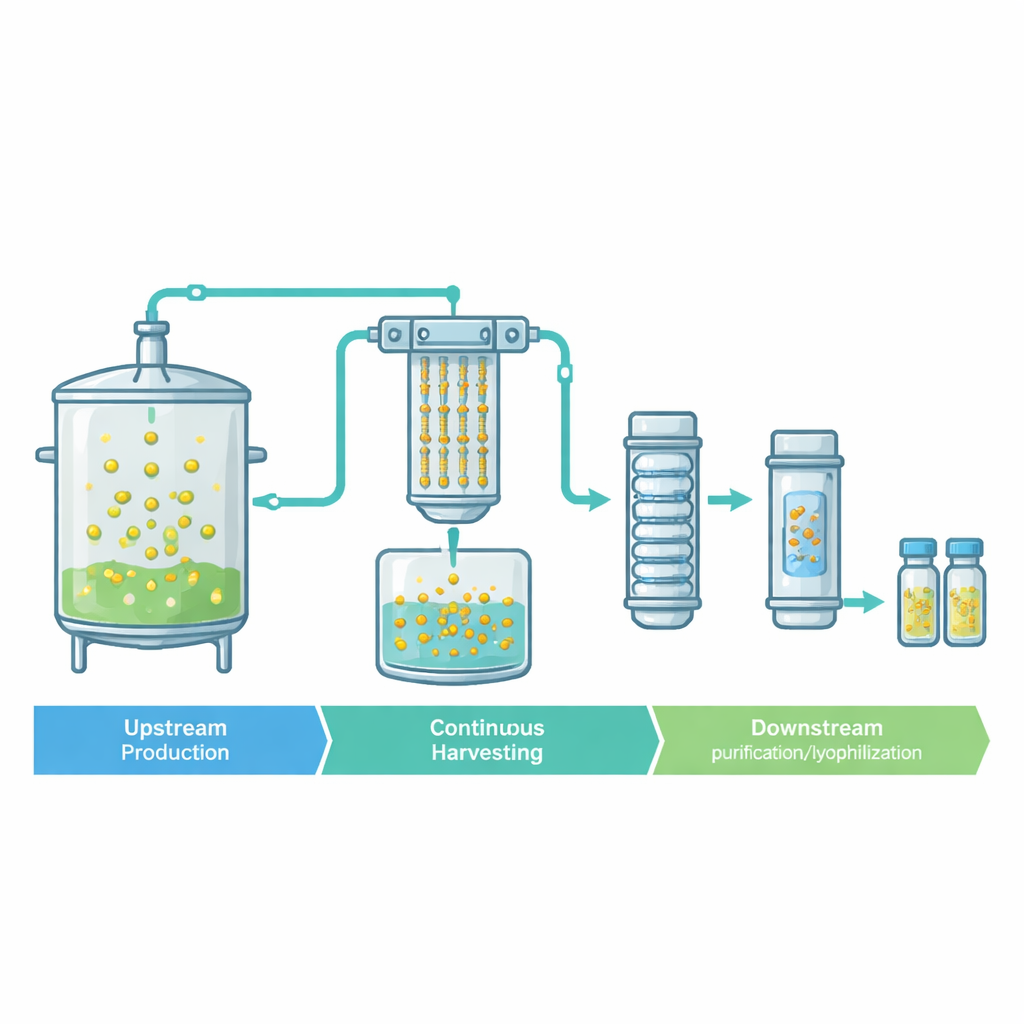
The researchers tackled these limits by redesigning the upstream, or production, step. They grew human HEK293 cells in a controlled bioreactor and used transient transfection to make them assemble HIV-1 Gag-based particles tagged with a fluorescent marker. Instead of growing the cells in a once-and-done batch, they ran the system in perfusion mode: fresh nutrient medium flowed in while used medium and products flowed out. A specially designed filtration unit held the cells inside the reactor but allowed the virus-like particles to pass through into a harvest stream. This setup enabled continuous collection of particles while maintaining healthy cell densities and avoiding excessive buildup of product around the cells.
Filtering, Separating, and Concentrating the Product
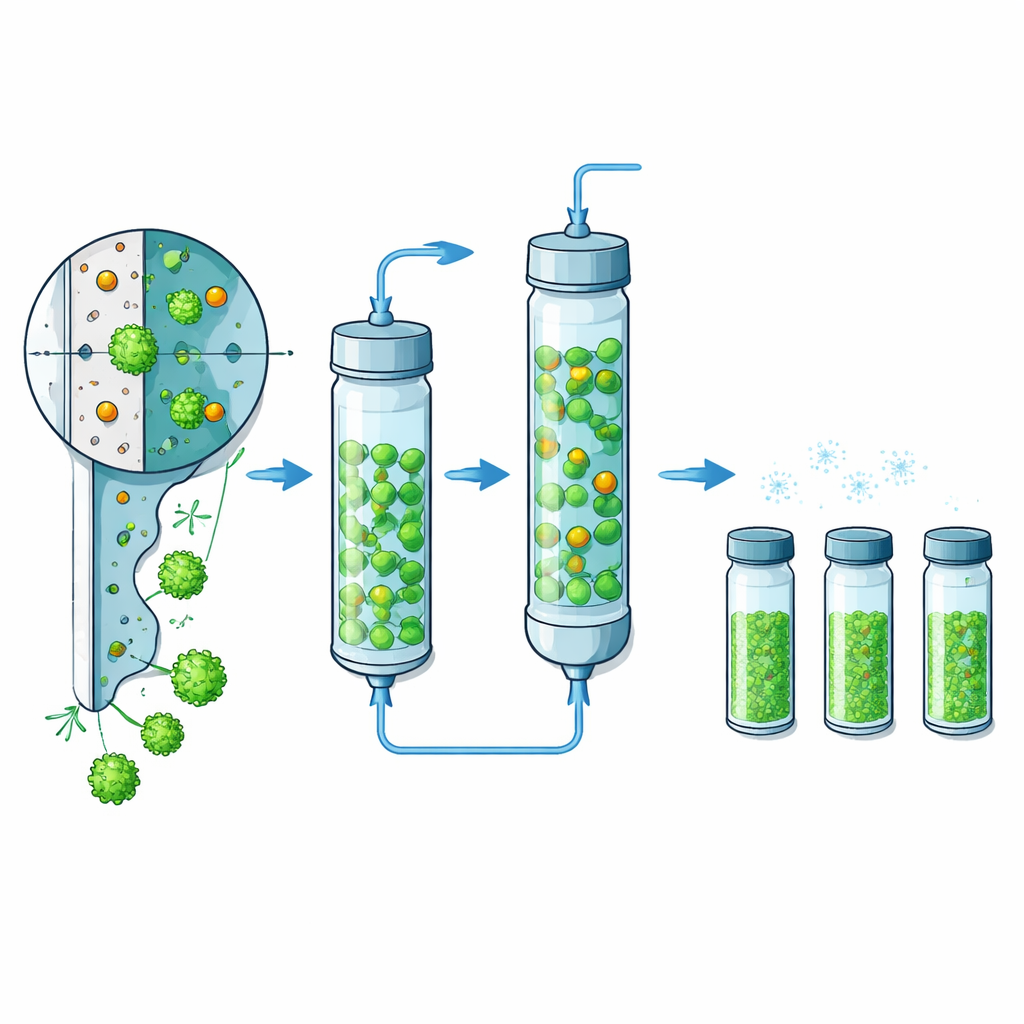
Once the particles left the bioreactor, the team developed a three-step downstream process to clarify and purify them. First, the initial harvest acted as a primary clarification because the cell-retention filter already removed almost all cells. A second depth filtration step further reduced cloudiness and removed residual debris with minimal damage to the delicate particles. Next, the clarified liquid was passed through a positively charged chromatography column that selectively captured the negatively charged HIV-1 Gag particles while letting many impurities pass through. By carefully adjusting salt conditions, the bound particles were then released in a much smaller volume, achieving about a 14-fold concentration, roughly 60% purity relative to all nanoparticles present, and about 60% recovery from the input material. Detailed measurements showed that this column could handle large amounts of particles per cycle, supporting future scale-up.
Making the Vaccine More Stable for the Real World
Even after purification, vaccine particles must survive storage and transport. Relying on constant refrigeration is costly and often unrealistic in many parts of the world. To address this, the team formulated the HIV-1 Gag particles in a protective mixture of sugars and amino acids and then freeze-dried them, a process known as lyophilization. After drying and rehydration, the particles retained their size, shape, and overall quality, as confirmed by several analytical techniques and electron microscopy. The number of particles remained in the same order of magnitude, and contaminants such as leftover cell proteins and DNA were greatly reduced throughout the process.
What This Means for Future Vaccines
Overall, the integrated process more than doubled particle productivity compared with previous perfusion approaches and cut the amount of culture medium needed per particle by over half. With realistic scale-up, the authors estimate that this strategy could produce hundreds of kilograms of HIV-1-based vaccine material per year and reduce the projected cost per dose by over sevenfold relative to earlier methods. While some impurities that resemble the particles are still difficult to separate completely, the work demonstrates that continuous harvesting, smart purification, and robust drying can be combined into a powerful, scalable manufacturing line. For the general public, this means that future vaccines based on safe viral shells could become cheaper to make, easier to ship, and faster to adapt to new diseases.
Citation: Lorenzo, E., Lavado-García, J., Pérez-Rubio, P. et al. Development of a scalable production bioprocess for HIV-1 virus-like particles coupling continuous VLP harvesting with end-to-end downstream processing. Sci Rep 16, 12009 (2026). https://doi.org/10.1038/s41598-026-41596-y
Keywords: virus-like particles, HIV-1 Gag vaccines, continuous bioprocessing, vaccine manufacturing, bioreactor perfusion