Clear Sky Science · en
Sonophore enables autonomous observation of micronekton communities in the ocean twilight zone
Listening to Life in the Ocean’s Dim Midwaters
Far below the ocean’s sunlit surface lies a vast “twilight zone” packed with small fishes, squids, shrimps, and jellies. These creatures quietly help regulate Earth’s climate by moving carbon into the deep sea and feeding predators like tuna. Yet their true numbers and daily movements remain largely unknown because they live far from shore and are hard to study. This paper presents a new tool called the “Sonophore” that listens for these animals using sound, without needing large research ships, opening the door to year‑round monitoring of one of the planet’s largest – but most uncertain – reservoirs of animal life.
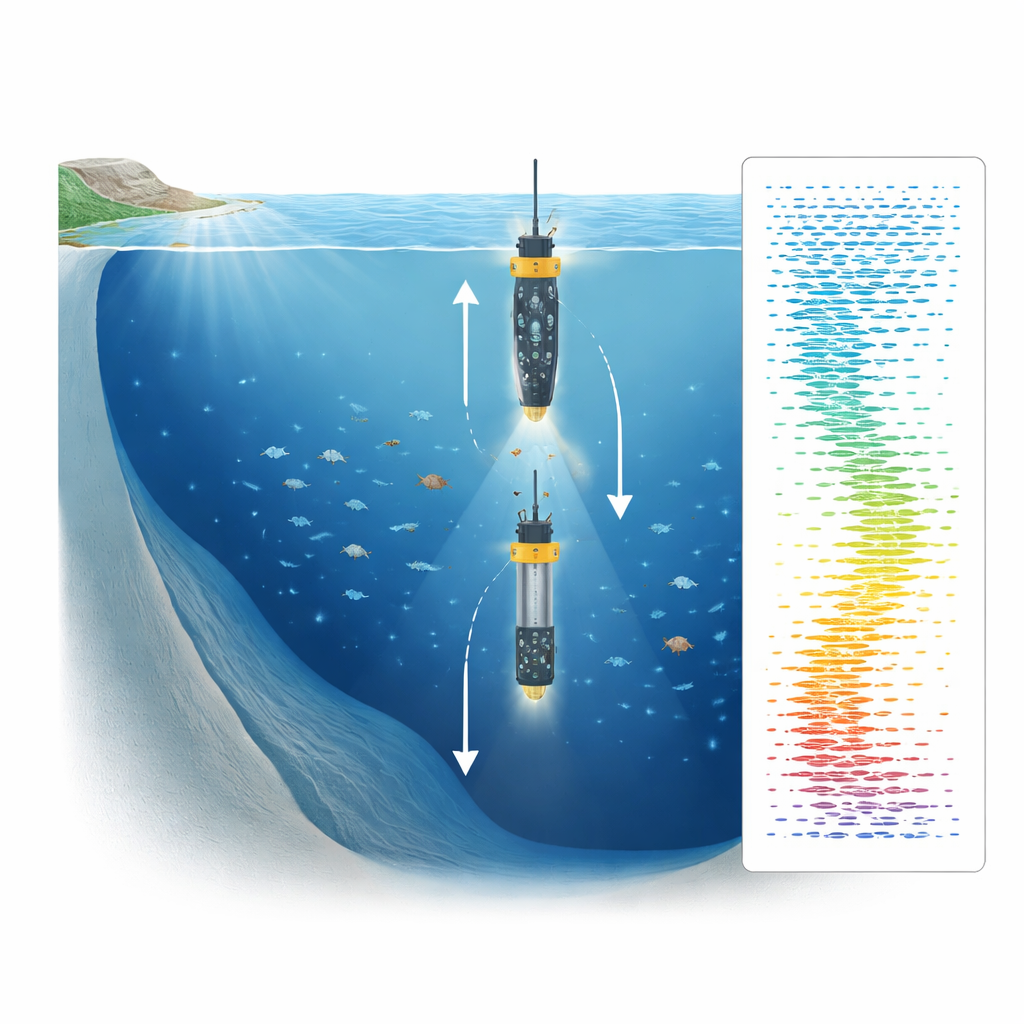
A Hidden World in the Twilight Zone
The ocean’s twilight zone, stretching from about 200 to 1000 meters deep, is home to swarms of small, active animals known as micronekton. Though individually modest in size, together they may represent the largest vertebrate biomass on Earth. By swimming up toward the surface at night to feed and returning to depth by day, they shuttle carbon, nutrients, and energy through the water column, helping power the “biological pump” that stores carbon in the deep ocean. These same animals also support major fisheries by feeding large predators. However, estimates of their total global mass differ by nearly a factor of ten, largely because traditional nets and ship‑based surveys are too sparse, selective, and expensive to capture the full picture.
A Floating Listener Built from Off‑the‑Shelf Parts
The researchers tackled this challenge by combining two widely available technologies: autonomous profiling floats, similar to those used in the global Argo program, and compact echosounders that send out sound pulses and record the echoes from individual animals. They mounted broadband acoustic sensors on commercial MRV Alto floats and let this new platform, the Sonophore, drift freely while repeatedly diving from the surface to about 1000 meters. Over a 102‑hour mission off Tasmania in 2025, two such systems completed 24 unassisted dives. The floats moved only a few kilometers per day with the currents, remained stable in the water with minimal tilt, and collected very clean acoustic data, showing that a simple, modular design can work reliably in real‑world conditions.
Following Daily Migrations in Fine Detail
Each dive generated roughly 20,000 acoustic pings and detections from thousands of individual organisms. From the strength of the echoes, the team could infer the relative size of each animal and its depth, building high‑resolution maps of how many animals occupied each layer of the water column. The data clearly showed day–night differences consistent with daily vertical migrations: during daylight, most animals clustered below about 450 meters, while at night many, especially the larger ones, gathered in the upper 100 meters. Subtler changes between 100 and 450 meters hinted at more complex behavior, such as different groups shifting their preferred depths or becoming more or less detectable as light levels changed.
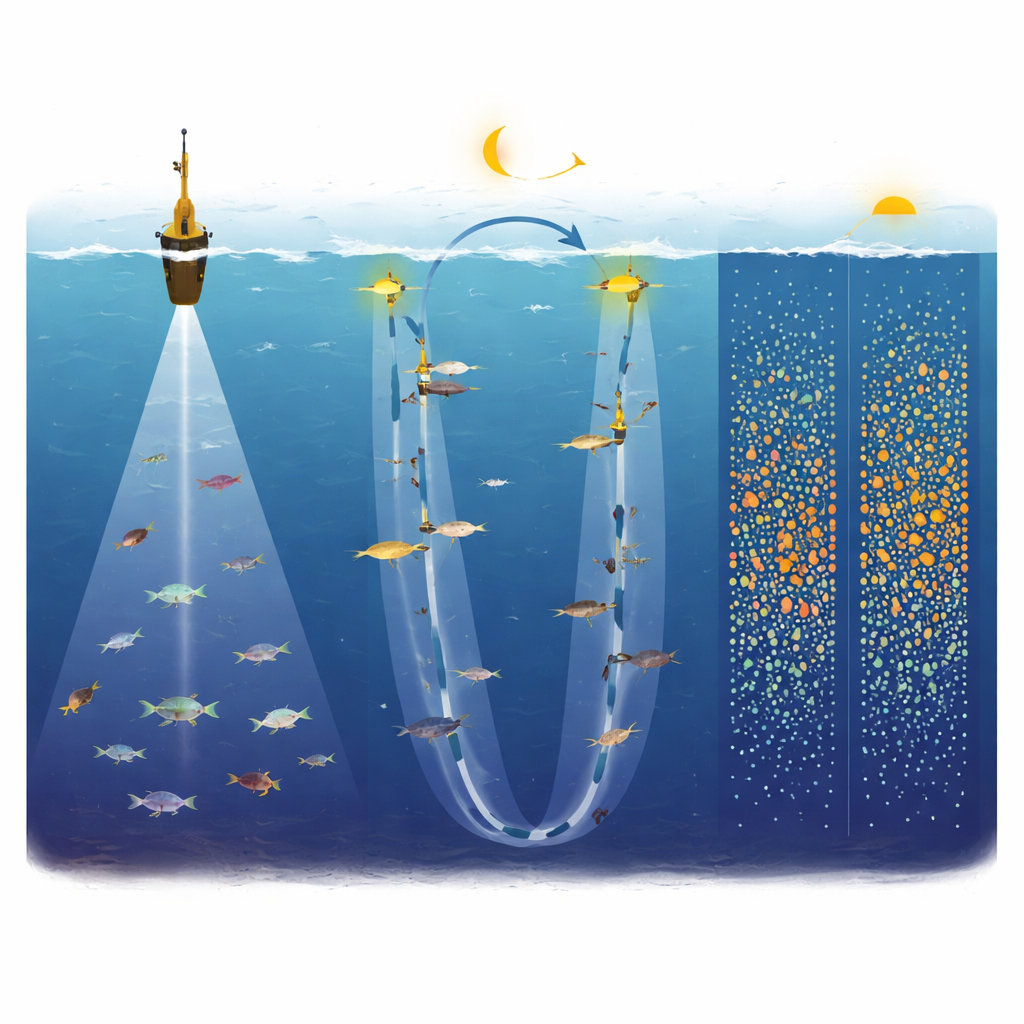
From Single Prototype to Global Observing Network
Beyond this initial demonstration, the authors outline how the Sonophore could evolve into a powerful global observing system. With improved power management, better coordination between float motion and acoustic sampling, additional acoustic frequencies, and on‑board data processing, future versions could match the multi‑year lifetimes of standard Argo floats and transmit compact data summaries via satellite. Because acoustic backscatter from micronekton is now recognized as a key variable for global ocean and climate observing, swarms of such floats could provide the sustained, basin‑scale measurements needed to refine ecosystem and climate models and to distinguish between different types of midwater communities, from rich upwelling zones to nutrient‑poor gyres.
Why This Matters for Climate and Fisheries
In simple terms, the Sonophore shows that it is now possible to send out low‑cost robotic sentinels that “listen” to life in the deep ocean for months to years at a time. By turning scattered ship surveys into continuous, depth‑resolved records of animal abundance and movement, this approach can greatly narrow the uncertainty around how much carbon micronekton carry into the deep sea and how much food they provide to commercially important fish. As oceans warm and change, fleets of such sound‑sensing floats could become an essential part of climate‑resilient ocean management, helping scientists and policymakers keep track of a hidden but vital component of Earth’s life‑support system.
Citation: Downie, R.A., Jansen, P., Macaulay, G.J. et al. Sonophore enables autonomous observation of micronekton communities in the ocean twilight zone. Sci Rep 16, 11558 (2026). https://doi.org/10.1038/s41598-026-41581-5
Keywords: mesopelagic micronekton, ocean twilight zone, autonomous profiling floats, acoustic monitoring, biological carbon pump