Clear Sky Science · en
Age-related alterations in trunk extensor force control during isometric and isokinetic contractions
Why keeping a steady back matters as we age
Many everyday activities—standing up from a chair, climbing stairs, catching your balance after a stumble—depend on the muscles that straighten and stabilize the spine. This study asks a deceptively simple question: as we get older, how well can our back muscles produce a smooth, steady effort rather than a shaky, fluctuating one? By comparing healthy younger and older adults, and by listening closely to the electrical signals in their lower-back muscles, the researchers uncover how aging alters the fine control of trunk strength in ways that could affect balance, mobility, and risk of back problems.
How the study looked inside the working back
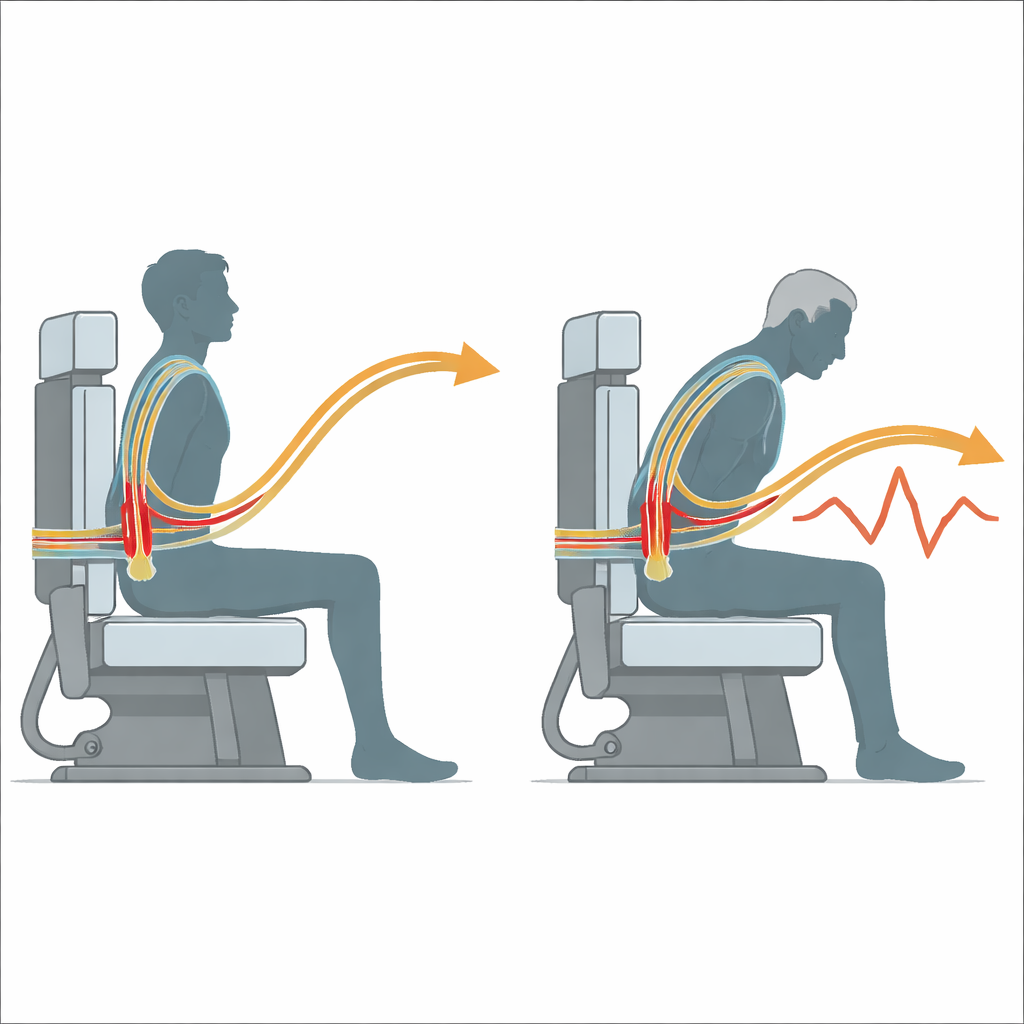
To explore this question, the team recruited 20 young adults (18–35 years) and 20 older adults (65–80 years), all without significant back pain or major medical issues. Participants were seated in a specialized chair that fixed the hips and legs and connected the upper body to a dynamometer—a device that precisely measures how much twisting force, or torque, the back muscles produce during extension. While people pushed their trunk backward to match low and moderate effort targets (25% and 50% of their personal maximum), the researchers recorded both the torque at the chair and the electrical activity of the lumbar erector spinae muscles, the thick columns of muscle that run along the lower spine.
Listening to muscle signals and force at the same time
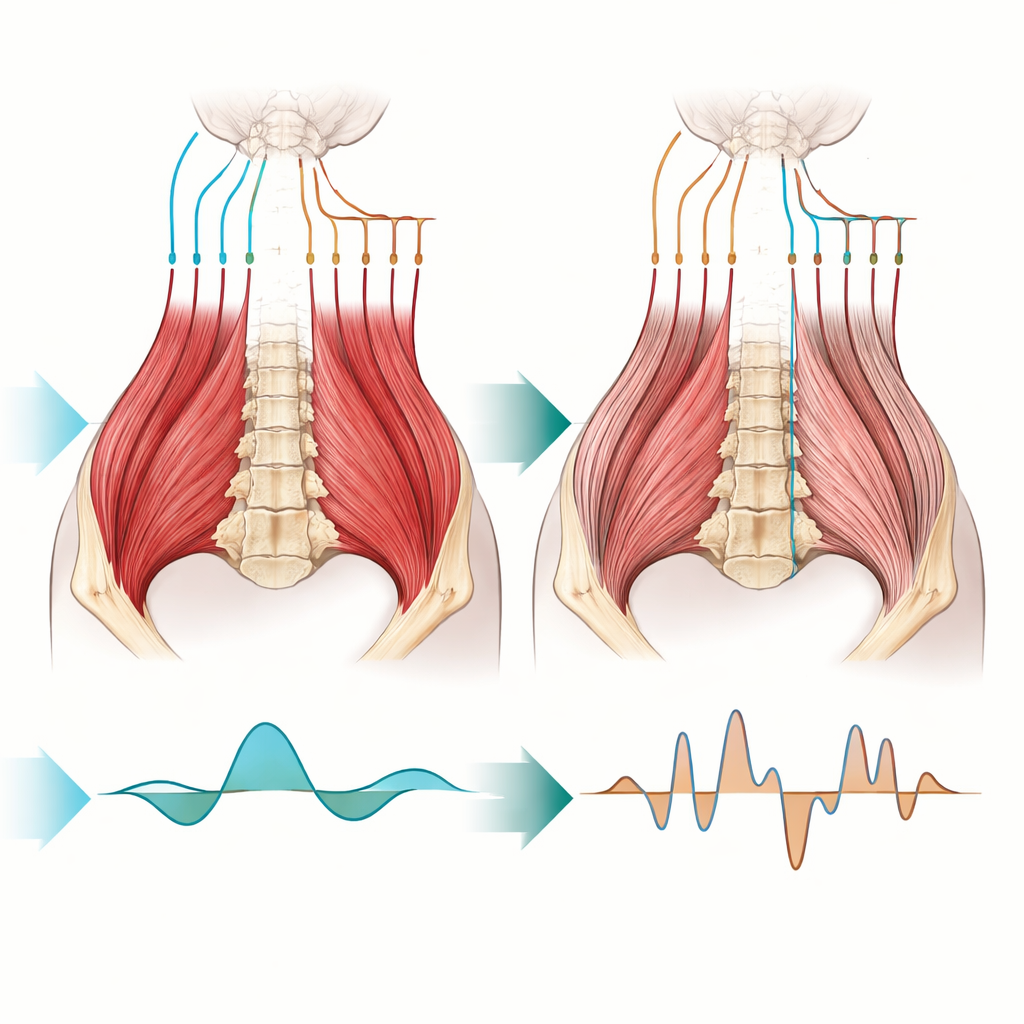
Instead of using a single pair of electrodes, the study used high-density grids placed over both sides of the lower back. These captured dozens of tiny signals from different regions of the muscles. The researchers then used mathematical tools to combine these signals into a cleaner summary of how the muscles were being driven by the nervous system, especially at very low frequencies that are most important for generating steady force. They compared this processed muscle activity with the torque measured at the chair, calculating how closely the two rose and fell together over time—a measure of how tightly neural drive to the muscles is linked to the mechanical output. They also mapped where on the muscle surface this coupling was strongest, revealing which regions contributed most during the tasks.
Older backs shake more, especially during movement
Across the board, older adults produced less maximum trunk extension torque than younger adults, confirming that strength declines with age. More striking, however, was what happened at submaximal efforts. For both static holds (isometric contractions, where the trunk angle does not change) and slow movements (isokinetic contractions, where the trunk slowly straightens and returns), torque from older adults fluctuated more from moment to moment. This loss of “steadiness” was modest during static tasks but much larger when the trunk was moving, and largest of all during the easier, low-intensity movement at 25% of maximum effort—levels similar to those used in everyday activities. Women, regardless of age, also showed slightly greater fluctuations during some tasks, pointing to sex-related differences in neuromuscular control.
Different hidden patterns for static and moving tasks
The link between muscle signals and torque told a more nuanced story. During static holds, older adults showed a similar overall coupling strength to younger adults, but the regions of the muscle that mattered most shifted: the strongest link to torque moved toward more upper and more central areas of the lower-back muscles. This suggests older individuals may rely more on muscle fibers near the spine and higher along the lumbar column, perhaps to compensate for age-related changes lower down. During moving contractions, by contrast, the overall coupling between muscle activity and torque was weaker in older adults, particularly at the low effort level. In these dynamic tasks, the left and right sides of the back also behaved less symmetrically in older participants, hinting at subtle postural adjustments or the recruitment of additional muscles that make torque less smooth even when the main back muscles are active.
What this means for healthy aging
Put simply, the study shows that older adults not only have weaker trunk extensor muscles, but also find it harder to generate a calm, steady push with those muscles—especially during slow, everyday movements at low effort. Underneath this behavior lie age-related shifts in how and where the nervous system drives the lower-back muscles, and how well that drive translates into smooth mechanical output. These insights suggest that exercise programs for older people should train not just strength, but also the fine control of back muscle force during movement, possibly with feedback tools that help users see and reduce their own torque fluctuations. Improving this hidden aspect of muscle control could support better balance, reduce strain on aging spines, and help maintain independence later in life.
Citation: Parrella, M., Arvanitidis, M., Borzuola, R. et al. Age-related alterations in trunk extensor force control during isometric and isokinetic contractions. Sci Rep 16, 13249 (2026). https://doi.org/10.1038/s41598-026-41572-6
Keywords: aging, back muscles, force control, balance, electromyography