Clear Sky Science · en
Impact of global climate change induced variations in reservoir-river systems on fish habitats
Why Warming Waters Matter for River Life
As the planet heats up, the changes we notice in air temperature and rainfall also ripple through rivers, reservoirs, and the fish that depend on them. This study looks at a major dam and river system on China’s Yellow River and asks a pressing question: under future climate change, will there still be enough cool, well-flowing water in the right places and seasons for native fish to survive and reproduce? By tracing how global warming alters water flow and temperature from the reservoir to the downstream river, the researchers show how an iconic carp species may lose its breeding grounds even when total water supplies remain sufficient.
From Global Warming to Local Rivers
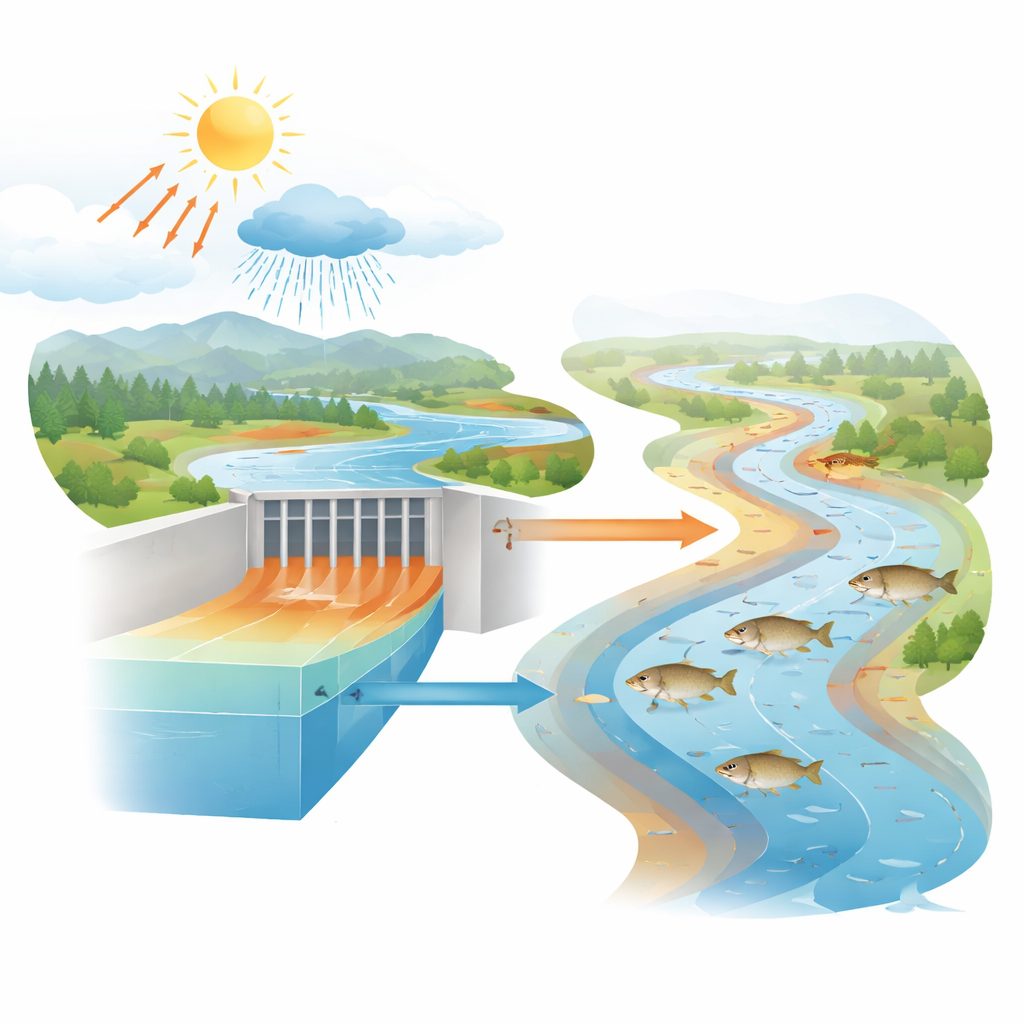
The researchers start with the big picture: global climate change is raising air temperatures, shifting rainfall patterns, and increasing extreme weather. These shifts disturb the water cycle, changing how much rain runs off the land into rivers and how quickly water evaporates. To understand what this means for a specific reservoir–river system, the team combines global climate projections with detailed regional models. They downscale coarse global climate data to the Yellow River Basin, then feed these future weather patterns into computer models that simulate runoff, river flow, and water temperature. This multi-step approach lets them translate worldwide warming into local conditions at a particular dam and its downstream reaches.
A Digital Twin of a Reservoir and River
The focus is the Xiaolangdi Reservoir, the last large gorge-type dam on the main Yellow River, and the long stretch of river below it. The team builds a linked set of models that act like a “digital twin” of the system. A watershed model estimates how future rain and snowmelt become inflow to the reservoir. Three‑dimensional and two‑dimensional hydrodynamic models then simulate how water moves and stratifies within the reservoir and flows along the downstream channel. Added temperature models track how heat is absorbed, mixed, and released, while a habitat model translates depth, current speed, and temperature into how much river area is actually usable by fish. This chain of models is calibrated and checked against decades of observed water levels, flows, and temperatures to ensure it reproduces past behavior well.
Runoff Stable, But Water Warmer
Using several climate scenarios that range from relatively mild to very strong warming, the study projects conditions through the end of this century. Despite climate change, the total amount of runoff entering the system stays high enough to meet current water needs in all four scenarios. The more subtle but crucial change is in water temperature. In Xiaolangdi Reservoir, warming air and altered inflows gradually heat the water column. By around 2100, the surface, middle, and bottom layers are all warmer than in today’s climate, with the strongest increases under the highest-emissions pathway. The surface warms the most, reinforcing thermal layering in the reservoir and influencing the temperature of the water released through the dam. These warmer releases, in turn, reshape the downstream river’s thermal conditions.
Shrinking Breeding Spaces for Carp
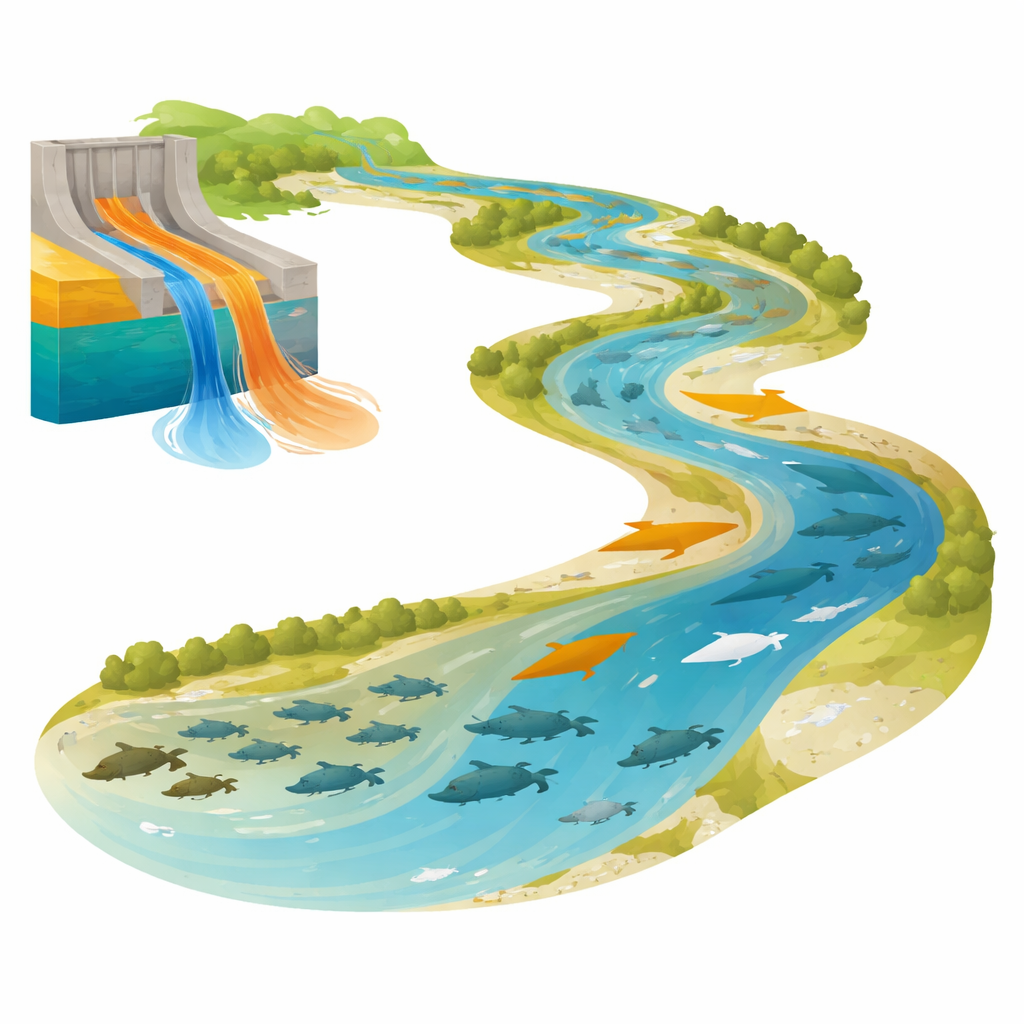
The team then examines what these hydrologic and thermal shifts mean for Yellow River carp, a native species that serves as an indicator of ecosystem health. Carp have specific needs for spawning and for their early juvenile stage, especially in spring and early summer when water depth, current speed, and temperature must all fall within certain ranges. Using fuzzy habitat rules derived from experiments and field surveys, the model converts the simulated river conditions into “weighted usable area” — an estimate of how much river space is suitable at any given time. Across all climate scenarios and time slices (around 2050, 2075, and 2100), the total suitable area for both spawning adults and juveniles declines, in some cases by more than 20 percent compared with the present-day baseline. Even though there is still enough water, the combination of altered flow patterns and warmer water makes fewer places “just right” for carp reproduction.
What This Means for Rivers and Fish
For a non‑specialist, the key message is that climate change can quietly undermine river ecosystems without visibly drying up the river. In this Yellow River system, future warming is likely to make the reservoir and downstream waters hotter and change how fast and deep they flow at critical times of year. These changes do not eliminate water, but they do erode the hidden qualities that make stretches of river good nurseries for fish. The study’s modeling framework offers a way for managers to test how different dam operation rules or conservation measures might protect fish habitats under warming conditions. In simple terms, keeping river life healthy in a hotter world will require not only enough water, but water released at the right times, in the right amounts, and at the right temperatures.
Citation: Zhao, G., Tian, S., Zhang, F. et al. Impact of global climate change induced variations in reservoir-river systems on fish habitats. Sci Rep 16, 11331 (2026). https://doi.org/10.1038/s41598-026-41555-7
Keywords: climate change, reservoirs, river ecosystems, fish habitat, Yellow River