Clear Sky Science · en
Theoretical study on loading history dependence of dynamic failure strength for brittle materials
Why fast breakage matters
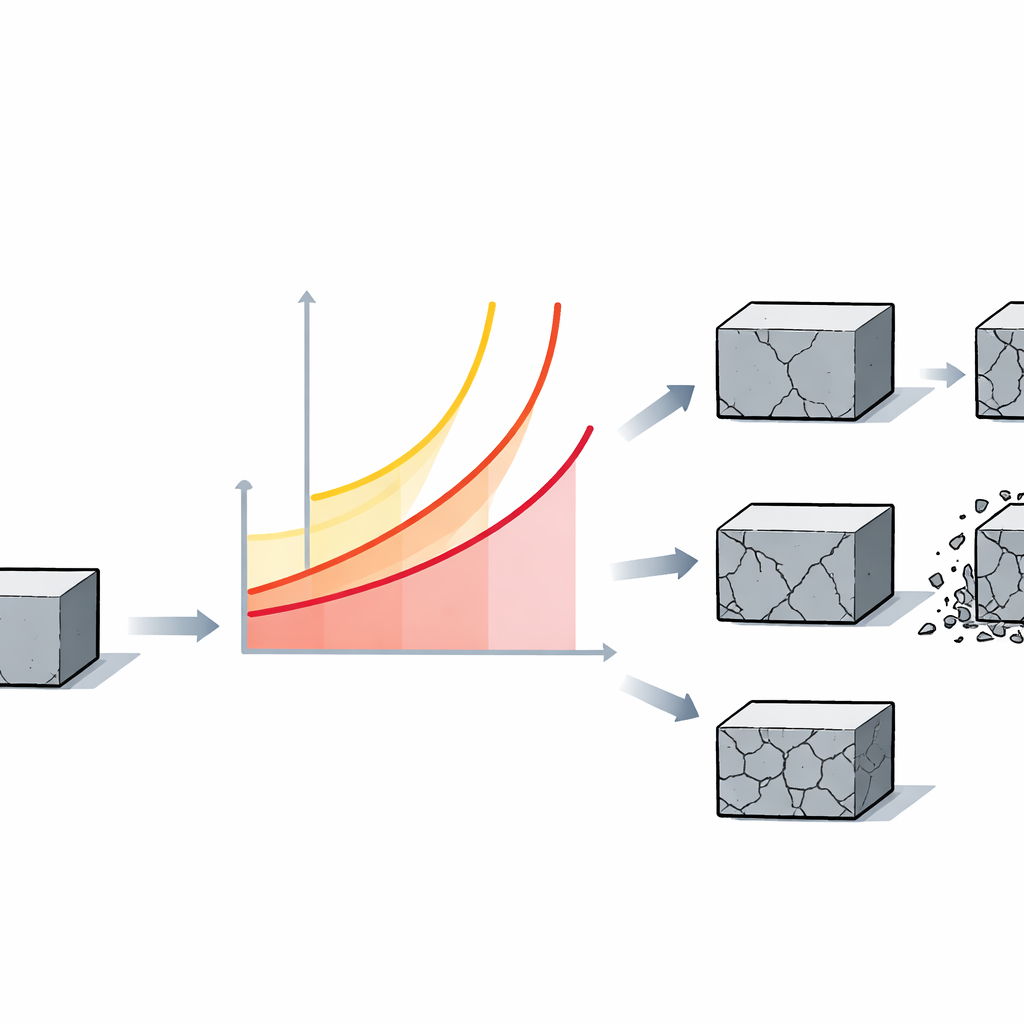
From concrete buildings to rock around underground tunnels, many everyday structures are made of brittle materials that crack suddenly rather than bend. Engineers have long noticed that when these materials are hit or loaded very quickly, they seem stronger than in slow, gentle tests. This apparent extra strength at high loading rates is crucial for designing buildings to withstand blasts, impacts, or earthquakes. But scientists are still debating a basic question: is this "dynamic strength" a true property of the material, or is it mainly a result of how the load is applied over time? This paper tackles that question by building a theory that links the timing of loading and the hidden growth of tiny cracks inside brittle solids.
Old views on a long‑standing puzzle
For decades, the standard view has been that dynamic strength is simply a rate‑dependent material property: push faster and the material’s peak strength increases in a predictable way. Based on this, many experiments have measured strength at different strain rates, and engineers have fitted simple formulas that plug directly into computer simulations. However, this picture treats strength as depending only on the instantaneous loading rate, not on the entire way the load has built up. A competing view, called dynamic load‑carrying capacity theory, argues that strength in rapid tests is not a fixed property of the material at all, but instead emerges from the full loading history and the inertia of the specimen as a structure. That approach relies on time‑integrated failure rules, which say that cracking needs a certain build‑up period before final breakage occurs, but it typically assumes the material stays perfectly elastic up to failure and does not fully explain what is happening inside the material.
A new clock for breaking
The authors propose a new way to describe when brittle materials fail under fast loading, called the characteristic time failure criterion. Instead of asking only how high the stress is at a given instant, the criterion asks how long the material has been stressed near or above its slow‑test strength. It introduces a material‑specific minimum duration needed at that strength level for enough microscopic bonds to break and for microcracks to grow to a critical state. In simple terms, the material does not fail the moment the stress reaches its usual strength; it needs a short but finite "incubation" time. This clock‑like parameter is then woven into a mathematical damage law that tracks how tiny cracks nucleate, grow, and coalesce as loading continues, turning the usual static stress–strain curve into a time‑dependent one.
From tiny cracks to overall behavior
Using this new criterion, the authors construct a uniaxial material model that describes how stress and strain evolve before the peak load in tension and compression tests. They treat the material as made up of many small elements, each with its own resistance to cracking and its own characteristic time, distributed statistically. As loading progresses, some elements fail earlier than others, and their cumulative failure defines a damage variable that reduces the effective stiffness of the material. Because the damage evolution depends on the full history of strain or stress, two tests with the same peak strain rate but different time paths can produce different stress–strain curves and different apparent strengths. When the model is fed with realistic loading histories and material parameters, its predictions for dynamic tensile and compressive strengths of rocks, micro‑concrete, and advanced ceramics match published experimental data across a wide range of high strain rates.
Why loading history changes strength
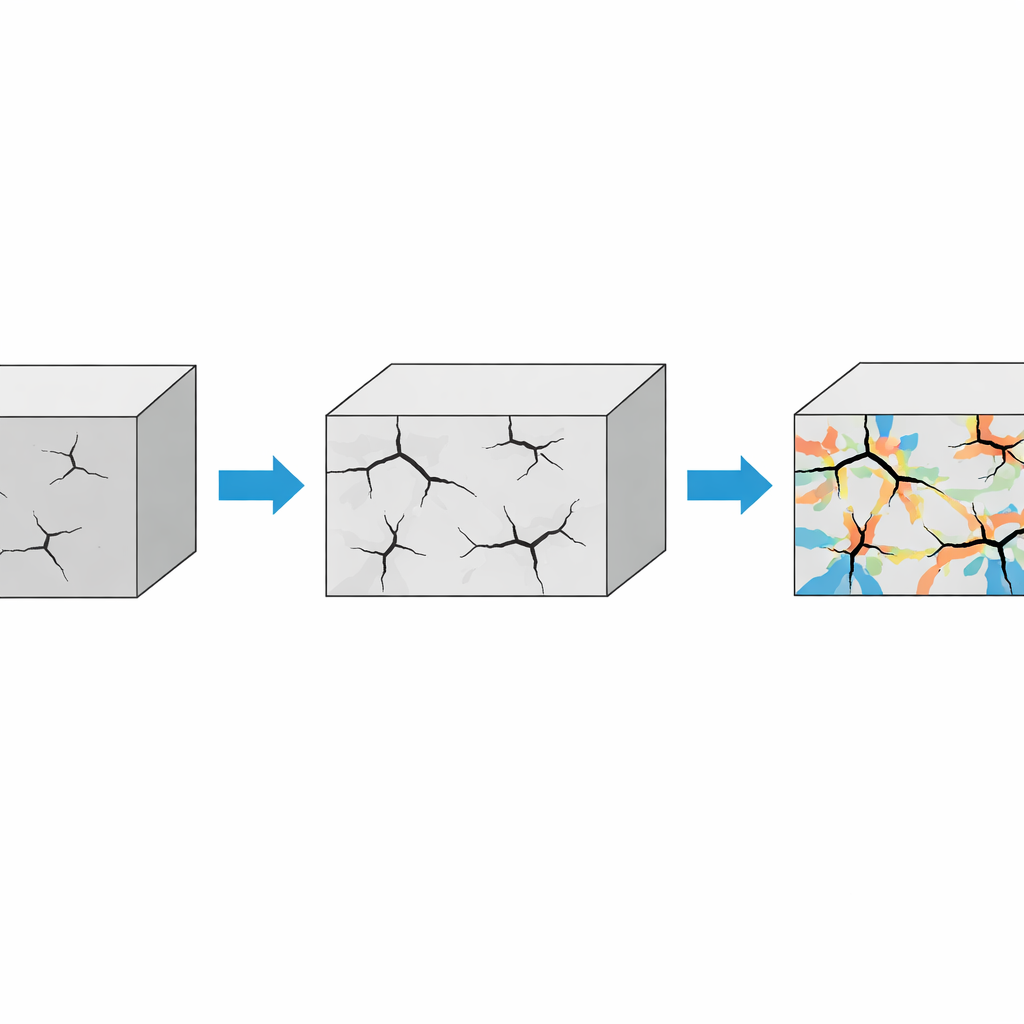
The model reveals that, at high loading rates, the internal crack network cannot keep up with the rapidly rising load. The inertia of the material surrounding each microcrack delays its opening and growth, so less new crack surface is created at a given overall strain compared with slow loading. This "microcrack inertia" acts like a lag in the damage process: it both raises the stress required to reach failure and makes the outcome sensitive to the exact shape of the loading curve. Other time‑dependent mechanisms, such as viscous resistance within the material, can add similar delays. As a result, the authors argue that the observed rate enhancement and history dependence of dynamic strength are not mere testing artefacts, but genuine mechanical behaviors of the material at the macroscopic scale, even though they arise from structural effects at the microscopic level.
What this means for real‑world design
In everyday terms, the study concludes that the peak stress a brittle material can carry in a fast event is not a fixed number that depends only on "how fast" you load it, but also on "how" you ramp up that load over time. The same material can appear stronger or weaker under different pulse shapes, even if the average loading rate is the same, because the internal cracks have more or less time to develop. For engineers and modelers, this means that simple formulas based only on a representative strain rate can miss important delays and may misjudge failure under complex, rapidly changing loads. Instead, accurate predictions of dynamic failure should be based on models that follow the full stress or strain history and the time‑dependent growth of damage inside the material.
Citation: Yang, X., Bai, Z., Duan, Z. et al. Theoretical study on loading history dependence of dynamic failure strength for brittle materials. Sci Rep 16, 10386 (2026). https://doi.org/10.1038/s41598-026-41538-8
Keywords: brittle materials, dynamic strength, loading history, microcrack inertia, damage evolution