Clear Sky Science · en
Compact multi-band bandpass filter with independently controlled passbands using CRLH-TZRP
Why small filters matter for wireless life
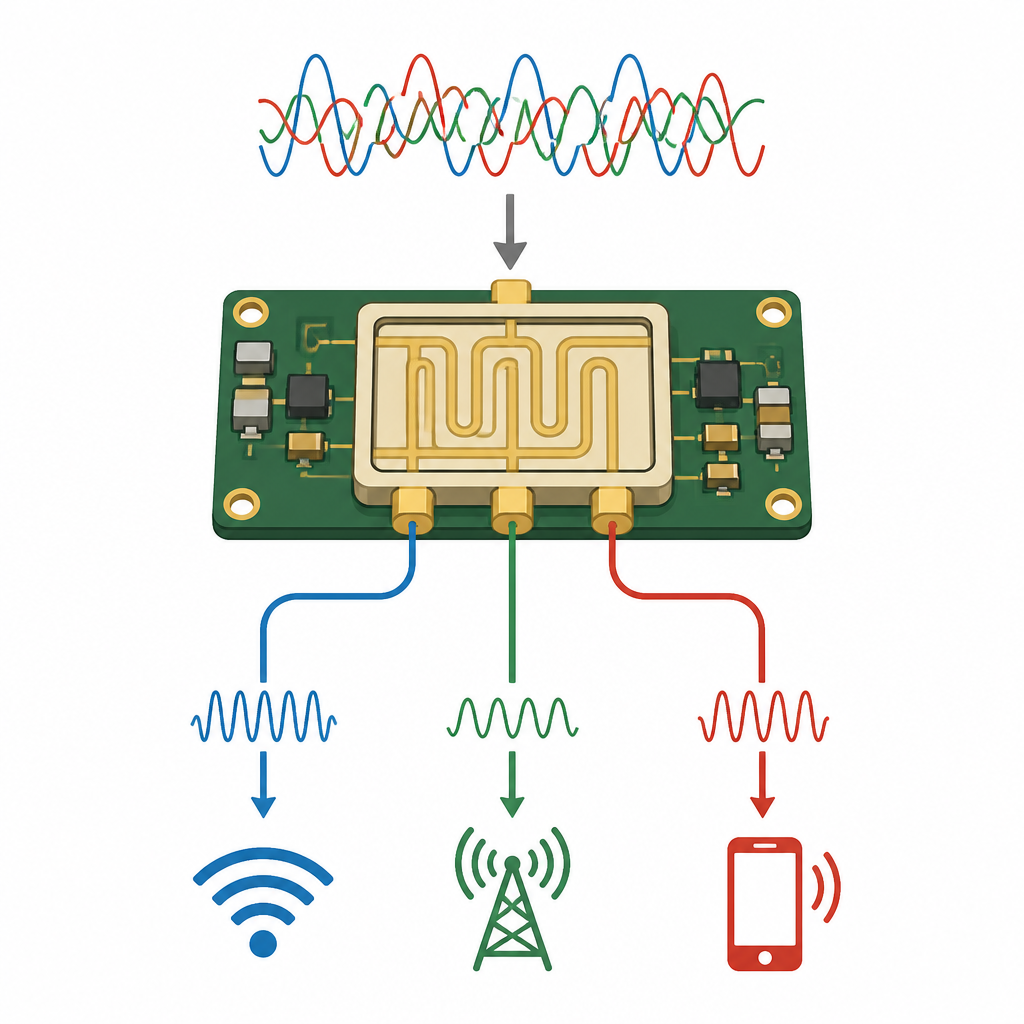
Every time your phone or laptop connects to Wi Fi or a 5G network, hidden radio filters help sort useful signals from noise. As more services crowd into the same slice of the airwaves, engineers need tiny circuits that can handle several frequency bands at once without wasting power or space. This paper presents a compact microchip scale filter that can serve Wi Fi, WiMAX, and 5G bands together while letting designers tune each band almost independently.
A smarter traffic cop for radio signals
Radio filters act like traffic cops, letting only certain frequencies pass through while blocking the rest. Traditional designs often need separate resonators for each band, which makes the circuit larger and makes it hard to adjust one band without disturbing the others. The authors tackle this problem by rethinking the basic resonator element at the heart of the filter, seeking a way to get more control and more bands from the same small footprint.
Getting more from each resonator
The key building block in this work is a special kind of resonator that combines two behaviors in one structure. Instead of the usual simple coil and capacitor, the new element mixes series and shunt parts so that it naturally creates two sharp blocking points and one passing point in frequency. By pairing two of these elements, the authors form what they call a transmission zero resonator pair, which now offers four blocking points and three passing points in a controlled pattern. Careful circuit analysis shows how changing each tiny coil or capacitor value shifts specific blocking points while leaving others nearly fixed.
From circuit idea to tiny circuit board
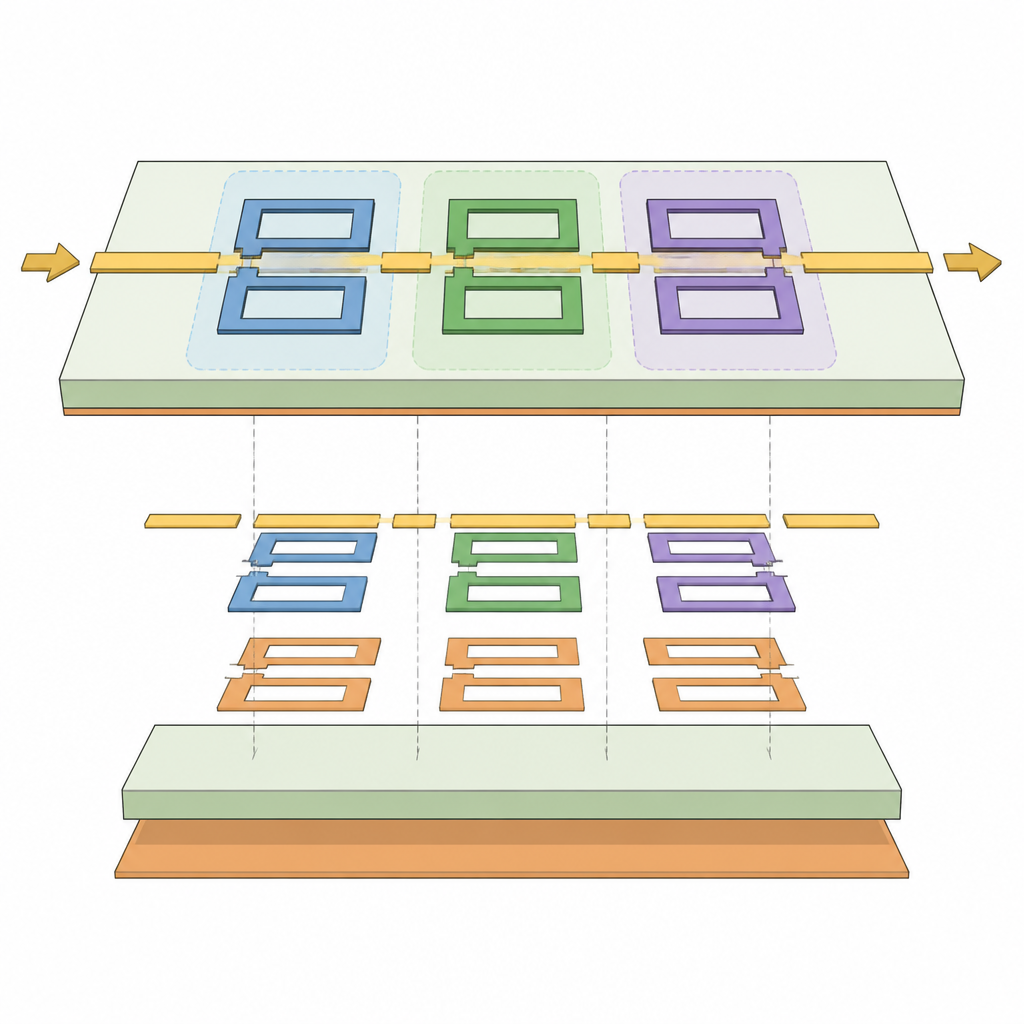
To turn the concept into hardware, the team implements the resonators as patterned copper lines and finger like gaps on a high dielectric circuit board. Two mirrored pairs of these structures are placed close together so that they interact through both electric and magnetic fields. By adjusting the spacing and shapes, the designers can place eight strong blocking points around three desired passbands near 2.4, 3.5, and 4.9 gigahertz. Computer simulations and electric field maps confirm that, at each target band, only part of the structure stores energy while the overall layout still passes the signal efficiently.
Performance in the lab
The finished filter, only about a centimeter on a side, is built on a Rogers RO3210 board and measured with standard microwave test equipment. The three bands line up closely with design targets used for Wi Fi, WiMAX, and a 5G band, and they show low insertion loss for such a compact structure. Sharp notches created by the multiple blocking points give strong rejection between and beyond the passbands, reducing unwanted interference. The study also checks power handling, showing that the field strengths and currents in the metal lines remain safely below levels that would damage the board in normal use.
What this means for future wireless devices
In simple terms, the authors have designed a tiny three in one radio filter where each channel can be tuned with less compromise than usual. By squeezing extra blocking and passing behavior into each resonator pair, they achieve eight helpful “guard points” that shape the response while keeping the circuit small and low loss. This approach could make it easier to build compact front ends for Wi Fi routers, WiMAX gear, 5G devices, and other multiband systems that must share crowded spectrum without talking over one another.
Citation: Bastani, A., Jam, S. & Darvishi, M. Compact multi-band bandpass filter with independently controlled passbands using CRLH-TZRP. Sci Rep 16, 14849 (2026). https://doi.org/10.1038/s41598-026-41529-9
Keywords: multiband filter, microstrip, Wi Fi, 5G, CRLH resonator