Clear Sky Science · en
Implementation of smart metasurfaces for the Sub-6 GHz 5G wireless systems: design, optimization, and its synthesis for enhancing antenna’s performance
Why smarter antennas matter for everyday devices
As our homes, cities, and gadgets fill up with connected electronics, there is growing interest in powering some of them by quietly sipping energy from the air instead of relying only on batteries. This study explores a new kind of compact antenna that can both talk to sub‑6 GHz 5G networks and more efficiently harvest stray radio waves to produce usable electrical power. By combining a carefully shaped metal surface under the antenna with an artificial‑intelligence design method, the authors show how to squeeze much better performance out of a very small hardware footprint.
From simple rod to smart signal catcher
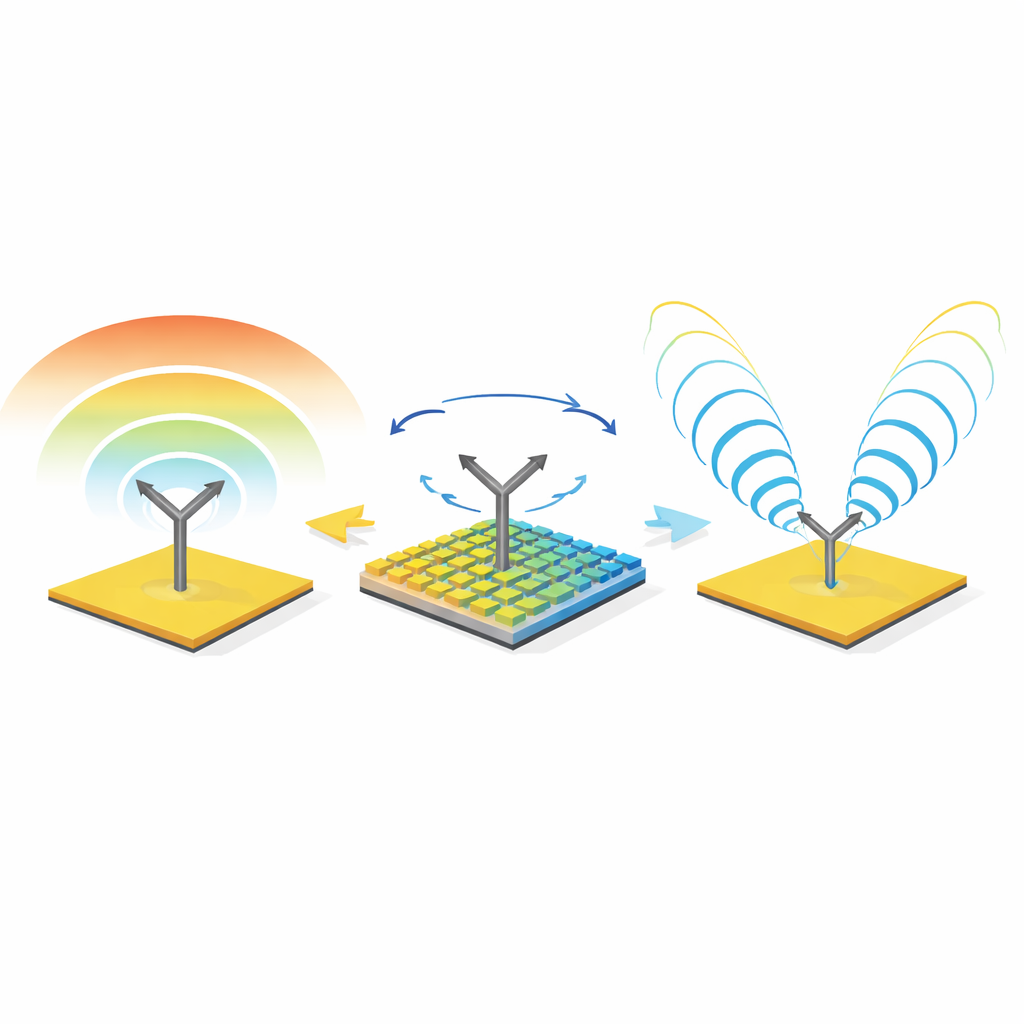
The work begins with a basic printed monopole antenna—essentially a small metal rod on a flat board—that normally receives waves with a single preferred orientation. The researchers modify this simple structure so it can pick up signals no matter how they are oriented in space, a property known as circular polarization. They do this by adding extra metal strips and a small connecting bridge on the ground plane behind the antenna, which reshapes the flow of electrical currents. This re‑routing causes the electric field to rotate as the wave arrives, helping the antenna stay well matched to signals coming from different directions, which is valuable when trying to capture unpredictable 5G and other ambient transmissions.

Turning a flat layer into a power‑boosting surface
The key leap in the paper is the addition of a “metasurface” layer—an array of small metallic features placed just beneath the main antenna, acting like a parasitic patch reflector. Rather than guessing its shape by hand, the authors use an AI‑assisted optimization method called SADEA, run in MATLAB, to tune the size and spacing of this layer. The algorithm repeatedly evaluates candidate designs with an electromagnetic simulator and builds a fast surrogate model that predicts performance, allowing it to home in on a configuration that maximizes useful bandwidth and gain while keeping the occupied area small. The resulting structure, printed on a common FR‑4 circuit board, thickens the useful frequency range around 5 GHz and shapes the outgoing waves into more focused beams.
How the new design improves signal and power
Careful measurements show that the final antenna configuration dramatically outperforms the intermediate designs without the metasurface. The useful impedance bandwidth—the range of frequencies over which the antenna efficiently exchanges energy with attached electronics—expands to about 3 GHz, more than five times that of the starting version. The range over which it maintains good circular polarization also widens several‑fold. Average circularly polarized gain rises from roughly 2.35 to more than 5 dBic, while overall efficiency exceeds 75%, meaning most of the captured radio energy is directed, not wasted as heat or backscatter. Analysis of current paths, field patterns, and equivalent circuits reveals that the metasurface promotes higher‑order resonance modes and lowers the quality factor, both of which naturally broaden bandwidth and sharpen the radiation pattern.
Harvesting radio waves to power tiny electronics
To demonstrate a practical use, the authors connect the antenna to a three‑stage rectifier circuit that converts the captured RF signal into direct‑current voltage. The rectifier uses a carefully matched network so that the antenna sees the right electrical load and can transfer energy efficiently. In simulations at 5 GHz with modest input power levels similar to what might be available from nearby 5G base stations, the system produces up to about 3.6 volts across a small resistor, with conversion efficiencies above 55%. Even at lower power, it exceeds common benchmarks from other recent designs, suggesting that such a setup could feed low‑power sensors in wearables, health monitors, or internet‑of‑things nodes without frequent battery changes.
What this means for the future of wireless power
In summary, the study shows that pairing a compact antenna with an AI‑designed metasurface layer can significantly widen its operating band, boost the strength and direction of its beams, and improve its ability to turn ambient 5G signals into useful DC power. For non‑experts, the takeaway is that smarter shaping of metal patterns on inexpensive circuit boards, guided by machine learning, can make small antennas far more capable. As networks and connected devices multiply, such designs could help enable more self‑powered sensors and communication links, cutting down on wiring and battery maintenance while quietly reusing energy that is already flowing through the air.
Citation: Behera, B.R., Paik, H., Kumar, J.A. et al. Implementation of smart metasurfaces for the Sub-6 GHz 5G wireless systems: design, optimization, and its synthesis for enhancing antenna’s performance. Sci Rep 16, 10420 (2026). https://doi.org/10.1038/s41598-026-41436-z
Keywords: 5G antennas, metasurface design, RF energy harvesting, wireless power, AI optimization