Clear Sky Science · en
Hydromechanical behavior of dredged slurry modified with industrial waste composite curing agents
Turning Mud into New Land
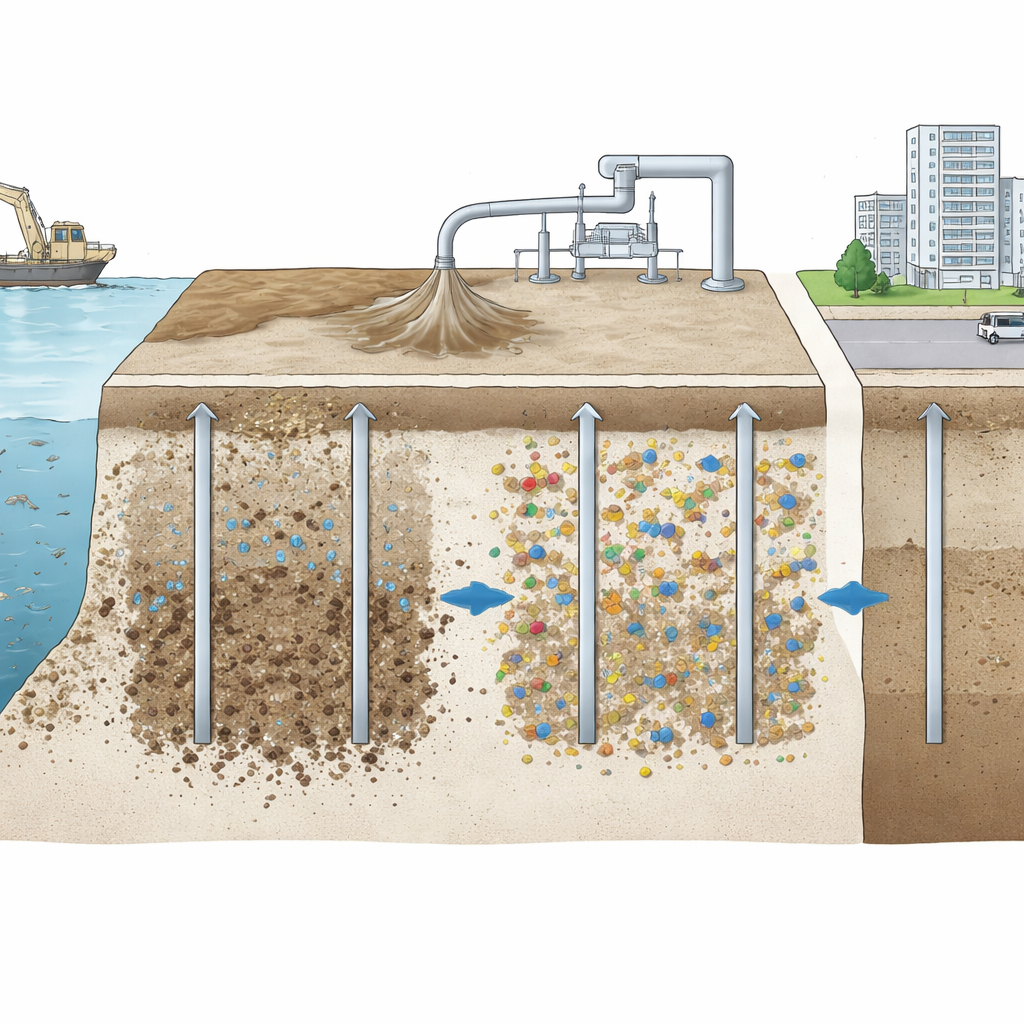
Along many crowded coasts, cities are literally running out of ground to build on. One way to create new land is to pump soft mud, or dredged slurry, from the seafloor into shallow areas and let it firm up into usable ground. But this slurry is more like a watery soup than a solid soil: it holds a lot of water, contains very fine clay, and drains extremely slowly. When engineers try to squeeze water out of it using vacuum systems, the mud often clogs the drains and refuses to dry. This study explores a smarter, greener way to help that mud stiffen and drain, using industrial by‑products instead of large amounts of conventional cement.
Why Soft Seabed Mud Is So Hard to Tame
Dredged slurry from harbors around Shanghai arrives with more than twice its own weight in water and over half of its particles in the clay size range. In this state it has almost no strength and barely lets water pass. Engineers commonly use a method called vacuum preloading: vertical plastic drains are pushed through the mud, a vacuum is applied at the surface, and water is drawn upward so the soil settles and strengthens. However, with such fine and sticky mud, particles crowd around the drains and form tight cylinders of nearly impermeable soil. These “soil columns” choke off the flow paths, so parts of the ground dry while others stay soft, slowing projects and raising costs.
Blending Waste Powders into a Helpful Additive
To tackle both clogging and climate impact, the researchers tested curing agents made from a mix of ordinary cement, lime, and two steel‑industry wastes: steel slag and blast furnace slag. Instead of fully hardening the slurry into concrete‑like blocks, the goal was to use very low dosages—around 1–5% of the dry soil mass—to create a semi‑solid framework that can bear weight while still leaving open channels for water to escape. In the lab, they first re‑created the watery slurry, then blended in different proportions of the four powders. They tracked how much water bled out over time in tall cylinders and then ran standard one‑dimensional consolidation tests, which measure how fast and how far the mud compresses when loaded.
Finding the Sweet Spot for Strength and Drainage
The tests revealed a clear threshold near a total additive dosage of 2%. Below this level, the mud stayed too soft and tended to compress a lot, even though drainage improved. Above about 3%, the mixture started behaving like a rigid solid: it resisted further compression but also stopped bleeding much water, which is bad news for vacuum systems that rely on flow. At roughly 2%, though, a semi‑solid skeleton formed. The mud could carry the applied load yet still allowed water to move. Compared with untreated slurry, adding 1% cement roughly doubled to tripled its permeability, while 2% increased it by about four to five times—meaning water could escape far more easily, speeding up ground improvement.
Making Cement Go Further with Steel and Furnace Slags
The team then asked whether industrial by‑products could replace most of the cement without sacrificing performance. They kept the total dosage fixed at 2% and gradually swapped cement for steel slag, slag, and a small amount of lime. A formulation with about 40% steel slag already showed faster stabilization in the bleeding tests. When 40% slag and 7–9% lime were added into the mix, the results were especially promising: the modified slurry kept its higher permeability—roughly two to three times that of untreated mud—even under higher loads, yet still consolidated effectively. Remarkably, this best‑performing blend used about 80% less cement than the all‑cement reference while maintaining or improving drainage behavior.
How the Tiny Particles Rebuild the Soil Skeleton
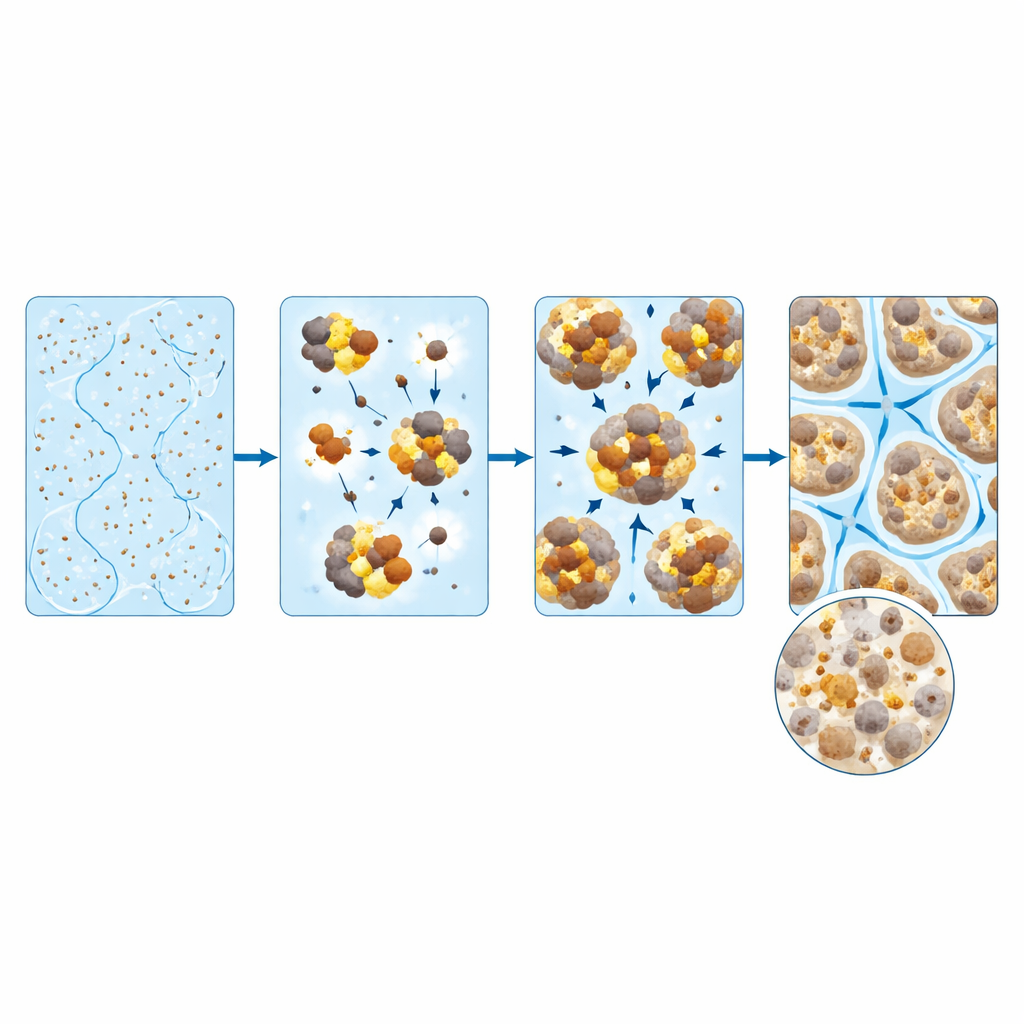
At the microscopic level, these powders change the mud in two main ways. First, calcium‑rich components in cement and lime quickly interact with the charged clay surfaces, triggering flocculation: fine particles gather into larger clusters, opening up bigger pore spaces between them so water can move more freely. Second, over time, reactions between calcium, silica, and aluminum in the soil and the industrial slags form new mineral gels and crystals, such as calcium silicate hydrate and needle‑like ettringite. These products knit the flocculated clusters together into a stable skeleton that resists long‑term creep without sealing off all the drainage paths. The carefully tuned composite blends strike a balance between building this skeleton and preserving enough open channels.
Cleaner Building on New Coastal Ground
In everyday terms, the study shows that we can turn watery harbor mud into buildable land more efficiently and with a smaller carbon footprint by “seasoning” it with a small, well‑chosen mix of powders, most of which are recycled from steel production. A total dosage of about 2% creates a semi‑solid, well‑drained soil that is less likely to clog vacuum drains, consolidates faster, and remains strong. Replacing most of the cement with steel slag, slag, and lime keeps that performance while sharply cutting the use of energy‑intensive cement. For coastal cities facing both land shortages and pressure to reduce emissions, this approach offers a practical, lower‑carbon way to expand safely onto reclaimed ground.
Citation: Liu, Y., Zhang, H., Liu, X. et al. Hydromechanical behavior of dredged slurry modified with industrial waste composite curing agents. Sci Rep 16, 11217 (2026). https://doi.org/10.1038/s41598-026-41409-2
Keywords: dredged slurry, vacuum preloading, industrial waste reuse, soil improvement, coastal land reclamation