Clear Sky Science · en
Theoretical analysis of thermomechanical response for biological skin tissues
Why warming the skin matters
From removing tumors with heat to sealing blood vessels with lasers, many modern treatments deliberately warm the skin. Yet when doctors heat tissue, they are not just changing temperature; they are also squeezing and stretching cells. This article develops a detailed mathematical model of how human skin simultaneously heats up and deforms when exposed to rhythmic, pulsing heat. By sharpening these predictions, the work could help design safer, more effective thermal therapies and reduce unintended tissue damage.
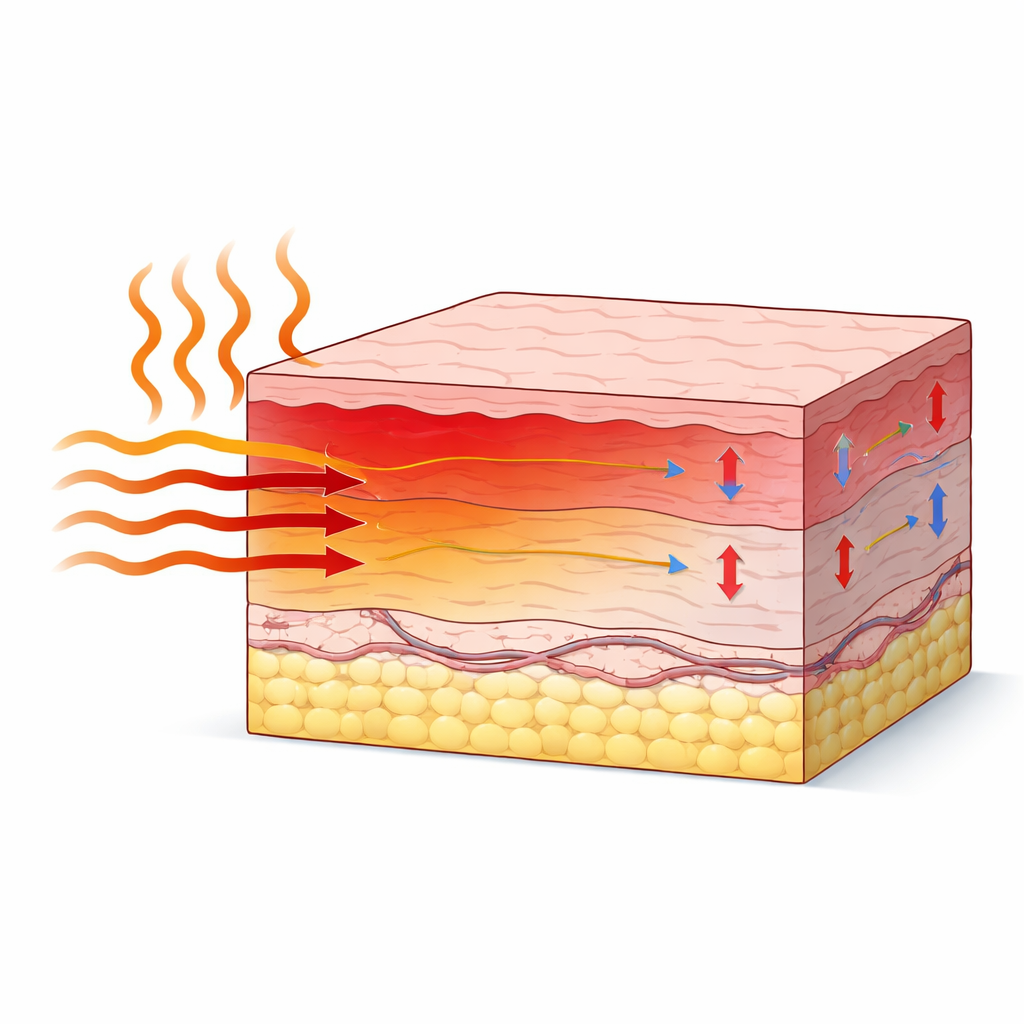
How skin reacts to heat
Our skin is more than a simple covering. It is a layered structure made of the thin protective epidermis, the thicker, blood‑rich dermis, and the cushioning hypodermis. When one side of this layered slab is heated—for example by a laser that turns on and off at a steady rhythm—heat spreads inward, blood flow redistributes warmth, and the material itself expands or contracts. Because these processes are tightly linked, a realistic description must treat temperature changes and mechanical deformation together instead of separately.
From old heat laws to modern views
Traditional models of heat transfer in living tissue, such as the classic Pennes bioheat equation, assume that heat spreads instantly, like dye diffusing smoothly in water. That picture works well for slow, gentle heating, but it breaks down when the skin is hit with rapid or high‑frequency pulses. To fix this, newer theories assume that both heat and temperature respond with short delays, leading to wave‑like heat motion. The authors compare four such thermoelastic theories: a classical coupled model, the Lord–Shulman (LS) model with one delay time, the dual‑phase‑lag (DPL) model with two distinct delays, and a nonlocal dual‑phase‑lag (NLDPL) model that also accounts for the skin’s microscopic structure by letting distant regions subtly influence one another.
Building a virtual skin slab
The study treats the outer skin as a thick plate that extends infinitely along the body but has a finite thickness from the outer surface downwards. One face is driven by a harmonic (sinusoidal) surface temperature, mimicking a periodic heat source, while the opposite face is kept free of heat and mechanical traction. Using normal mode analysis and an eigenvalue approach, the authors convert the governing equations into a form that can be solved analytically, and then compute detailed temperature, displacement, stress, and volume‑change patterns with numerical simulations in MATLAB. This approach allows them to explore how the system behaves over both space and time without resorting solely to brute‑force computation.
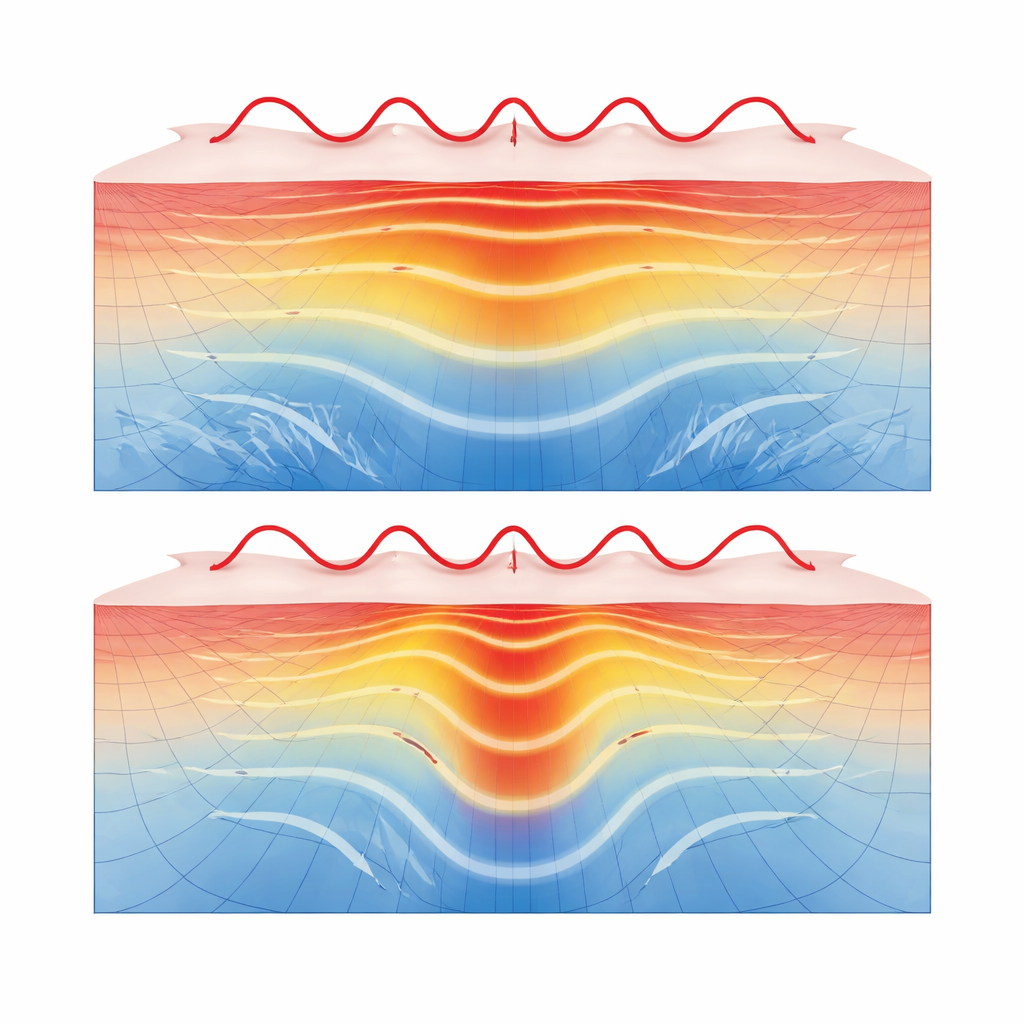
What the models reveal
The comparisons show that the simplest classical theory tends to overestimate peak temperatures and stresses during transient heating, making it less trustworthy for delicate procedures. The LS and DPL models perform better but still miss important features of how skin’s microstructure spreads out heat and strain. In contrast, the nonlocal dual‑phase‑lag model produces smoother, more moderate stress and temperature profiles that align better with expected physical behavior. The study also shows that two key knobs strongly shape the response: the angular frequency of the applied heating and the nonlocal parameter tied to tissue microstructure. Higher heating frequencies intensify both temperature peaks and mechanical compression, while stronger nonlocal effects reduce extreme stresses, smooth temperature gradients, and slightly limit volumetric expansion.
Why this matters for treatment
Taken together, the results argue that advanced models including both time delays and microstructural effects are essential for realistically capturing how skin responds to rapid, repeated heating. For therapies like laser surgery and hyperthermia, where tissues may be raised to around 40–44 °C to weaken tumor cells, better predictions of temperature, stress, and deformation can guide safer treatment plans and device settings. In practical terms, this work helps turn our skin from a mysterious black box into a predictable system, enabling clinicians and engineers to fine‑tune heating strategies that damage tumors while preserving as much healthy tissue as possible.
Citation: Islam, N., Das, B. & Lahiri, A. Theoretical analysis of thermomechanical response for biological skin tissues. Sci Rep 16, 12495 (2026). https://doi.org/10.1038/s41598-026-41406-5
Keywords: bioheat transfer, thermoelasticity, skin tissue modeling, hyperthermia therapy, laser heating