Clear Sky Science · en
A novel leaf counting method for field tobacco plants based on UAV imagery and an improved PointNext
Why Counting Leaves from the Sky Matters
Knowing how many leaves a crop has might sound like a small detail, but for tobacco farmers it is a direct window into plant health and future yield. Today, workers still walk the fields and tally leaves by hand, a slow, tiring, and expensive task that does not scale to modern plantations. This study shows how drones, 3D imaging, and artificial intelligence can team up to automatically count leaves on tobacco plants growing in real fields, offering a faster and more precise way to guide fertilizer use, predict harvests, and support breeding of better varieties.
From Drone Flights to a 3D View of the Field
The researchers first turned to drones as flying cameras. They flew a commercial quadcopter over tobacco fields in Yunnan, China, taking high-resolution photos from several heights and at steep angles around plots of interest. Using photogrammetry software, these overlapping images were stitched into detailed three-dimensional models of the plants. Each plant was then extracted as its own cloud of points in 3D space, where each point represents a tiny patch on a stem, leaf, or surrounding clutter such as soil and neighboring foliage. This step transforms flat pictures into a rich 3D description that can reveal leaves even when they overlap in ordinary photographs. 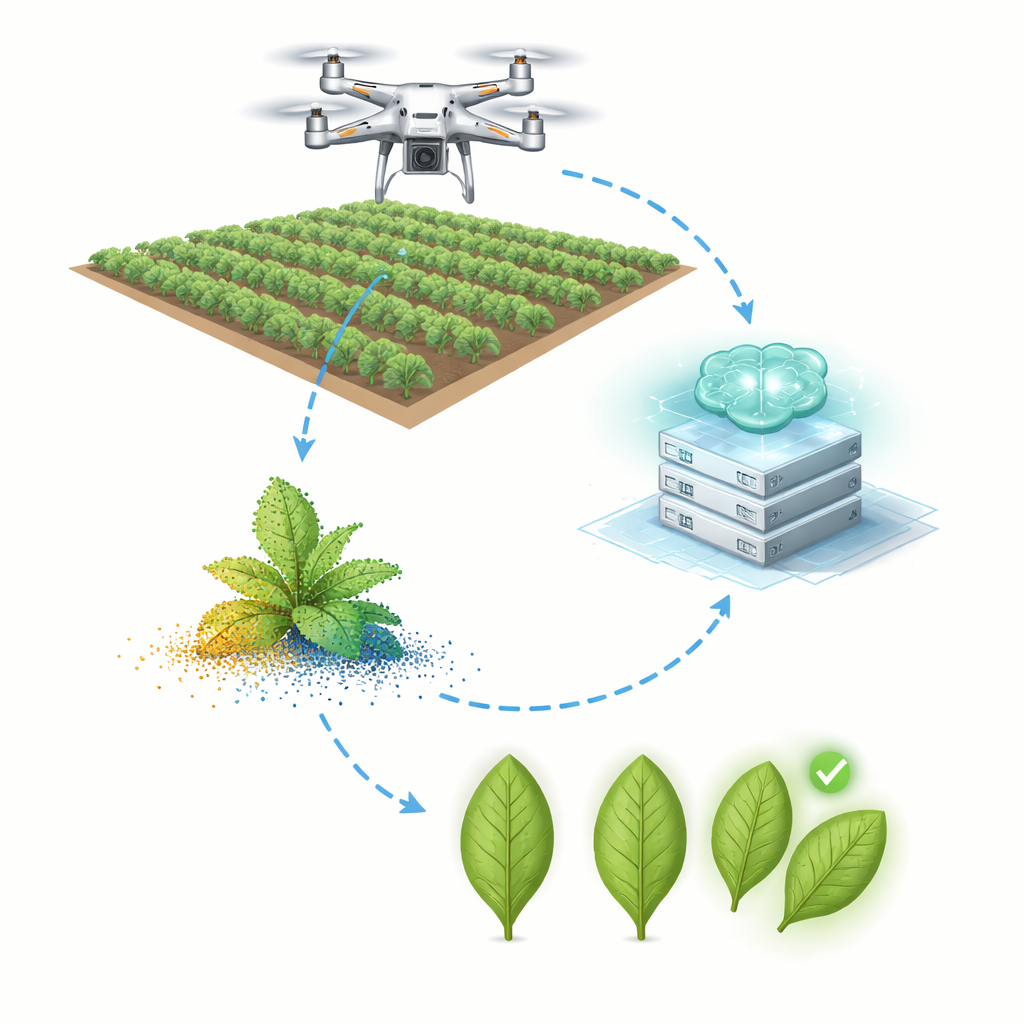
Teaching a Computer to See Individual Leaves
To make use of these 3D point clouds, the team built a large, carefully labeled dataset. They collected 1,000 individual plant models and manually tagged each point as belonging to target leaves, stems, other plants, or noise. With this training material, they refined a modern 3D deep-learning network known as PointNext into a new version tailored to field crops, called SRW-PointNext. Three key upgrades were added: an attention module that helps the network focus on the most informative spatial and color patterns; a revised loss function that prevents the abundant leaf points from drowning out rarer classes like stems and background; and a strengthened output head that better recovers fine details when parts of the point cloud are missing or uneven.
Turning Segmented Clouds into Leaf Counts
Once SRW-PointNext had learned to label each 3D point, the model could separate the cloud of a single plant into its leaf and non-leaf parts. But scientists still needed to know how many actual leaves were present. For this, they turned to a clustering approach called MeanShift. In simple terms, the algorithm searches for dense pockets of leaf points in three dimensions, with each dense pocket corresponding to one leaf. The choice of a single “bandwidth” setting controls how tightly or loosely the algorithm groups points. Too small a setting causes one leaf to split into artificial clusters, inflating the count; too large a setting merges nearby leaves, lowering the count. By carefully tuning this setting, the researchers were able to group the segmented leaf points into realistic, individual leaves. 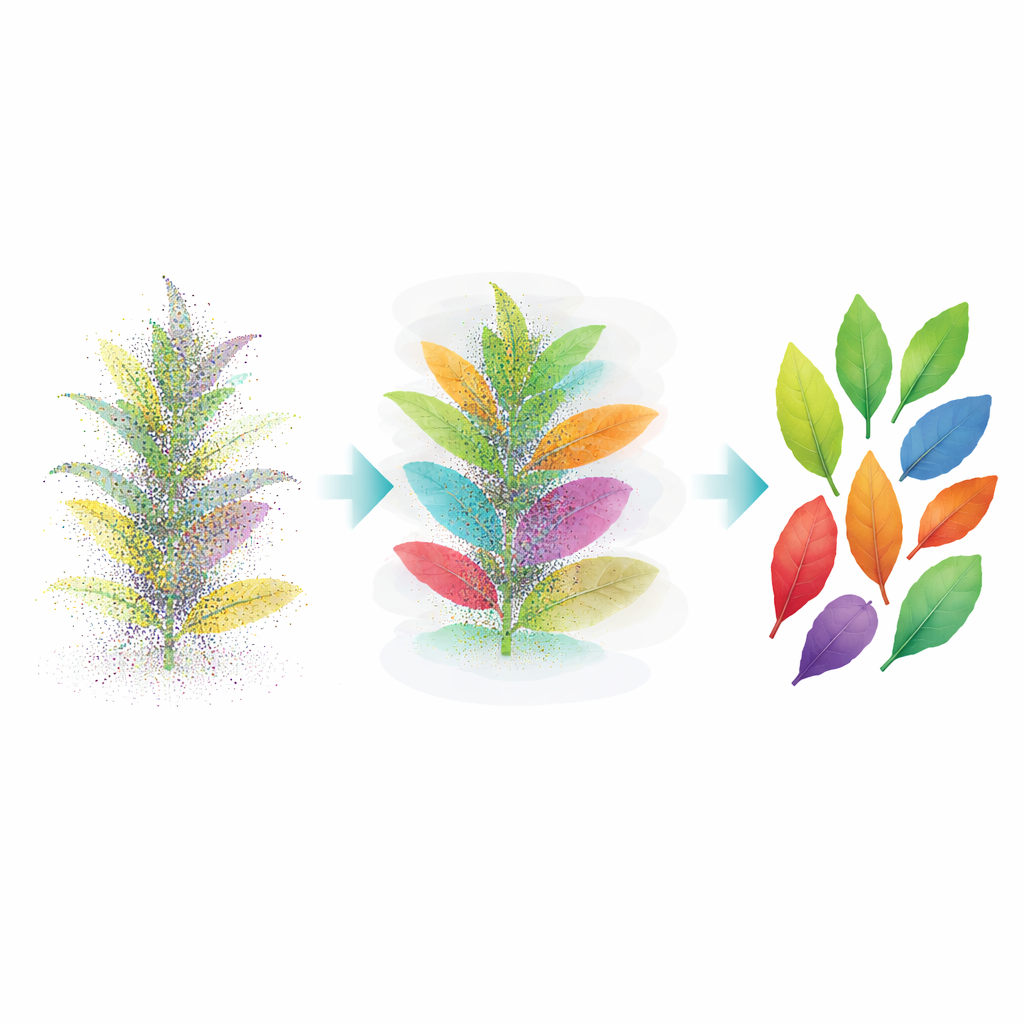
How Well the Method Performed
To test accuracy, the team compared automated counts against painstaking manual tallies for 230 field plants. Their pipeline—drone imaging, 3D reconstruction, SRW-PointNext segmentation, then MeanShift clustering—reached a leaf-count accuracy of about 92.6 percent. The improved network also achieved high-quality segmentation: roughly 92 percent precision and a mean intersection-over-union of 76 percent, outperforming several popular 3D point-cloud methods such as PointNet, PointNet++, RandLA-Net, and the original PointNext. Importantly, this gain in accuracy came with only a modest increase in computational cost, suggesting that the approach is practical for large-scale surveys.
What This Means for Future Farming
To a non-specialist, the core message is straightforward: by combining drones, 3D modeling, and an upgraded AI model, the researchers can now count tobacco leaves in real fields almost as reliably as people, but far faster and over much larger areas. This moves leaf counting from clipboards and boots on the ground to an automated, data-rich process that can feed into digital crop management systems. While the current work focuses on tobacco during one growth stage and depends on good 3D reconstructions, the same strategy could be extended to other crops and seasons. In time, such tools may become routine aids for farmers, helping them monitor plant growth, fine-tune inputs, and select better-performing varieties with far less manual effort.
Citation: Nan, D., Li, J., Liang, H. et al. A novel leaf counting method for field tobacco plants based on UAV imagery and an improved PointNext. Sci Rep 16, 11052 (2026). https://doi.org/10.1038/s41598-026-41365-x
Keywords: tobacco phenotyping, drone agriculture, 3D point clouds, leaf counting, deep learning in farming