Clear Sky Science · en
A visual imagery paradigm for BCI strategies using imagined flickering patterns
Imagining Light to Talk to Machines
For people who cannot move or speak, brain–computer interfaces (BCIs) offer a way to communicate using only brain activity. Many of today’s systems rely on staring at flickering lights on a screen, which is impossible or uncomfortable for some patients. This study explores a different idea: instead of looking at flashing patterns, what if users simply imagine them and still manage to control a computer?
From Flashing Lights to Mental Pictures
Traditional BCIs often use steady flickering images to provoke a repeatable response in the visual parts of the brain. When a person stares at a light that blinks at a fixed rate, the brain’s electrical activity subtly echoes that rhythm, and sensors on the scalp can pick it up. However, this method assumes that the user can keep their eyes fixed on the screen. People with severe paralysis or eye-movement problems, such as those with locked-in syndrome after a stroke or due to a neurodegenerative disease, may not manage this, limiting who can benefit from the technology.
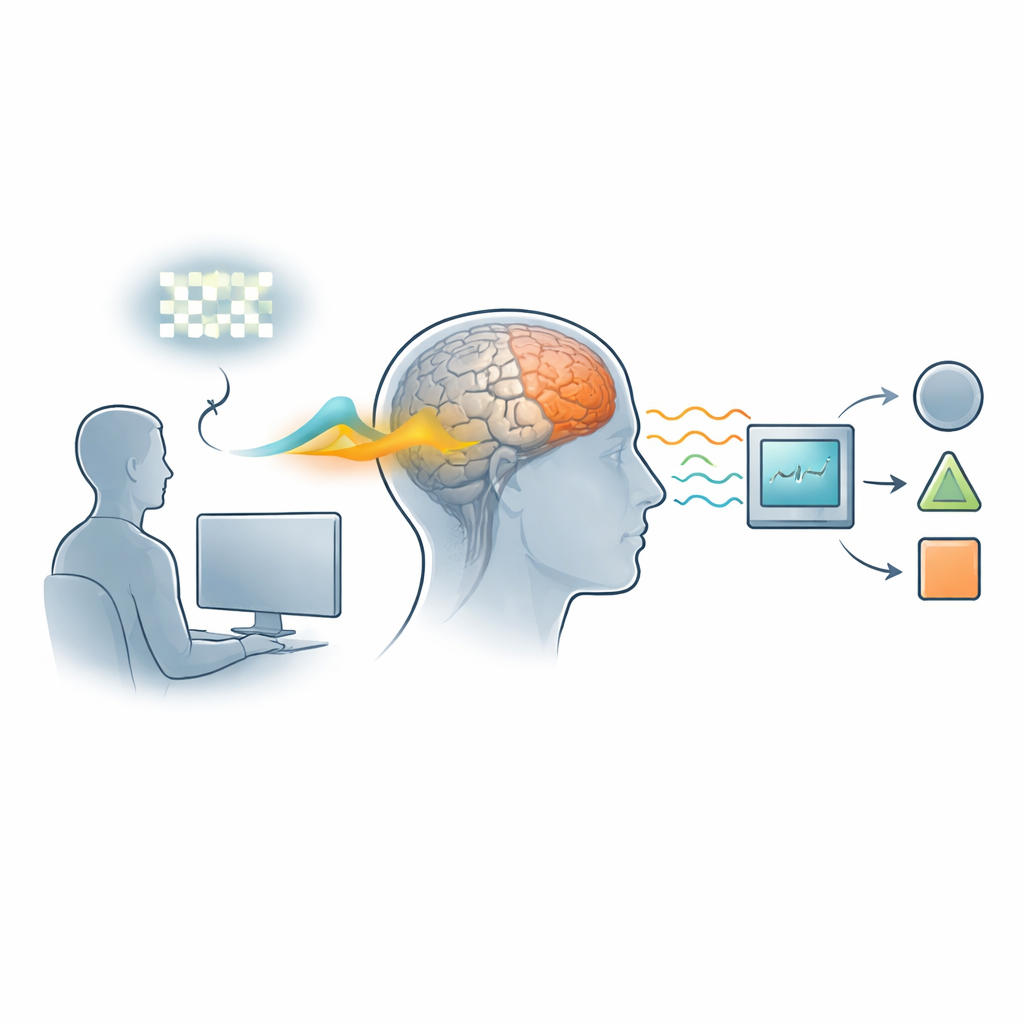
Turning Mental Flickers into Control Signals
The authors built a BCI that replaces external flickers with mental ones. First, 20 healthy volunteers watched checkerboard patterns on a computer screen that blinked at different speeds. This initial phase identified which two blinking speeds each person’s brain responded to most clearly. Next, the volunteers practiced a mixed routine where they sometimes saw the flickers and sometimes had to imagine them. Finally, in the main tests, the screen went dark: only arrows or simple shapes on the screen told participants which of two flicker speeds to picture in their mind, or when to rest. Throughout, an array of 10 electrodes on the scalp recorded brain activity, which was then converted into a summary of how much power different rhythmic components contained.
Teaching a Machine to Read Imagined Patterns
To turn these subtle rhythms into commands, the researchers used a standard pattern-recognition method that draws a boundary between different types of signals. For each volunteer, the computer program was trained to distinguish three mental states: imagining a slow flicker, imagining a faster flicker, or resting. In an “offline” phase, the computer analyzed previously recorded data and tested how well it could guess the correct state. Later, in an “online” phase, the system had to classify the brain activity in real time while the person was performing the mental tasks live, more closely mimicking a practical BCI.
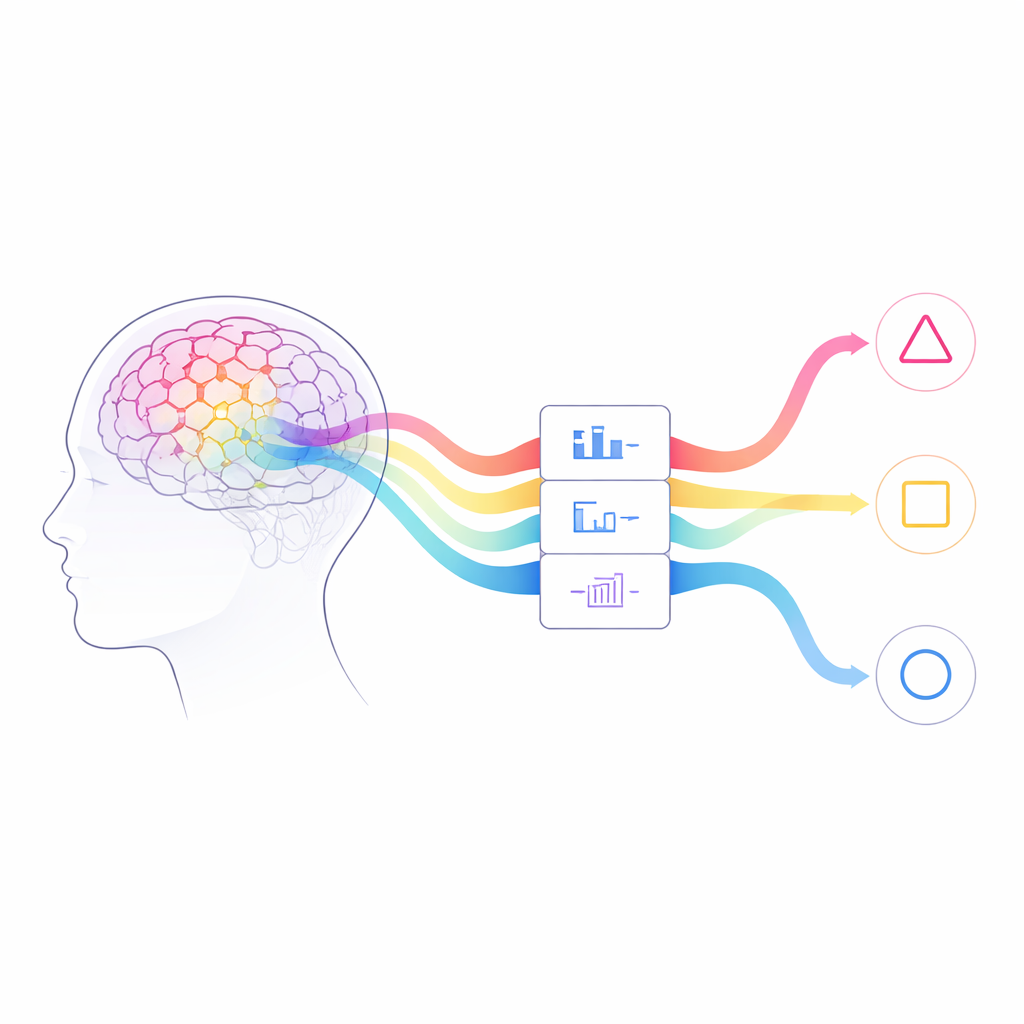
How Well the Imagery-Based System Worked
When the data were examined offline, the system correctly identified the user’s mental state about 61 percent of the time on average across the 20 subjects. For a three-choice problem, random guessing would hover around one-third accuracy, so this performance is well above chance. In the live online test, accuracy dropped to about 51 percent on average, but still remained clearly better than random performance for the group as a whole. Some people did quite well, while a few hovered closer to chance, reflecting natural differences in how easily individuals can sustain vivid visual images and steady attention. The choice of flicker speeds also mattered, but attempts to automatically pick each person’s “best” pair of frequencies produced mixed benefits, suggesting that this step still needs refinement.
What This Could Mean for Future Users
The study shows that simply imagining flickering patterns can provide a usable control signal for brain–computer interfaces, without requiring users to stare at bright, flashing images. Although the system currently offers only three choices and works with moderate accuracy, it requires little training and uses standard, affordable equipment. With further development—such as improving how the best frequencies are chosen and adding more mental commands—this kind of imagery-based BCI could become a practical option for people who cannot move their eyes well or tolerate visual stimulation, opening another path to communication and control using only the mind’s eye.
Citation: Priori, S., Ricci, P., Consoli, D. et al. A visual imagery paradigm for BCI strategies using imagined flickering patterns. Sci Rep 16, 11967 (2026). https://doi.org/10.1038/s41598-026-41324-6
Keywords: brain-computer interface, visual imagery, EEG, neurorehabilitation, assistive communication