Clear Sky Science · en
Gain-enhanced petal-shaped MIMO antenna system with FSS loading for sub-6 GHz V2X communications
Smarter car connections made simple
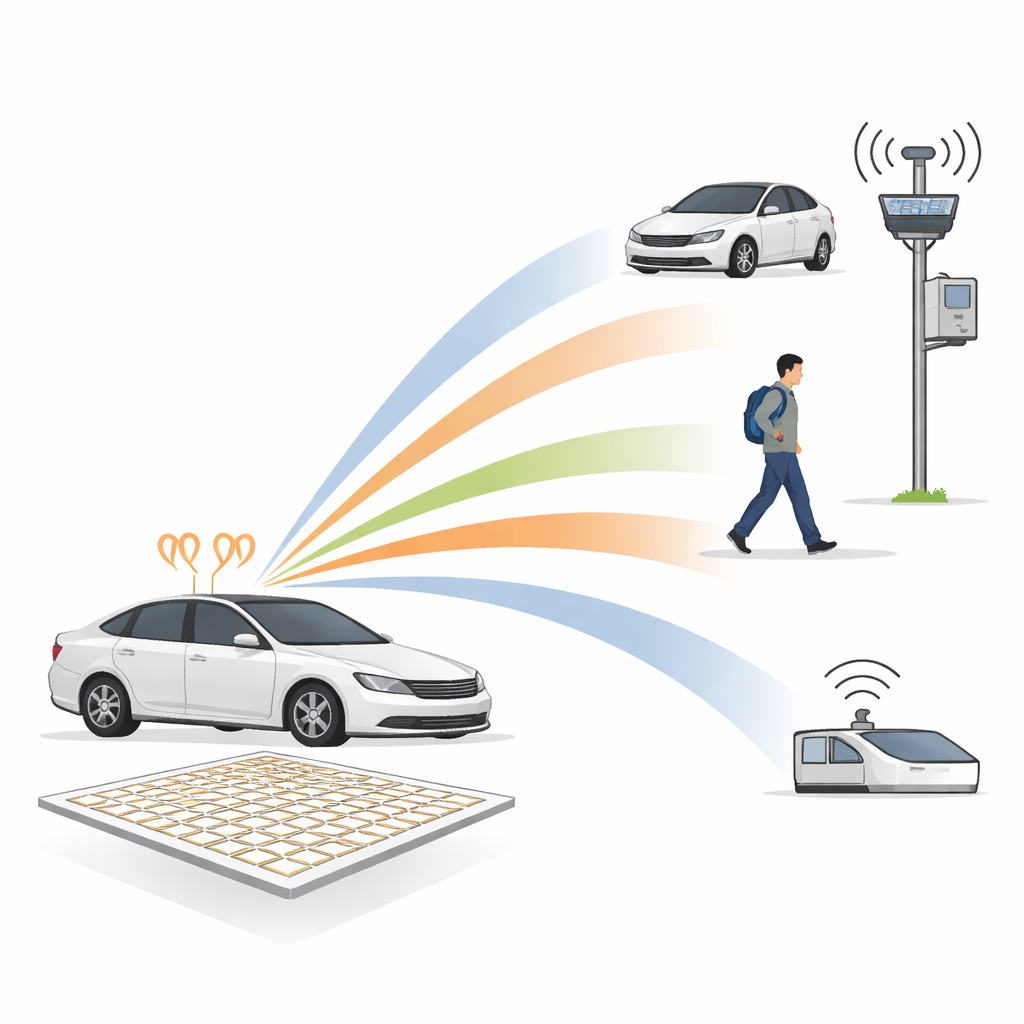
Modern cars are quickly turning into rolling computers that constantly talk to other vehicles, traffic lights, road signs, and even pedestrians’ phones. To make this vehicle‑to‑everything communication fast and reliable, each car needs compact, efficient antennas that fit into tight spaces without ruining the look of the vehicle. This paper presents a new rooftop antenna system that boosts signal strength and reliability in the key 5.9 GHz safety band, while staying small, inexpensive, and practical for real cars.
A small rooftop helper for safer roads
The heart of the work is a tiny dual‑antenna module, only about the size of a postage stamp, that can be mounted on a car roof. Instead of the usual rectangular metal plates, each antenna element has a rounded, petal‑like shape etched onto a standard circuit board material. This shape is carefully tuned so that the pair of antennas covers a wide slice of radio spectrum around 5.9 GHz, the band used worldwide for car safety messages. Because two antennas are used together, the system can send and receive multiple data streams at once, improving both data rate and reliability in busy traffic.
Keeping antennas from fighting each other
When two antennas sit very close together, they tend to interfere, like two loudspeakers placed side‑by‑side playing different songs. That interference can spoil the benefits of using multiple antennas. To avoid this, the researchers redesigned the metal layer hidden under the antenna, known as the ground plane. Instead of a solid sheet, they cut a series of angled slots and an arrow‑shaped pattern into it. These carefully arranged gaps disrupt unwanted currents that would otherwise leak from one antenna into the other. Measurements show that the antennas remain largely independent, even though they share the same small board, which is essential for stable links in crowded urban streets.
A clever mirror that boosts the signal
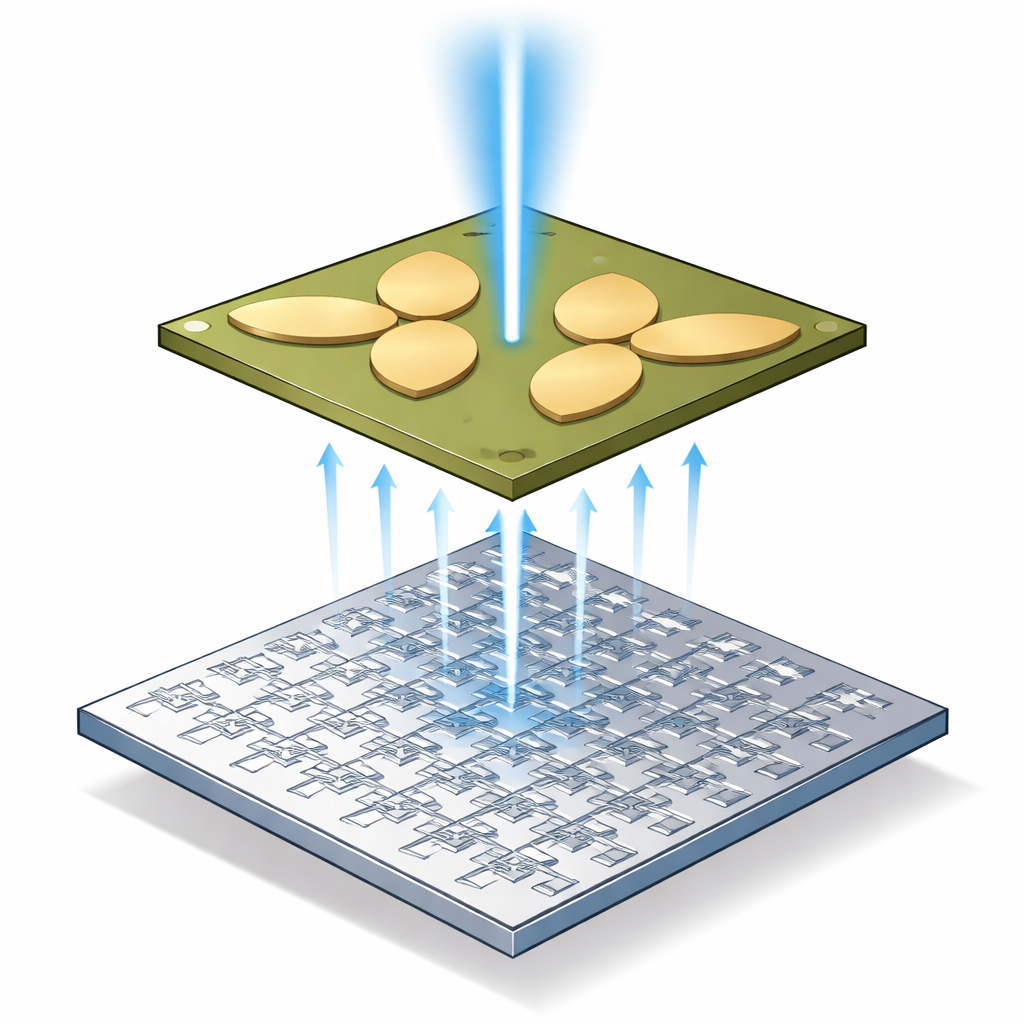
Strong signals are just as important as clean ones. To increase the effective strength of the antenna without adding bulky hardware, the team placed a special reflective panel under the rooftop module. This panel, called a frequency‑selective surface, is a flat grid of repeating metal patterns printed on a board. It acts like a tuned mirror for radio waves: signals in the 4–7 GHz range are mostly reflected upward instead of leaking downward into the car body. When the rooftop antennas transmit, their downward radiation bounces off this panel and adds to the main upward beam, much like a stage spotlight reflector. Tests show that this raises the peak gain from a modest level of around 2–3 dB to about 7.6 dB, a substantial boost that helps messages travel farther and remain clearer.
Built for real‑world driving conditions
Beyond simple signal strength, the team evaluated how well the antenna pair would perform in the messy, echo‑filled environment of real roads, where signals bounce off buildings, trucks, and guardrails. They computed standard multi‑antenna quality measures that capture how independent the two antennas really are, how much extra reliability they add, and how much data they can support without bogging down. Across the target band, these indicators stayed within or better than accepted limits for advanced automotive systems, meaning the design should handle dense traffic and complex reflections without collapsing into dropped packets or stalled links. Simulations with the antenna mounted on a car model further confirmed that it keeps an almost all‑around coverage pattern suitable for talking to other cars, roadside units, and nearby pedestrians.
What this means for future connected cars
In simple terms, this work shows how careful shaping of tiny metal patterns can turn a small, low‑cost circuit board into a high‑performance communication hub for vehicles. By combining a compact dual‑antenna module, an isolation‑friendly ground pattern, and a tuned reflective panel, the authors achieve stronger, cleaner signals in the standard V2X band without resorting to bulky hardware or exotic materials. As car makers add more sensors and radios to their vehicles, such space‑saving antenna designs could help ensure that safety messages get through quickly and reliably, paving the way for smoother traffic flow and safer, more connected roads.
Citation: Perli, B.R., Sathish, K., Bansal, A. et al. Gain-enhanced petal-shaped MIMO antenna system with FSS loading for sub-6 GHz V2X communications. Sci Rep 16, 11854 (2026). https://doi.org/10.1038/s41598-026-41292-x
Keywords: V2X antenna, connected vehicles, 5G sub-6 GHz, MIMO communications, frequency selective surface