Clear Sky Science · en
CFD-based numerical investigation of convective heat transfer in multi-channel micro-exchangers using MWCNT–water nanofluid
Why cooler chips matter
From smartphones to data centers, modern electronics are crammed with tiny components that run hot. If this heat is not removed quickly and evenly, processors slow down, age faster, or fail altogether. This paper explores how to make very compact "mini radiators"—called microchannel heat exchangers—pull heat away from chips far more efficiently by smartly reshaping the tiny channels inside them and by using a special coolant made from water and carbon nanotubes.

Tiny channels as smart heat highways
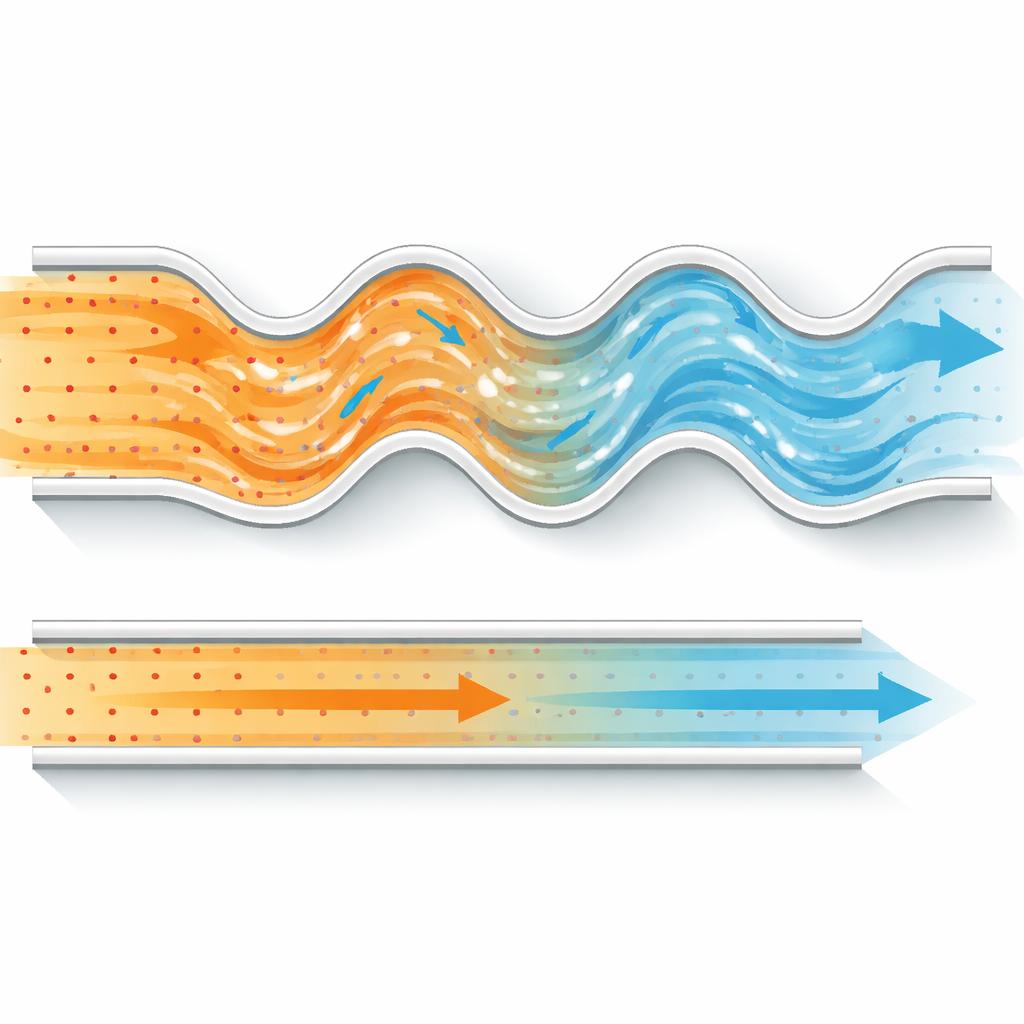
The study looks at a palm-sized aluminum block etched with many hair‑thin channels through which liquid coolant flows. These microchannels act like a dense network of highways that carry heat away from an electronic chip pressed against the top surface. Instead of assuming that all channels are simple rectangles, the authors compare five shapes—circular, square, sawtooth, cross‑shaped, and a wavy "curved sawtooth"—and three counts of channels (5, 8, and 11). By changing only the outline of each channel while keeping its cross‑sectional area the same, they test how added surface area and flow disturbance can improve cooling without making the device bigger.
A new twist: nano‑enhanced coolant
Beyond reshaping the channels, the work also upgrades the coolant. Ordinary water is used as a baseline, then tiny amounts of multi‑walled carbon nanotubes are mixed into the water to create a "nanofluid" at very low concentrations (0.1 and 0.2 percent by volume). These nanotubes are extremely good at conducting heat and, when well dispersed, help shuttle thermal energy more effectively through the liquid. Using computer simulations based on fluid‑flow and heat‑transfer equations, the authors calculate how these nanofluids change key performance measures such as how much heat is carried away, how cool the solid block stays, and how evenly the temperature is spread.
What the simulations reveal
The numerical experiments show that channel shape is the single most powerful design lever. Complex shapes with larger inner perimeter—particularly the curved sawtooth layout—provide more wetted surface and stir the liquid near the walls, thinning the insulating layer that normally forms there. As a result, these channels pull down the hottest wall temperatures and raise both the local and overall heat transfer performance compared with plain circles or squares. Increasing the number of channels from 5 to 8 generally improves cooling by adding surface area and distributing the flow better, but going from 8 to 11 brings only modest gains and risks lower flow speed in each channel, which weakens convection.
Boost from carbon nanotube nanofluids
When the researchers switch from pure water to water loaded with carbon nanotubes, the cooling performance climbs sharply even though the nanoparticle content is tiny. In the best cases, the convective heat transfer coefficient—an indicator of how effectively heat crosses from solid walls into the liquid—more than quadruples compared with the baseline water‑filled square channels. The 0.2 percent nanofluid works better than 0.1 percent, reducing peak wall temperatures by several degrees and raising both system‑level and local heat transfer measures. However, the study also notes that simply packing in more channels does not always help; as channels multiply, the flow rate per channel drops and the slightly thicker, more viscous nanofluid can face more resistance, softening the gains.
Finding the design knobs that matter most
To quantify which choices matter most for real‑world design, the authors apply a statistical method called ANOVA to the simulation results. This analysis shows that channel geometry explains roughly 70 percent of the improvement in how effectively heat is removed, while the number of channels provides a substantial but smaller share, and the interaction between these two factors is minor. In short, carefully sculpting the channel cross‑section gives designers far more leverage than simply adding more channels or modestly adjusting coolant properties.
What it means for future devices
Put in everyday terms, the paper shows that you can keep powerful chips cooler and more uniform in temperature by carving smarter paths for coolant and slightly enhancing that coolant with heat‑loving nanoparticles. A wavy, curved‑tooth channel pattern combined with a low‑dose carbon‑nanotube water mixture delivers much stronger heat removal than a simple square channel with plain water, without requiring a bigger heat sink. This points the way toward slimmer, more reliable cooling modules for electronics, electric vehicles, and other compact systems where every degree and every millimeter counts.
Citation: Anjaneya, G., Sunil, S., Hanamantraygouda, M.B. et al. CFD-based numerical investigation of convective heat transfer in multi-channel micro-exchangers using MWCNT–water nanofluid. Sci Rep 16, 11055 (2026). https://doi.org/10.1038/s41598-026-41225-8
Keywords: microchannel cooling, nanofluid coolant, electronics thermal management, carbon nanotubes, heat exchanger design