Clear Sky Science · en
Square-slotted THz metamaterial-inspired MIMO antenna design optimized with machine learning for TWPAN networks and next-generation communication systems
Faster Links for Everyday Devices
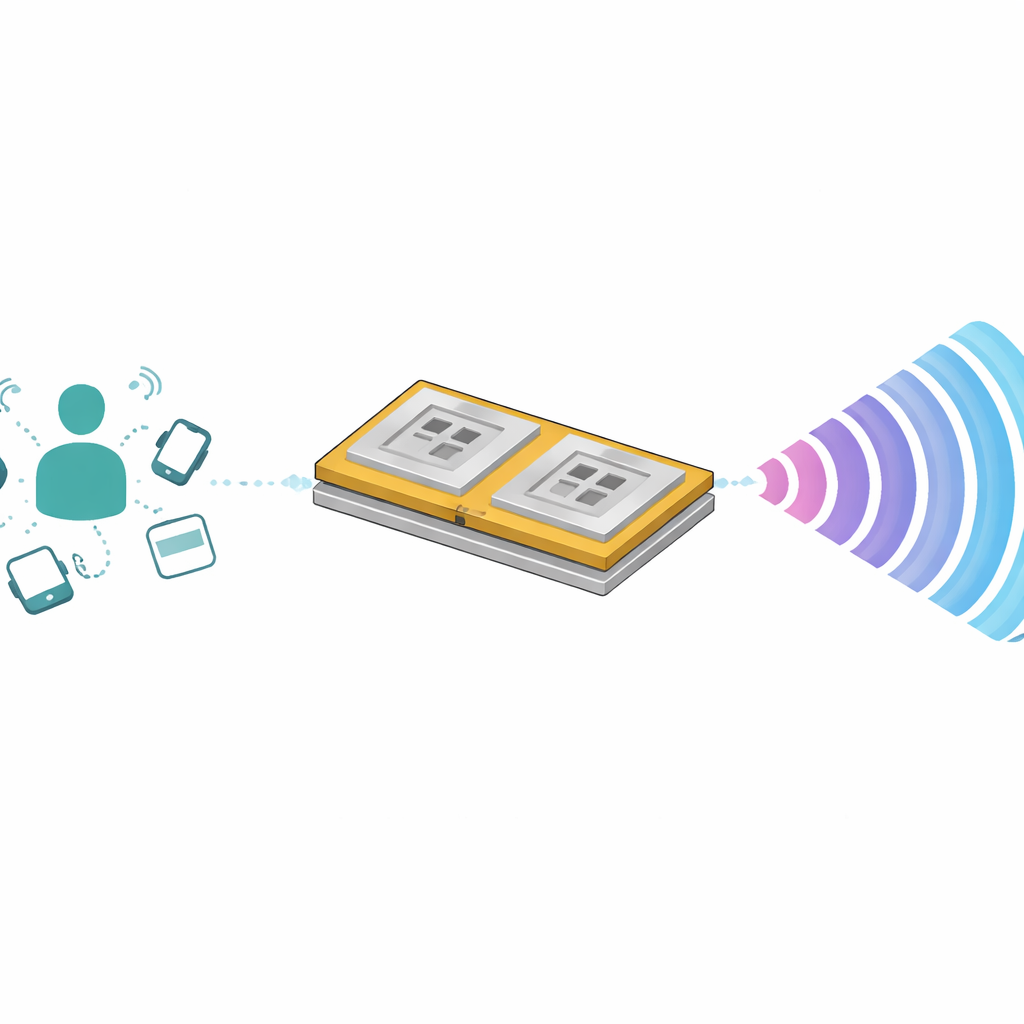
Streaming ultra‑high‑definition video to your glasses, syncing data instantly among wearables, or linking dozens of gadgets on your desk without cables all rely on tiny antennas hidden inside electronics. This paper explores a new kind of miniaturized antenna designed to work at terahertz frequencies—far above today’s Wi‑Fi and 5G—aimed at powering next‑generation short‑range wireless networks with enormous data rates, low delay, and compact hardware.
Why We Need New Tiny Antennas
As wireless technology pushes toward ever higher speeds, moving into the terahertz band opens vast new “real estate” in the radio spectrum. But ordinary antenna designs struggle there: they must be extremely small, yet still deliver strong, well‑focused signals over a broad range of frequencies. The authors target future Terahertz Wireless Personal Area Networks, where phones, sensors, headsets, and other nearby devices talk to each other at close range. To make such networks practical, the antennas must pack high performance into microscopic footprints, avoid interfering with each other when several are used together, and remain efficient across tens of terahertz of bandwidth.
Shaping Metal to Tame Terahertz Waves
The team proposes a "metamaterial‑inspired" antenna: instead of a simple metal patch, the radiating surface is carved with four square slots, forming a pattern that guides electromagnetic waves in unusual ways. Two of these patterned patches are placed side by side on a thin flexible plastic layer (polyimide), above a partially cut‑out metal ground plane. This arrangement fits into an area only about 110 by 55 micrometers—far smaller than a grain of sand—yet it behaves like a carefully engineered medium that can confine and launch terahertz waves efficiently. The four slots create multiple current paths, allowing several resonant modes to overlap and produce an ultra‑wide operating band while keeping the radiation mainly pointed away from the device.
Two Antennas Working Together, Not Against Each Other
Modern devices often use multiple antennas side by side, a strategy known as MIMO, to boost reliability and data throughput. When these antennas sit very close, they can "talk" to each other unintentionally, degrading performance. The proposed design is optimized to minimize this unwanted coupling. Simulations show that the two elements remain strongly isolated over a huge frequency span from about 10 to 70 terahertz. In engineering terms, the signal that leaks from one port into the other is tens of thousands of times weaker than the intended signal. At the same time, the structure maintains a peak gain of around 7.6 dBi, meaning it concentrates energy in useful directions rather than spraying it equally everywhere.
Letting Machine Learning Fine‑Tune the Details
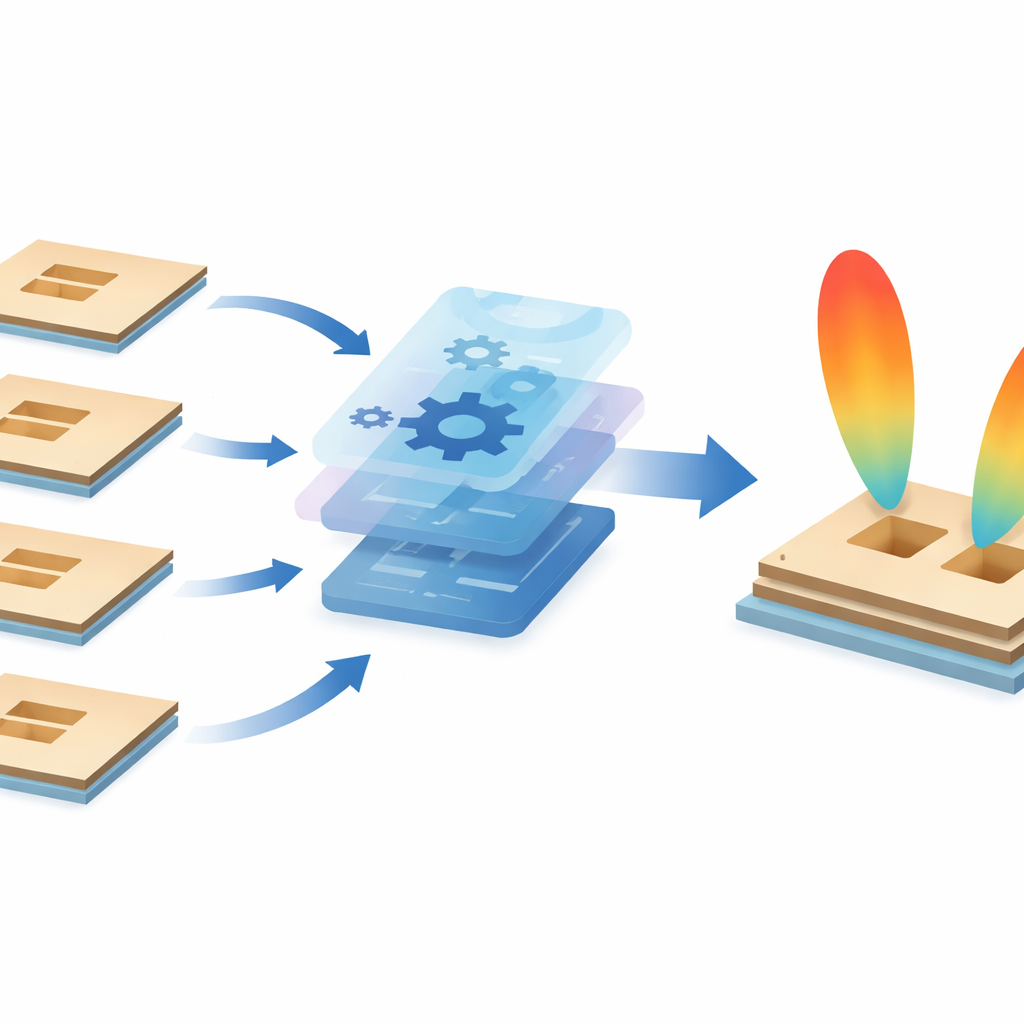
Because the antenna is so small, tiny shifts in dimensions—such as patch length, overall width, substrate thickness, or ground‑plane width—can move the operating band or weaken isolation. Exploring all possible combinations by trial and error would be painfully slow. The authors instead train a simple machine‑learning model (linear regression) on simulation data. This model learns how geometric tweaks affect key figures of merit such as signal reflection, gain, and mutual coupling. It then points designers toward promising regions of the design space where performance is high and more tolerant to manufacturing variations. For several key parameters, the model’s predictions track the simulated results closely, allowing efficient optimization without exhaustive computation.
What the Results Promise for Future Devices
Once optimized, the square‑slotted antenna pair offers an ultra‑broad bandwidth of roughly 54 terahertz, strong gain, and excellent metrics for multi‑antenna operation, including very low channel correlation and minimal loss of data capacity. Although the work is presently based on simulations rather than fabricated hardware, it shows that combining metamaterial‑like patterns with data‑driven tuning can unlock powerful new designs at terahertz frequencies. For non‑specialists, the takeaway is that antennas small enough to fit comfortably inside future wearables and tiny sensors could still deliver fiber‑like data speeds over short distances, forming the backbone of high‑speed personal networks in homes, offices, and smart devices.
Citation: Alsharari, M., Sharma, Y., Armghan, A. et al. Square-slotted THz metamaterial-inspired MIMO antenna design optimized with machine learning for TWPAN networks and next-generation communication systems. Sci Rep 16, 11921 (2026). https://doi.org/10.1038/s41598-026-41207-w
Keywords: terahertz wireless, metamaterial antenna, MIMO, machine learning design, personal area networks