Clear Sky Science · en
Neural investigation of default effects on decision-making under uncertainty
Why our gut reactions to “default” choices matter
From pension sign-ups to online privacy settings, many of the choices that shape our lives come pre-ticked. We can stick with the suggested option or actively switch. This study asks what happens in the brain when we face such default choices under uncertainty—when one option is safe but modest, and the other is a gamble with unclear chances. Understanding these hidden influences helps explain why people so often go along with defaults, and how policymakers might design them more responsibly.
Everyday gambles between safe and unsure options
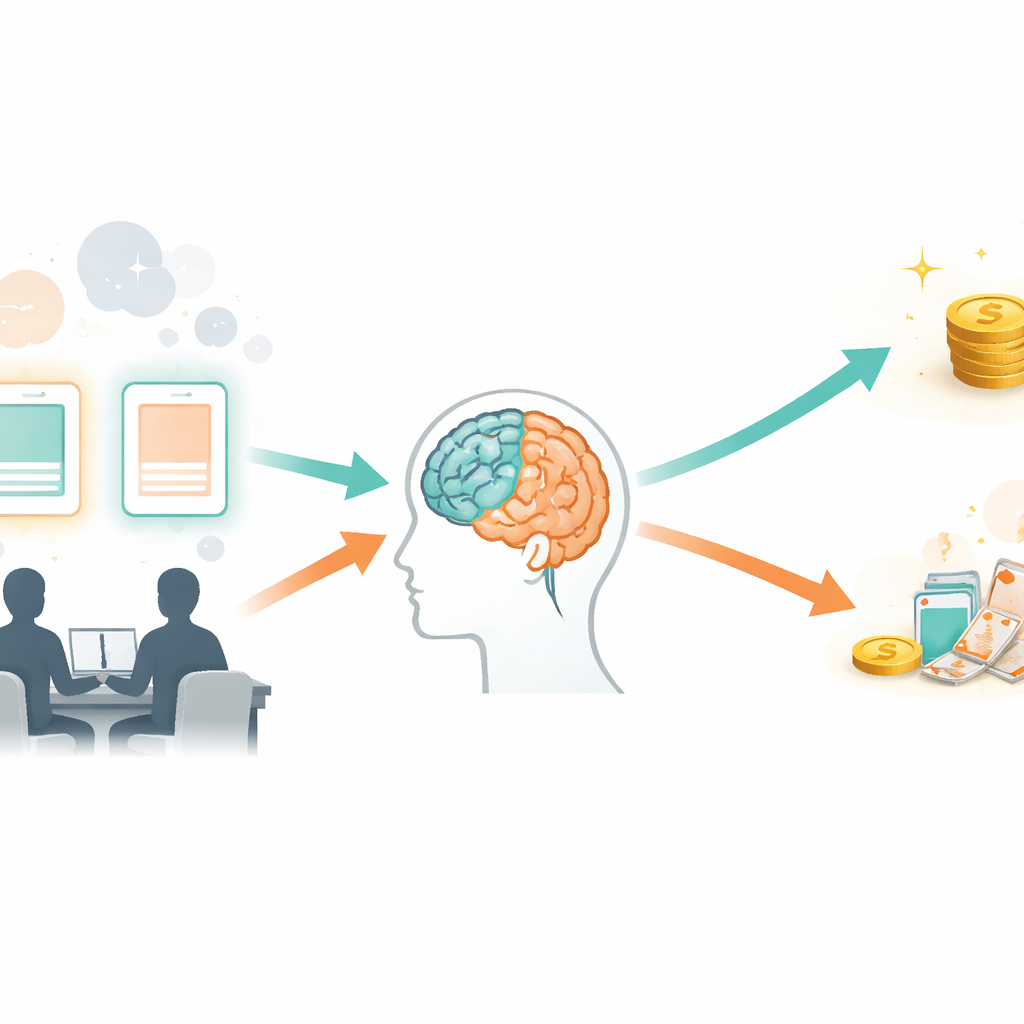
The researchers invited young adults into the lab to play a simple money game. In each round, participants chose between a guaranteed cash amount and a card-based gamble that could pay more—or nothing. Sometimes the odds of winning the gamble were known (risk), and sometimes they were unknown (ambiguity). On each trial, either the safe payoff or the gamble was pre-marked as the default, meaning it would be chosen automatically if the participant failed to respond in time. Although everyone did respond on time, this subtle framing still shaped their decisions: people picked the option more often when it was set as the default, and they were more willing to gamble when the risky option—with known odds—was the default than when probabilities were ambiguous.
Looking inside the brain during split-second weighing of options
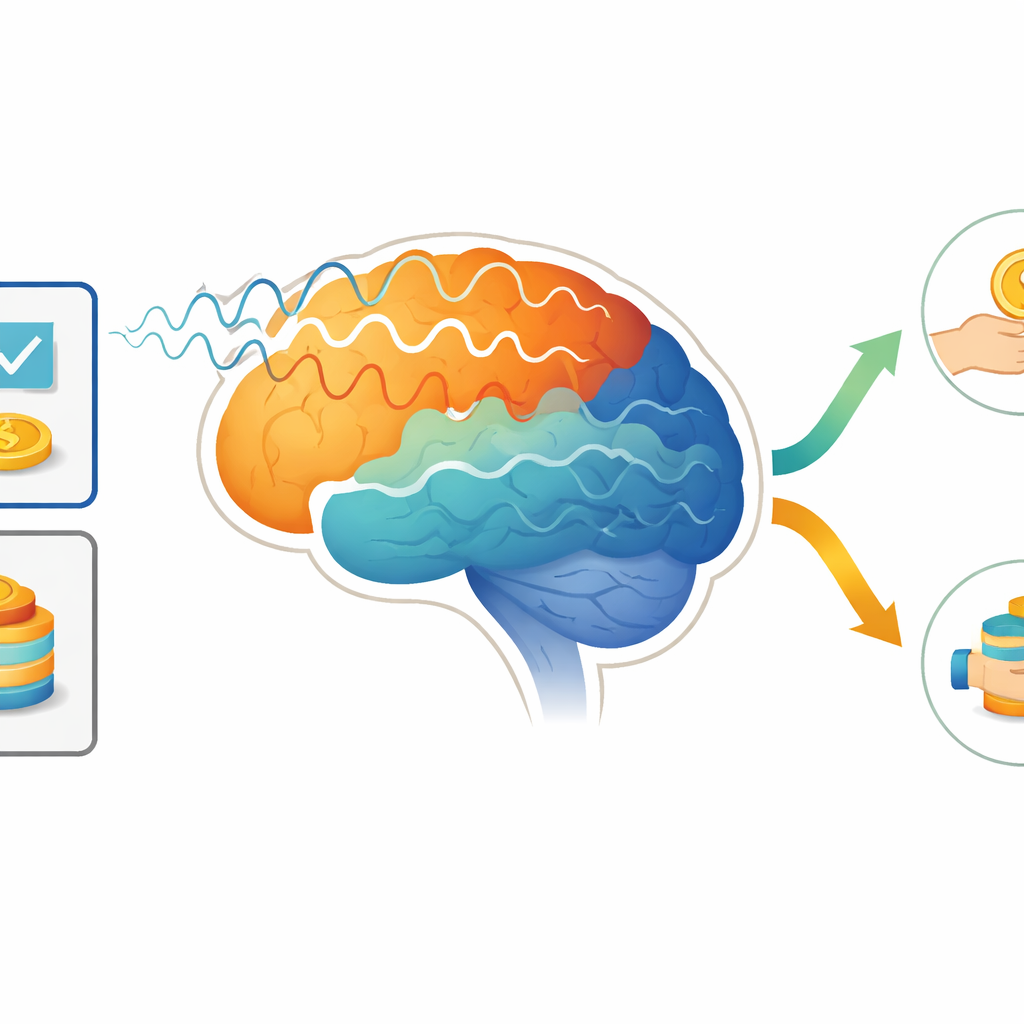
While participants made these choices, the team recorded their brain activity using electroencephalography (EEG), which tracks tiny voltage changes on the scalp at millisecond speed. This allowed the authors to examine fast “bumps” in the signal that arise at different stages of evaluation, from quick initial reactions to more sustained emotional weighing. They focused on several well-studied responses that unfold within the first second after the options appeared, as well as rhythmic brain waves in the slower theta range, which have been linked to conflict and control. By comparing these signals across conditions, the researchers could see when and how default status and uncertainty left their fingerprints on the brain.
How defaults and uncertainty leave distinct brain traces
The brain reacted differently depending on both what the default was and whether the gamble involved known or unknown odds. Early responses over frontal regions, only a few hundredths of a second after the options appeared, were especially sensitive to default status. When the safe payoff served as the default, it triggered stronger early signals and greater theta-band activity than when the gamble was the default. This suggests that a safe default grabs attention and engages control systems, potentially making it harder to abandon. In contrast, the distinction between risk and ambiguity showed up not just in these early signals but also in later, more sustained responses over parietal regions. Known-risk options tended to elicit larger signals than ambiguous ones, paralleling people’s behavioral tendency to shy away from ambiguity.
Linking brain patterns to real choices
The authors then asked whether these neural signatures actually related to how individuals behaved. Using statistical models, they found that one later brain response, a broad positive wave called the late positive potential, was a reliable predictor of people’s willingness to choose uncertain options. Participants who showed stronger sustained activity in this time window were more likely to take the gamble rather than stick with the sure payoff. A complementary pattern analysis, which compared the overall similarity of brain activity and choice patterns across conditions, showed that neural activity in the frontal region about 270–300 milliseconds after option onset closely tracked the pattern of subsequent choices. Together, these findings suggest that both rapid initial evaluations and later motivational processing help tilt decisions toward or away from uncertainty.
What this means for nudging and policy design
For a lay reader, the main message is that default settings and our dislike of unknown odds shape decisions through partly separate neural routes. Safe defaults quickly anchor our attention and engage control systems, making them feel like the natural option. At the same time, options with unknown chances provoke different emotional and cognitive responses than those with clearly stated odds, feeding into later, more sustained brain activity that predicts whether we will dare to choose the uncertain path. These insights suggest that how choices are pre-set and how clearly risks are presented can influence behavior long before we are consciously aware, underscoring the responsibility that institutions carry when they design default options for important life decisions.
Citation: Yu, J., Liu, X., Yu, J. et al. Neural investigation of default effects on decision-making under uncertainty. Sci Rep 16, 10233 (2026). https://doi.org/10.1038/s41598-026-41206-x
Keywords: default options, decision-making under uncertainty, risk and ambiguity, brain activity, behavioral nudges