Clear Sky Science · en
Enhanced crystallinity, hardness and thermal stability of PEEK/TC4 composites for biomedical applications
Stronger Materials for Safer Implants
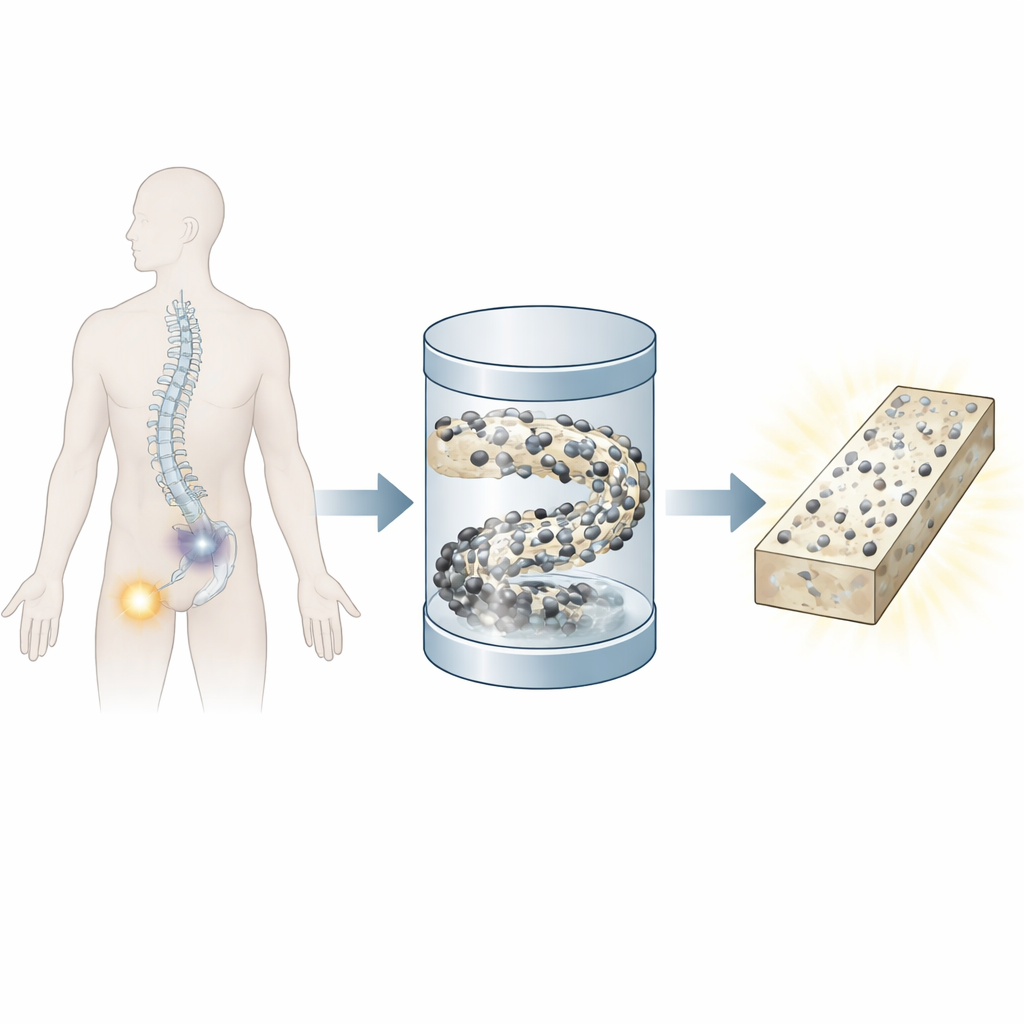
Modern hip joints, spinal cages, and dental implants must endure years of chewing, walking, and twisting inside a warm, salty, ever‑moving body. This study explores a way to toughen a promising plastic called PEEK, already used in many implants, by blending it with tiny particles of a well‑known titanium alloy. The goal is simple but vital: create a material that is strong, hard, and heat‑resistant enough for demanding medical devices, while remaining friendly to the human body.
Why Combine Plastic and Metal?
Today’s implants often rely on solid metals like titanium alloys, which are very strong but much stiffer than bone. That stiffness difference can cause the bone around an implant to weaken over time. PEEK, by contrast, has a stiffness closer to real bone and does not interfere with X‑ray and CT scans. However, pure PEEK is relatively soft, wears down under repeated loading, and its surface does not naturally invite bone cells to attach. Blending PEEK with bio‑friendly metal particles offers a promising middle ground: keep the bone‑like flexibility of the plastic, while borrowing the strength and durability of the metal.
How the New Material Is Made
The authors fabricated their hybrid material by mixing fine powders of PEEK and a medical‑grade titanium alloy called Ti‑6Al‑4V (often shortened to TC4). Instead of simply melting everything together, which can cause metal clumps, they used centrifugal powder compaction: the powder mixture sits in a mold spun at very high g‑forces, pushing particles into a dense, uniform arrangement before heating. The compacted material is then vacuum‑sintered—heated just enough for the PEEK to melt and flow around the metal particles without burning, then slowly cooled to avoid internal stresses.
What the Microscopes and Heat Tests Revealed
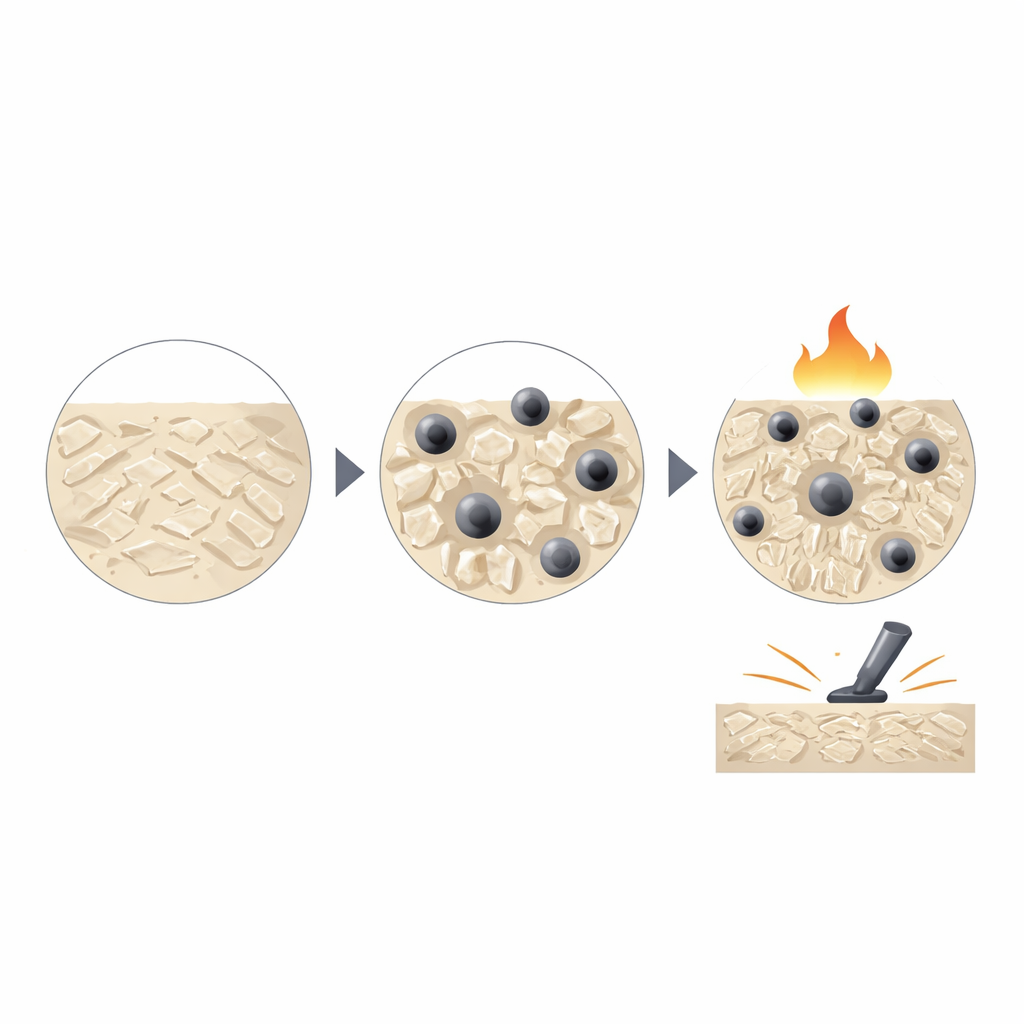
Under the electron microscope, the researchers saw that the titanium alloy spheres were spread relatively evenly throughout the PEEK, even at high metal contents. This uniform layout, with visible zones where the plastic grips the particle surfaces, is important because it allows mechanical loads to transfer smoothly from soft matrix to hard filler. Thermal tests showed that these composites begin to break down at similar temperatures as pure PEEK, but lose far less weight as heating continues: at 800 °C the version with 40% metal still kept about three‑quarters of its mass, compared with just over half for pure PEEK. In everyday terms, the metal particles act like heat‑proof skeletons that help the plastic resist extreme temperatures.
From Inner Order to Outer Toughness
Differential scanning calorimetry and X‑ray diffraction—tools that probe how ordered a solid’s internal structure is—revealed that PEEK becomes more crystalline when TC4 is added. The metal particles behave as tiny seeds that encourage the plastic chains to line up and pack more tightly as they cool. This added internal order boosts the fraction of crystalline regions from about 41% in pure PEEK to 48% in the composite with the most metal. When the team pressed an indenter into the polished surfaces to measure hardness, they found that this most heavily reinforced material was about 35% harder than pure PEEK, a level approaching that of human cortical bone. The close match between experiments and a standard composite model suggests that both the hard particles and the more ordered plastic network work together to resist deformation.
What This Could Mean for Future Implants
By carefully dispersing titanium alloy particles inside PEEK using a powder‑based, centrifugal process, the researchers created a material that holds its shape at high temperatures, has a more ordered internal structure, and better resists indentation. For non‑specialists, the takeaway is that this composite plastic–metal blend behaves more like a tough, heat‑stable bone substitute than PEEK alone. While further work is needed to confirm long‑term safety, wear behavior, and how bone cells respond directly to this specific composite, the results point toward a new class of implant materials that combine the comfort and imaging advantages of advanced plastics with the ruggedness of titanium.
Citation: Sariyev, B., Rao, H., Ozhiken, A. et al. Enhanced crystallinity, hardness and thermal stability of PEEK/TC4 composites for biomedical applications. Sci Rep 16, 11127 (2026). https://doi.org/10.1038/s41598-026-41202-1
Keywords: PEEK implants, titanium composites, biomedical materials, orthopedic implants, thermal stability