Clear Sky Science · en
A wideband slot antenna for RF energy harvesting
Power from the Air
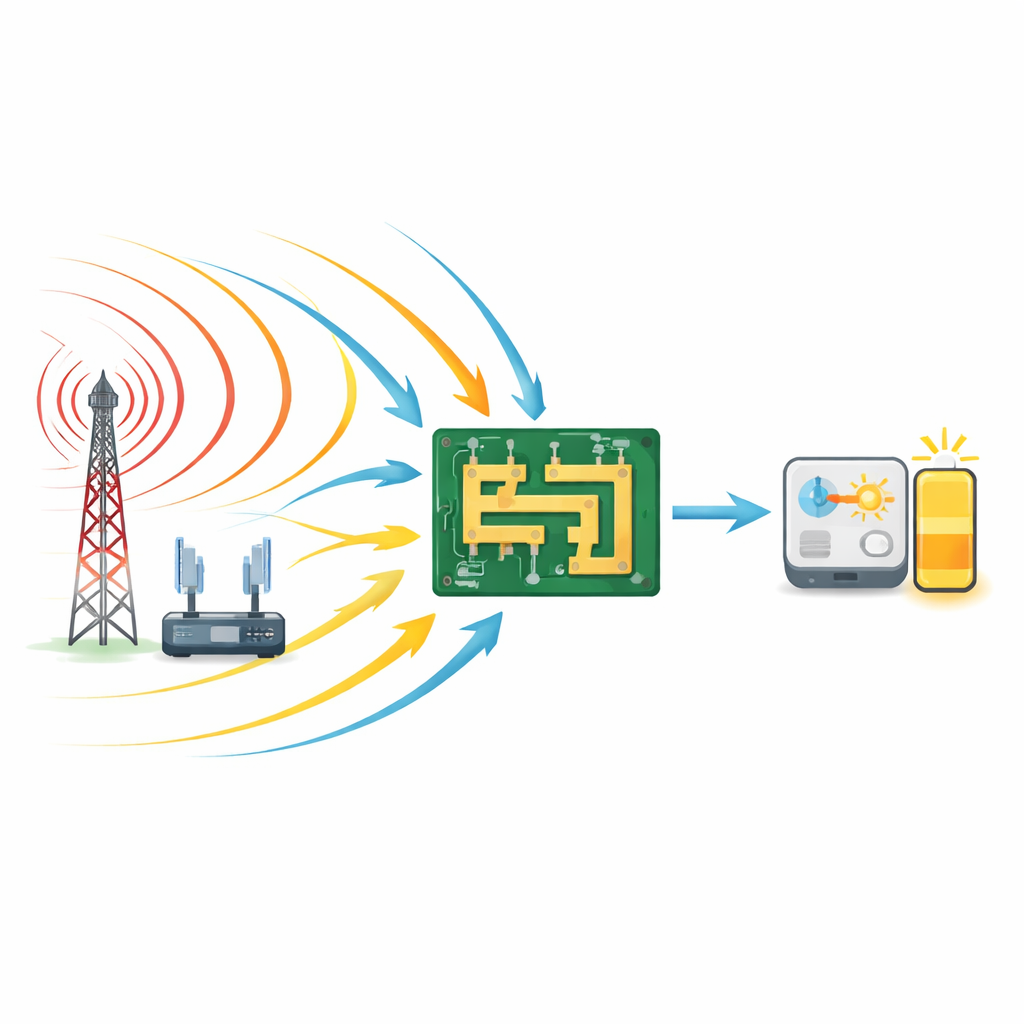
Our homes, offices, and city streets are filled with invisible radio waves from mobile phones, Wi‑Fi routers, and broadcast towers. This paper explores a way to tap into that ever-present sea of signals and turn a tiny fraction of it into useful electricity. By carefully reshaping a small metal pattern on a circuit board, the authors create an antenna that can soak up energy from many everyday wireless bands at once and feed it to low-power gadgets such as Internet of Things (IoT) sensors—potentially reducing our dependence on disposable batteries.
Catching Many Signals at Once
The work begins from a simple idea: if radio waves are everywhere, why not recycle them as a trickle of power? The challenge is that these waves come from many different services—cellular networks, TV broadcasts, and wireless data links—spread across a broad stretch of frequencies. A conventional antenna is tuned to a relatively narrow band, so it misses much of what is available. The researchers therefore set out to design a compact "wideband" antenna that can respond to a large portion of this spectrum, especially the crowded region from roughly 0.8 to 1.9 gigahertz that includes popular communication services used indoors and outdoors.
A Clever Pattern in a Small Space
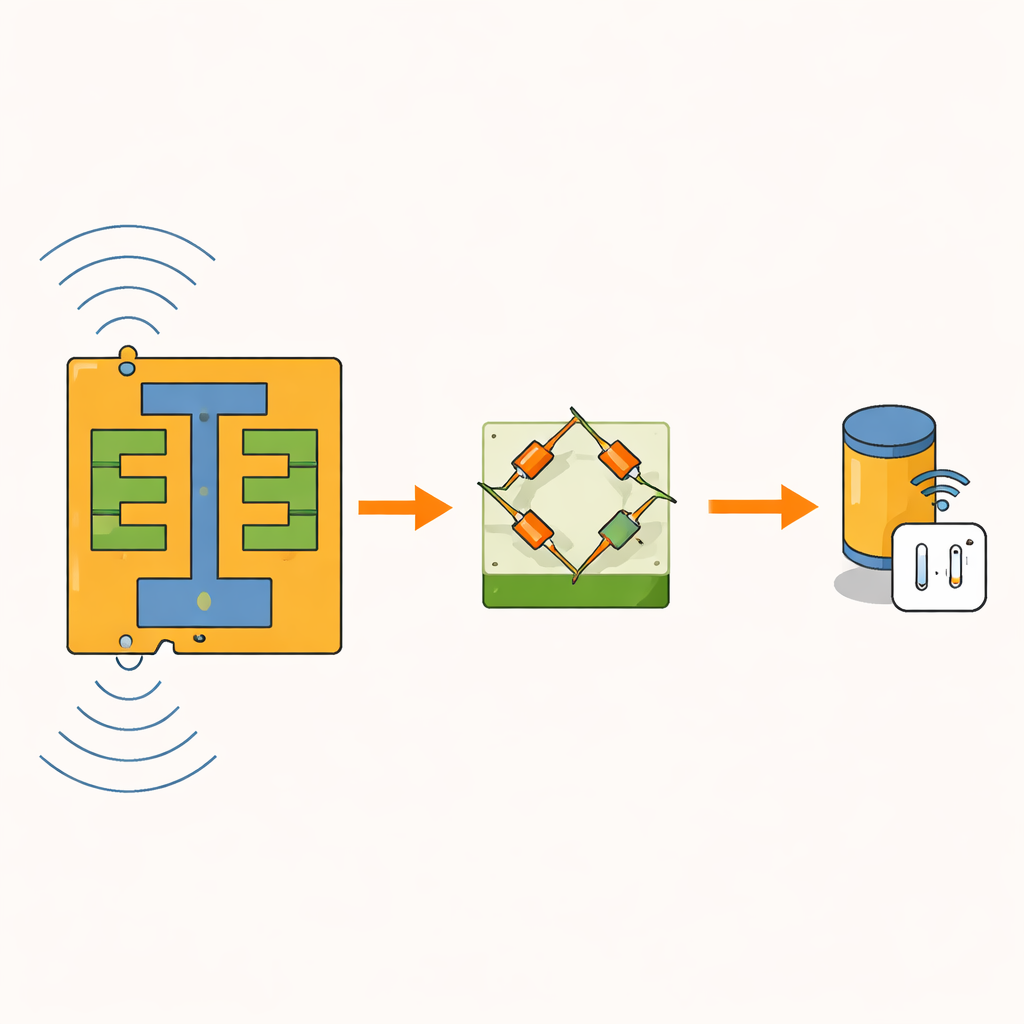
At the heart of the design is a flat copper shape etched on a common fiberglass circuit board. Instead of a simple bar or patch, the team carves a large rectangular opening and fills it with a carefully arranged pattern: an upside-down T in the center and two mirror-image E shapes on either side. These added arms and branches act like extra paths for the electric currents set up by incoming waves. By adjusting their lengths and positions, the authors coax several natural resonances to overlap, so the structure responds strongly over a wide span of frequencies while still fitting into a footprint smaller than the wavelength of the lowest frequency it uses.
Tuning and Testing the Design
To understand how each piece of the pattern contributes, the researchers simulate a series of intermediate designs, starting from a simple T-shaped feed and gradually adding the side E shapes and central inverted T. They then vary key dimensions in computer models to see how the operating range shifts. This step-by-step tuning shows that lengthening the main slot lowers the lowest usable frequency, while adjusting the vertical stem of the inverted T and the branches of the E shapes helps merge higher-frequency resonances into a smooth, continuous band. Once they settle on optimal dimensions, they fabricate a prototype and measure its performance in an anechoic chamber designed to mimic free space. The measured results closely match the simulations: the antenna maintains good operation from about 0.84 to 1.89 gigahertz, with respectable gain and radiation efficiency above 80 percent.
From Radio Waves to Usable Power
An antenna alone only gathers energy; it must be paired with circuitry that converts the oscillating radio signal into steady direct current. The team connects their wideband antenna to a specialized rectifier built from fast diodes and matching components, forming what engineers call a “rectenna.” In real outdoor tests, they point this setup toward everyday sources such as nearby base stations and measure both the radio spectrum and the resulting voltage. Even under ordinary ambient conditions, the combined system produces around 0.44 volts without any external biasing, and controlled-lab measurements show that, for modest input powers similar to what distant transmitters provide, the rectifier can convert nearly four-fifths of the captured RF power into DC. The antenna also maintains clean polarization and consistent radiation patterns across its band, which helps it collect energy reliably from different directions.
Toward Battery-Light Sensor Networks
In summary, the paper demonstrates that a thoughtfully sculpted metal pattern on a standard circuit board can balance competing needs: it is small, covers a wide frequency range, and converts scattered radio waves into electricity efficiently when paired with a matching rectifier. While the harvested power is modest, it is well suited for ultra-low-power IoT sensor nodes that wake periodically to send data. By shaving down battery use or allowing some devices to run without batteries at all, such wideband energy-harvesting antennas could help make future sensor networks more sustainable and easier to deploy in hard-to-reach places.
Citation: Yau, U., Tiang, J.J., Muhammad, S. et al. A wideband slot antenna for RF energy harvesting. Sci Rep 16, 10448 (2026). https://doi.org/10.1038/s41598-026-41191-1
Keywords: RF energy harvesting, wideband antenna, slot antenna, IoT sensors, rectenna