Clear Sky Science · en
Design of a Li-ion battery cooling system incorporating PCM, heat pipes, and liquid circuits using marine predator algorithm-enhanced ANN and multi-verse optimization
Keeping Car Batteries Cool and Safe
Lithium-ion batteries power everything from smartphones to electric cars, but they don’t like getting too hot. When a battery pack heats up unevenly, it can lose capacity faster, waste energy, and in extreme cases even fail dangerously. This paper explores a smart way to keep such batteries at comfortable temperatures by combining several cooling methods and using artificial intelligence to fine‑tune the design, aiming for safer, longer‑lasting, and more efficient electric vehicles.
A New Kind of Cooling Sandwich
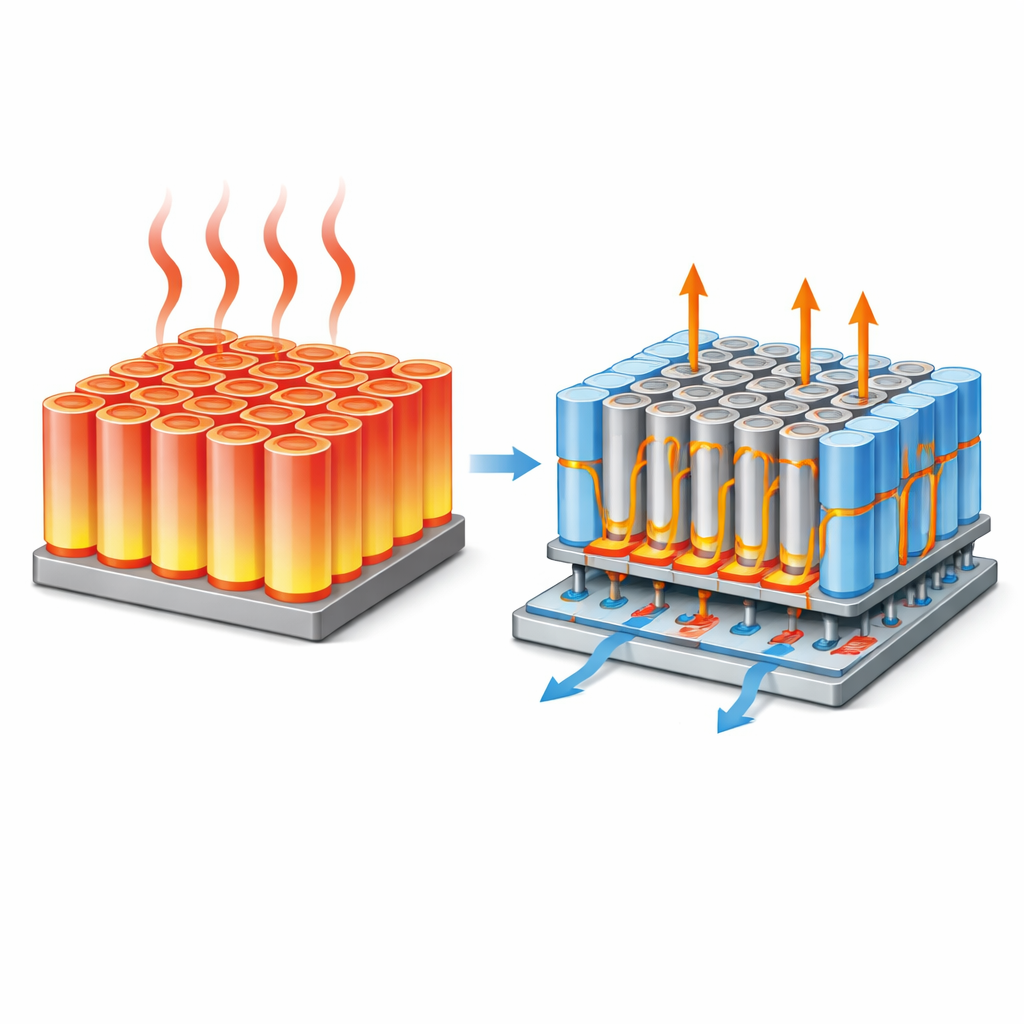
The study focuses on a “hybrid” cooling system wrapped around a module of cylindrical lithium‑ion cells. Instead of relying on air alone, the batteries are embedded in a sandwich of three cooperating elements: a phase‑change material (PCM) that absorbs heat by melting, a forest of tiny embedded heat pipes that spread heat quickly, and a liquid cooling plate that carries heat away. Together, these layers try to do two things at once: smooth out hot spots between neighboring cells and keep the overall temperature below a safe limit, all while preserving as much usable energy per kilogram as possible.
Balancing Space, Shape, and Storage
Because batteries must fit into tight spaces in cars and buses, the authors pay close attention to geometry: the spacing between cells in two directions, and the thickness and height of the heat pipe array. Using detailed computer simulations from earlier experimental work, they analyze how these dimensions affect three outcomes: how uneven the temperatures become inside the pack, how high the hottest cell gets, and how much energy the whole module can store per unit weight. The results show clear trade‑offs. Wider spacing and thicker, taller heat pipe layers help spread and remove heat, lowering both hot‑spot temperature and unevenness. But these same design choices add bulk and weight, reducing the energy density of the pack.

Teaching Algorithms to Design the Cooling
To explore all these design choices efficiently, the researchers build machine‑learning models that act as fast “stand‑ins” for expensive simulations. They train neural networks to predict temperature difference, peak temperature, and energy density from the geometric inputs. Two nature‑inspired search methods—a genetic algorithm and a marine predator algorithm—are used to tune the internal settings of these networks so that their predictions closely match the reference data. Once trained, the models reach very high accuracy, allowing the team to rapidly estimate how millions of design variants would behave without rerunning the full physics simulations each time.
Finding the Best Compromises, Not Just One Best Design
Rather than hunting for a single perfect layout, the study uses a multi‑objective optimization method that generates a “Pareto front” of equally valid compromises. On this frontier, improving one goal—such as squeezing more watt‑hours into the same mass—inevitably worsens another, like raising the hottest cell temperature. The analysis shows that very thick and tall heat pipe structures can keep temperature differences as low as about 2 °C and maximum temperatures around 38–39 °C, but cut energy density down to roughly 140 Wh/kg. Thinner designs push energy density up near 157 Wh/kg, closer to what automakers want, but allow larger temperature spreads and higher peaks. Intermediate designs land in the middle, offering both reasonable safety margins and respectable storage capacity.
From Curves on a Plot to Real‑World Choices
Engineers still need to pick a single design for an actual battery pack. To bridge this final gap, the authors apply a decision‑making method that ranks the many Pareto‑optimal options according to different priorities—such as maximizing safety, maximizing capacity, or striking a balanced compromise. By adjusting these weightings, they identify specific geometric recipes for scenarios like safety‑critical electric vehicles, energy‑dense portable systems, or balanced grid‑storage modules. In simple terms, the paper shows how combining clever cooling hardware with advanced algorithms can turn a tangle of trade‑offs into clear guidance, helping designers build battery packs that are cooler, safer, and more capable in everyday use.
Citation: Ali, N.B., Louhichi, B., Hassan, W.H. et al. Design of a Li-ion battery cooling system incorporating PCM, heat pipes, and liquid circuits using marine predator algorithm-enhanced ANN and multi-verse optimization. Sci Rep 16, 11796 (2026). https://doi.org/10.1038/s41598-026-41155-5
Keywords: lithium-ion battery cooling, battery thermal management, electric vehicles, phase change materials, machine learning optimization