Clear Sky Science · en
High-sensitivity dual-band microstrip sensor for oil–water mixture analysis with RBF neural network optimization
Why measuring mixed oil and water matters
From oil wells to refineries, knowing exactly how much water is hiding in crude oil has huge economic and environmental stakes. Too much water lowers the value of the product, corrodes equipment, and wastes energy in transport and processing. Yet routine checks are still often done with bulky lab gear that is slow and hard to bring into the field. This paper introduces a tiny electronic sensor, smaller than a fingernail, that can quickly read out how much water is in an oil–water mixture by sending microwave signals through it and interpreting the response with a smart learning algorithm.
A tiny circuit that feels fluids
The heart of the work is a compact “microstrip” circuit—flat metal patterns printed on a common circuit-board material. The authors shape this metal into a combination of a semicircle and an isosceles trapezoid, forming two resonators that naturally ring at two separate microwave frequencies, around 1.2 and 14.92 gigahertz. When a droplet of fluid is placed over the region where the electric field is most intense, the ringing frequencies shift slightly depending on how easily the fluid’s molecules polarize in response to the microwaves. Because oil and water differ strongly in this electrical behavior, their mixtures leave distinct fingerprints in the sensor’s response. 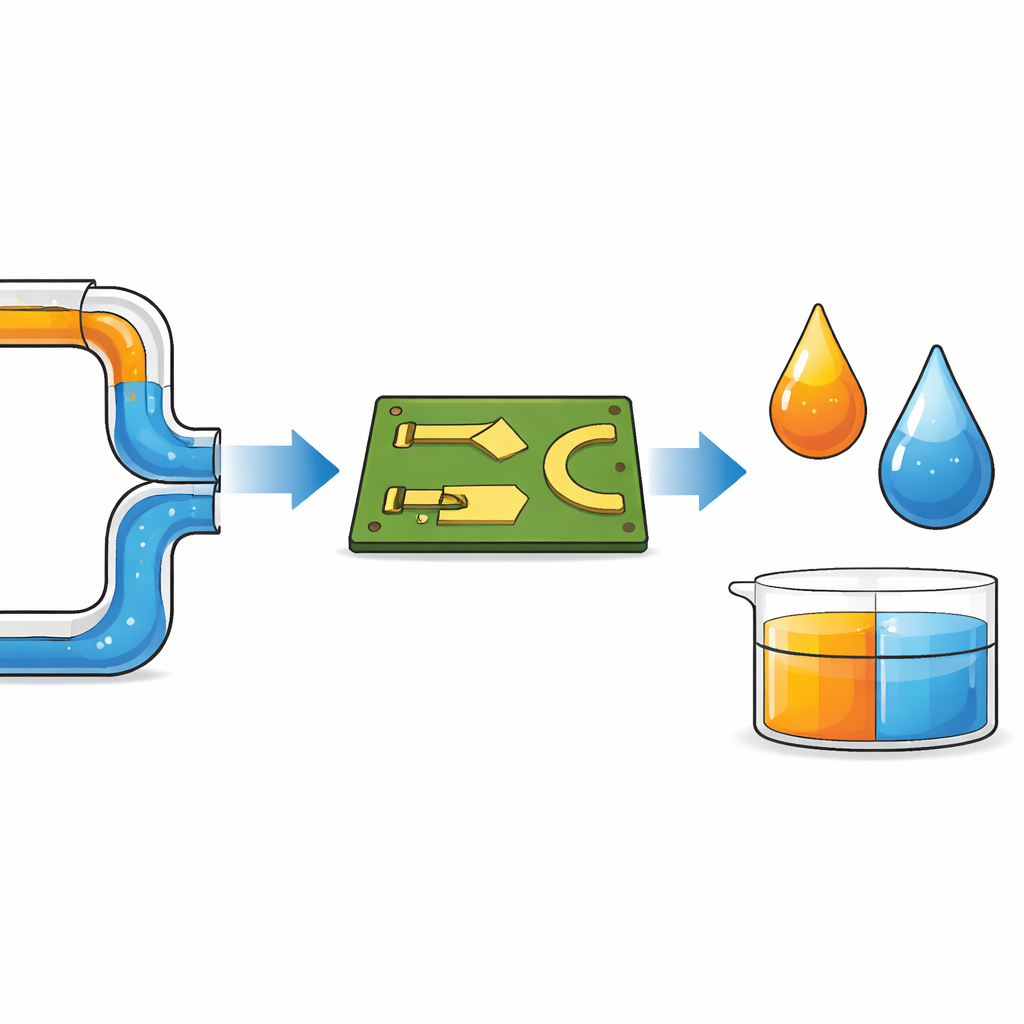
Two bands for sharper listening
Most earlier sensors of this type listen at only one microwave frequency, which limits how finely they can distinguish similar liquids. By deliberately designing the circuit to operate in two well-separated bands, the researchers effectively give their device a second “ear.” The lower frequency band is sensitive to broad changes in the mixture, while the higher band reacts more strongly to subtle differences. Careful circuit modeling, using simple inductors and capacitors as stand-ins for each metal segment, shows that the physical layout and the theoretical model agree closely, and measurements confirm that the device has clean, well-defined resonances in both bands with very low signal loss.
Watching oil and water tug on the waves
Computer simulations and lab tests reveal how the microwaves flow through the sensor as the oil–water ratio changes. At the resonant frequencies, strong currents crowd into the sensing region, maximizing interaction with the sample. As water content varies from 0 to 100 percent in 5 percent steps, the resonance peaks shift in frequency and change in height in a distinctly nonlinear way—the curves bend rather than forming straight lines. This nonlinearity reflects the complex way oil and water molecules respond together to alternating fields across different frequencies. Notably, the higher-frequency band shows larger shifts for the same composition change, translating into higher sensitivity: up to about 87.5 and 114.2 megahertz shift per unit change in electrical constant in the low and high bands, respectively, outperforming many previously reported designs.
Letting a neural network read the signal
Because the sensor’s response curves are not simple straight lines, traditional calibration methods struggle to turn the measured data into accurate water percentages. To solve this, the team feeds multiple microwave features—resonant frequencies, signal strengths, quality factors, and phase information—into a radial basis function neural network, a type of machine-learning model that excels at capturing smooth but nonlinear relationships. Trained on measurements from dozens of mixtures prepared under tightly controlled conditions, the network learns to map these microwave fingerprints directly to water content. The resulting predictions match the true values extremely well, with a statistical fit above 0.99 and typical errors of only a few percent, and residual-error analysis shows no strong bias across the full 0–100 percent range. 
From lab chip to real-world monitor
In essence, the study shows that a very small, low-cost microwave circuit, when paired with a smart learning algorithm, can act as a precise “electronic nose” for oil–water mixtures. The dual-frequency design gives the sensor a richer picture of how the mixture behaves, while the neural network handles the messy, nonlinear physics that would otherwise require complex modeling. Although further work is needed to harden the device for harsh industrial conditions and long-term field use, the combination of high sensitivity, compact size, and intelligent data processing points toward practical, real-time monitors for pipelines, storage tanks, and environmental checks wherever oil and water mix.
Citation: Dehkalani, F.V., Hayati, M., Horri, A. et al. High-sensitivity dual-band microstrip sensor for oil–water mixture analysis with RBF neural network optimization. Sci Rep 16, 10332 (2026). https://doi.org/10.1038/s41598-026-41132-y
Keywords: microwave sensor, oil water mixture, microstrip resonator, fluid composition, neural network sensing