Clear Sky Science · en
Space–time variable-order fractional analysis of nonlinear longitudinal wave propagation in magneto-electro-elastic materials
Waves That Remember
From medical ultrasound scanners to smart sensors embedded in aircraft wings, many modern devices rely on waves traveling through advanced materials. In some "smart" materials, mechanical motion is tightly linked with electric and magnetic effects, making their wave behavior surprisingly rich—and hard to predict. This paper introduces a new mathematical way to describe how such waves move, one that allows the material to "remember" its past and vary in space and time, revealing behaviors that simpler models miss. 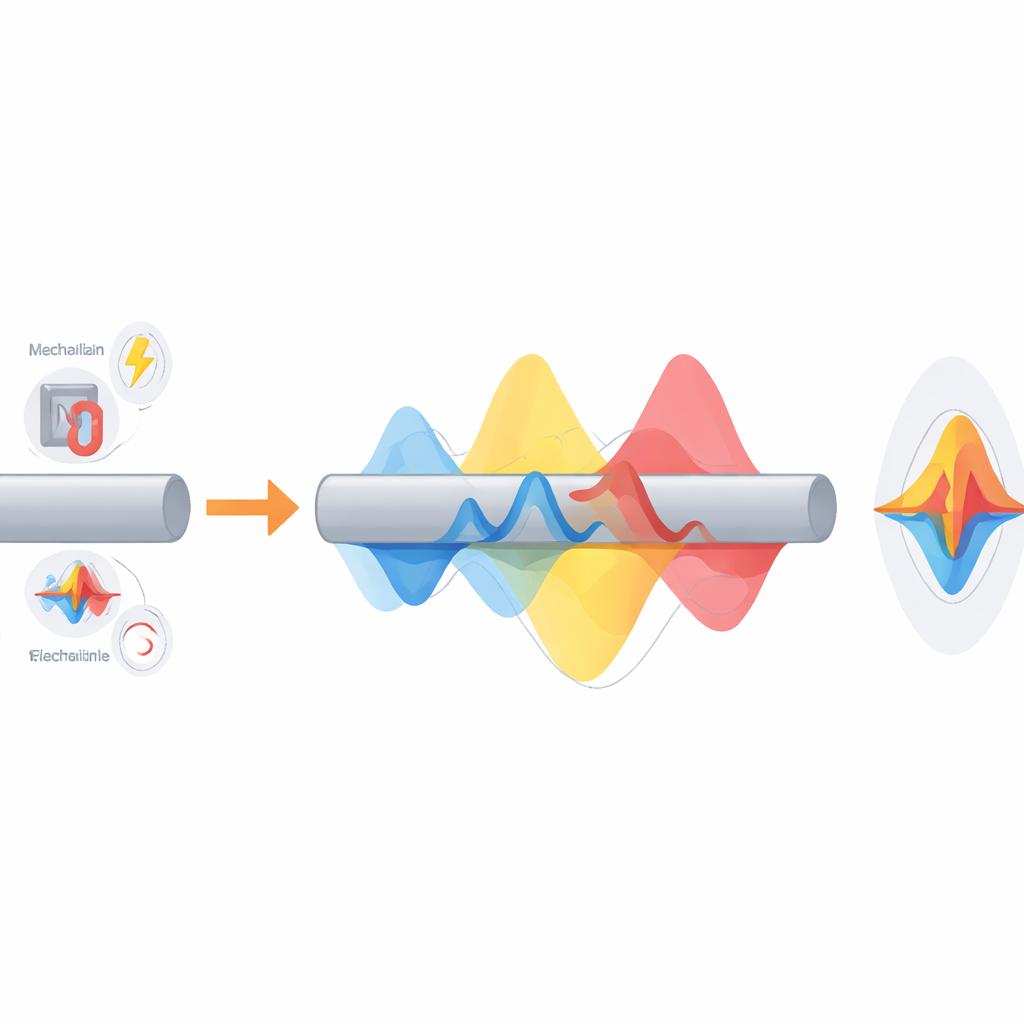
Smart Materials with Many Personalities
The study focuses on magneto–electro–elastic materials, which respond simultaneously to stretching, electric fields, and magnetic fields. These materials are used in high-precision sensors, actuators, and adaptive structures because a single component can convert mechanical signals into electrical or magnetic ones, and vice versa. When a longitudinal wave—like a tiny compression pulse—travels along a rod made of such a material, the mechanical motion is tightly coupled to electric and magnetic effects. This coupling changes how stiff and how dense the material seems to the wave, which in turn alters its speed, shape, and tendency to spread out. Traditional models, which assume that the material reacts instantly and locally, often cannot capture these subtle and delayed interactions.
A New Way to Capture Memory and Nonlocal Effects
To address this, the authors replace the classical wave equation with a fractional version that includes space–time variable-order derivatives, a tool from modern calculus designed to describe systems with memory. In this framework, two key quantities control how the material "remembers" past events and how far interactions extend: a time-dependent order that encodes how strongly past motions influence the present, and a space-dependent order that reflects how distant regions of the rod affect one another. Unlike older fractional models that use a single fixed memory strength everywhere, this approach lets both temporal and spatial memory vary smoothly along the rod and over time. This flexibility enables the model to represent heterogeneous materials whose internal structure or operating conditions change from place to place.
Finding Structured Waves in a Complex Setting
Working within this variable-order framework, the authors seek organized wave patterns known as traveling waves—disturbances that keep a recognizable shape while moving. Using a technique called the exp(−φ)-expansion method, they reduce the complicated wave equation to a simpler ordinary differential equation along a combined space–time coordinate and then build analytic expressions for the wave profiles. Even though this reduction is approximate, it yields explicit formulas for several important wave types: periodic waves, kink-like fronts connecting two different states, and solitary waves that remain localized. By tuning the variable-order parameters and coupling strengths, they generate families of solutions and identify when wave shapes stay smooth, become sharply localized, or develop singular features that signal breakdown of physical realism. 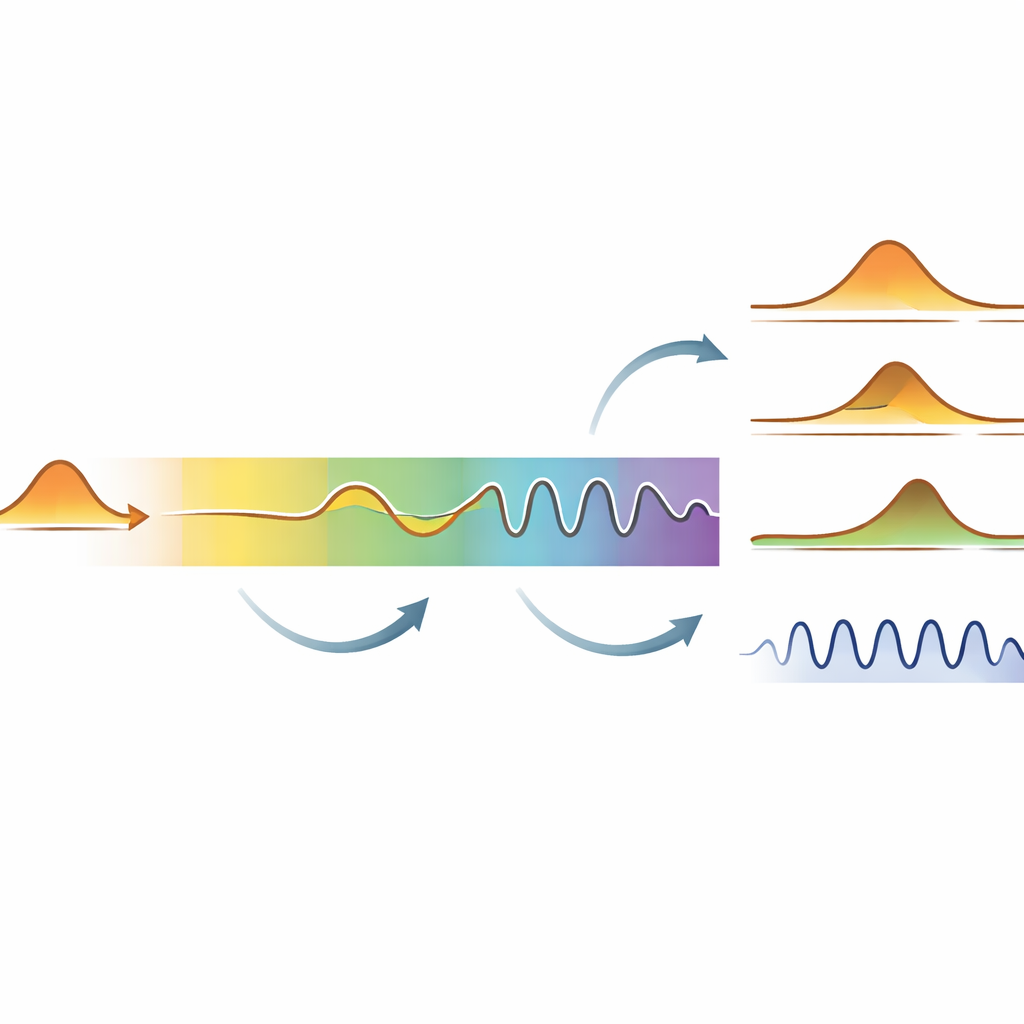
How Memory and Distance Shape the Waves
With these solutions in hand, the paper explores how changing the time and space orders alters wave behavior. Lowering the time-related order strengthens memory, which tends to increase wave amplitude and slow propagation. Adjusting the space-related order changes how localized the waves are: smaller values confine energy into sharper pulses, while larger values encourage broader, more dispersed profiles. Stability analysis of a reduced dynamical system derived from the wave equation shows that small variations in material and wave parameters can move the system between stable and unstable regimes, altering whether waves settle into steady patterns or evolve into more complex dynamics. When external disturbances are added, the same reduced model can exhibit chaotic trajectories, indicating that realistic forcing may drive irregular, hard-to-predict wave responses even when the underlying system is orderly.
Why This Matters for Future Devices
Overall, the study shows that allowing the strength of memory and nonlocal effects to vary in space and time gives a much richer and more realistic description of waves in multifunctional materials than constant-order models. The new framework can reproduce a continuum of wave states—periodic, kink-like, solitary, and even perturbation-induced chaotic behavior—by adjusting a small set of variable-order functions. For engineers and physicists designing high-sensitivity sensors, energy harvesters, or smart structures, this means they now have a more versatile theoretical tool to predict how coupled mechanical, electrical, and magnetic waves will travel through complex media, and to tailor material architectures that produce the desired wave response.
Citation: Khan, M.A., Ali, M.K.M., Sathasivam, S. et al. Space–time variable-order fractional analysis of nonlinear longitudinal wave propagation in magneto-electro-elastic materials. Sci Rep 16, 12176 (2026). https://doi.org/10.1038/s41598-026-41053-w
Keywords: magneto-electro-elastic waves, fractional calculus, variable-order models, soliton propagation, wave stability and chaos