Clear Sky Science · en
Graph clustering and prediction models for DISC-based personality and competency analysis
Why your workplace data tells a story
Most organizations collect piles of information about their people: personality test results, skills, roles, and even self-reported stress. This study shows how that scattered data can be woven into a map of how employees resemble one another, revealing hidden groups and hints about who might feel under pressure at work. It focuses on the popular DISC personality framework and asks a simple but important question: how far can we go from personality-style reports to useful, data-driven insight about stress and team needs—and where do the limits lie?
From color codes to connection patterns
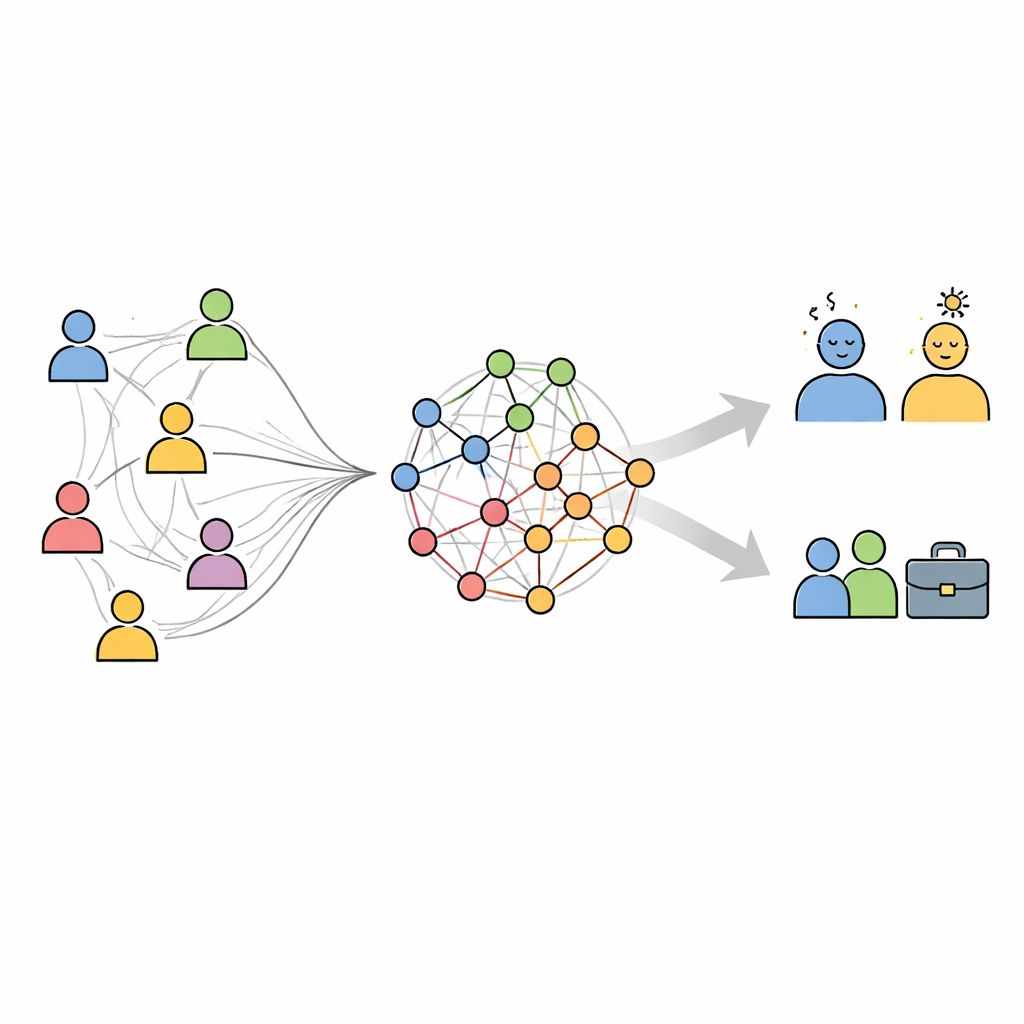
The researchers start from DISC, a model that groups people by general behavior styles such as being more forceful, people-focused, steady, or detail-oriented. In one university organization, 195 employees had completed a DISC-based assessment that also rated 17 job-related skills, listed standout strengths and weaker traits, and recorded their stress level. Rather than treating these profiles as isolated scores, the team treated every employee as a point in a network, where the closeness between two people depends on how similar their skills, roles, and traits are.
Building a map of who is like whom
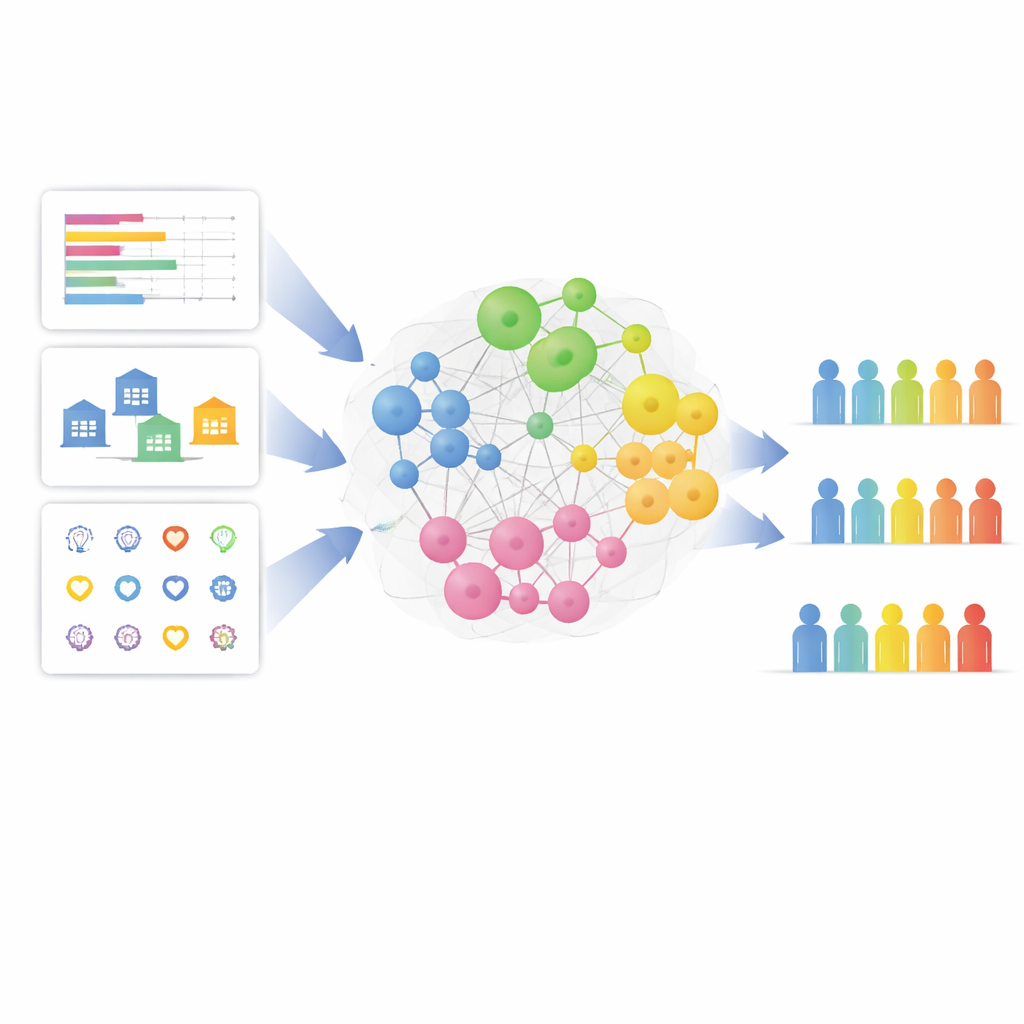
To draw this network, the authors combined three kinds of likeness. They measured how similar people were in their skill ratings, how many of their organizational details matched (such as unit or task type), and how much overlap there was in their trait descriptions. These three ingredients were blended into a single similarity score for every pair of employees. Each person was then linked to their most similar colleagues, forming a web in which thicker links mean more resemblance. A community-detection algorithm searched this web for natural clusters—groups of people who are more tightly connected to each other than to the rest of the organization.
Hidden groups and their stress mix
The resulting network was far from random. The method uncovered six communities of employees, each with its own blend of DISC styles and stress levels. Some groups contained many “organizer” or “analyst” types, while others were more mixed. The study found that these clusters also differed in how common various stress levels were, suggesting that combinations of behavior style, skills, and role context tend to travel together. This provides a way for human-resources teams to think about interventions at the group level, such as targeted training or reviewing workload for specific clusters, rather than focusing only on individuals in isolation.
Trying to forecast stress from profiles
The authors then turned from mapping to prediction. Using a popular machine-learning method called a random forest, they tried to guess each employee’s stress category (low, medium, high, or high and clearly tied to work) from their DISC type, skills, traits, and organizational details. The model did better than pure guessing, but not as well as a very simple strategy of always predicting the majority class, which was low stress. In other words, there is some signal in the personality and competency data, but a great deal of what shapes stress seems to lie elsewhere—such as changing deadlines, personal life events, or shifting team relationships that were not captured in this one-time survey.
What really drives pressure on the job
Even with its limits, the predictive model highlighted some telling patterns. Skill ratings linked to sales targets and client relationships were among the most important inputs when the algorithm tried to separate different stress levels. This fits common experience: roles where results and customer contact are central often come with extra pressure. The study also ran a separate exercise to “predict” competency-group labels and obtained near-perfect scores—but here the target labels were essentially built from the same information used as inputs, a textbook example of information leakage that looks impressive on paper but does not generalize.
Why this matters for people and teams
For a general reader, the key message is that personality and skill tests can do more than place you in a neat lettered box; when combined carefully, they can reveal how you sit within the broader fabric of your workplace. At the same time, this study cautions against overconfidence: stress is not something we can reliably read off a personality chart. Network-style maps of similarity may help organizations spot meaningful groups and think about training or balance across teams, but serious decisions about well-being still require richer, ongoing information and, above all, direct human conversation.
Citation: Samanta, S., Allahviranloo, T., Mrsic, L. et al. Graph clustering and prediction models for DISC-based personality and competency analysis. Sci Rep 16, 10186 (2026). https://doi.org/10.1038/s41598-026-41013-4
Keywords: workplace stress, personality assessment, team dynamics, organizational analytics, employee competencies