Clear Sky Science · en
Efficacy and safety of ultrasound-guided radiofrequency ablation versus laparoscopic cholecystectomy in gallbladder polyps: a bicentric study
Why keeping this small organ matters
Many people discover tiny growths called gallbladder polyps during routine ultrasound scans, often by surprise and without any symptoms. Doctors usually worry about these growths because a small fraction can turn into cancer, and the standard solution has long been to remove the whole gallbladder with keyhole surgery. This study explores a gentler alternative: burning away the polyps from the inside under ultrasound guidance while leaving the gallbladder in place. For anyone facing surgery for gallbladder polyps—or simply curious about less invasive medicine—these results hint at a future where treatment is safer, recovery is faster, and digestion stays closer to normal.
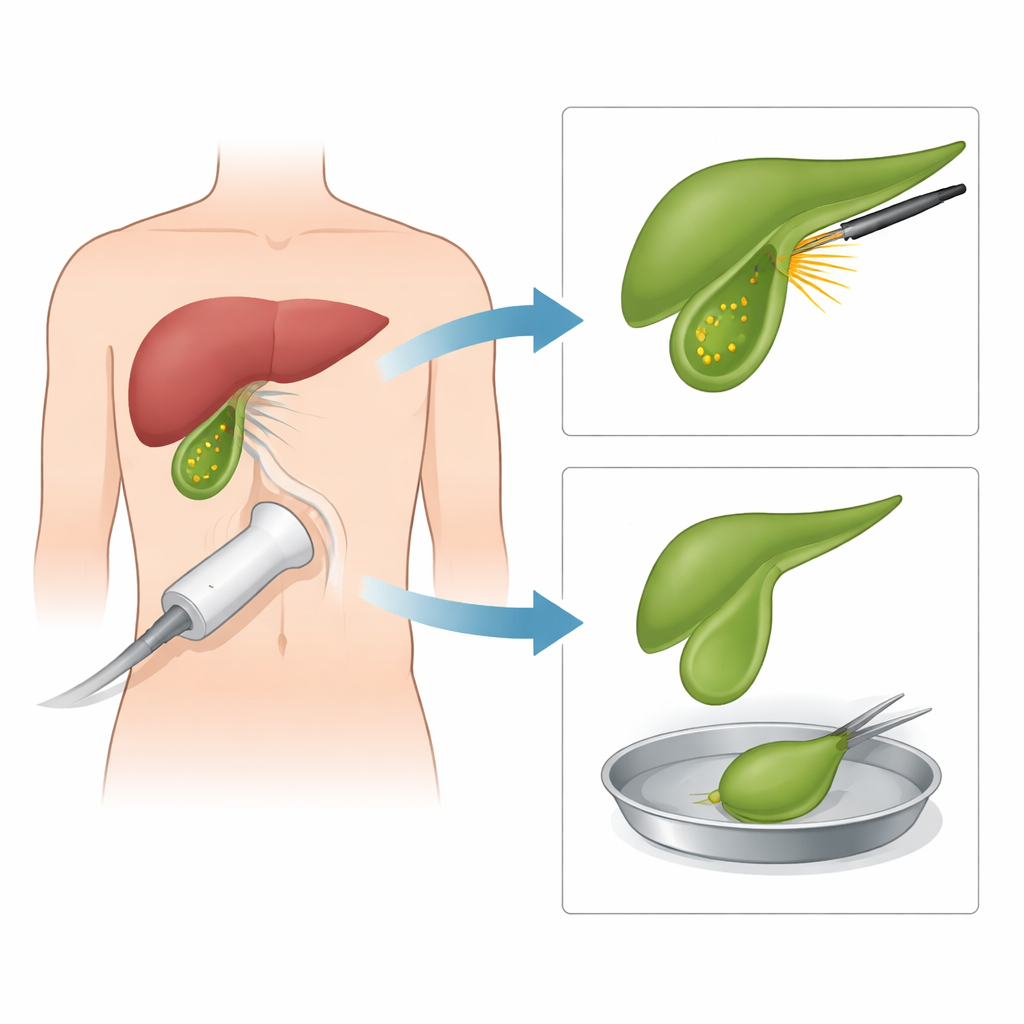
Two different paths for the same problem
The researchers followed 160 adults with one or two gallbladder polyps between 1 and 2 centimeters, a size range where the risk of cancer starts to concern doctors. All polyps looked benign on detailed imaging. At two hospitals in China, 79 patients chose ultrasound-guided radiofrequency ablation, in which a thin needle heats and destroys the polyp from outside the body under real-time imaging. The other 81 patients underwent the more familiar keyhole surgery to remove the entire gallbladder, called laparoscopic cholecystectomy. Because the work is retrospective, the team looked back at records and scans collected over at least a year to see how well each approach worked and how patients felt afterward.
Removing growths while sparing the organ
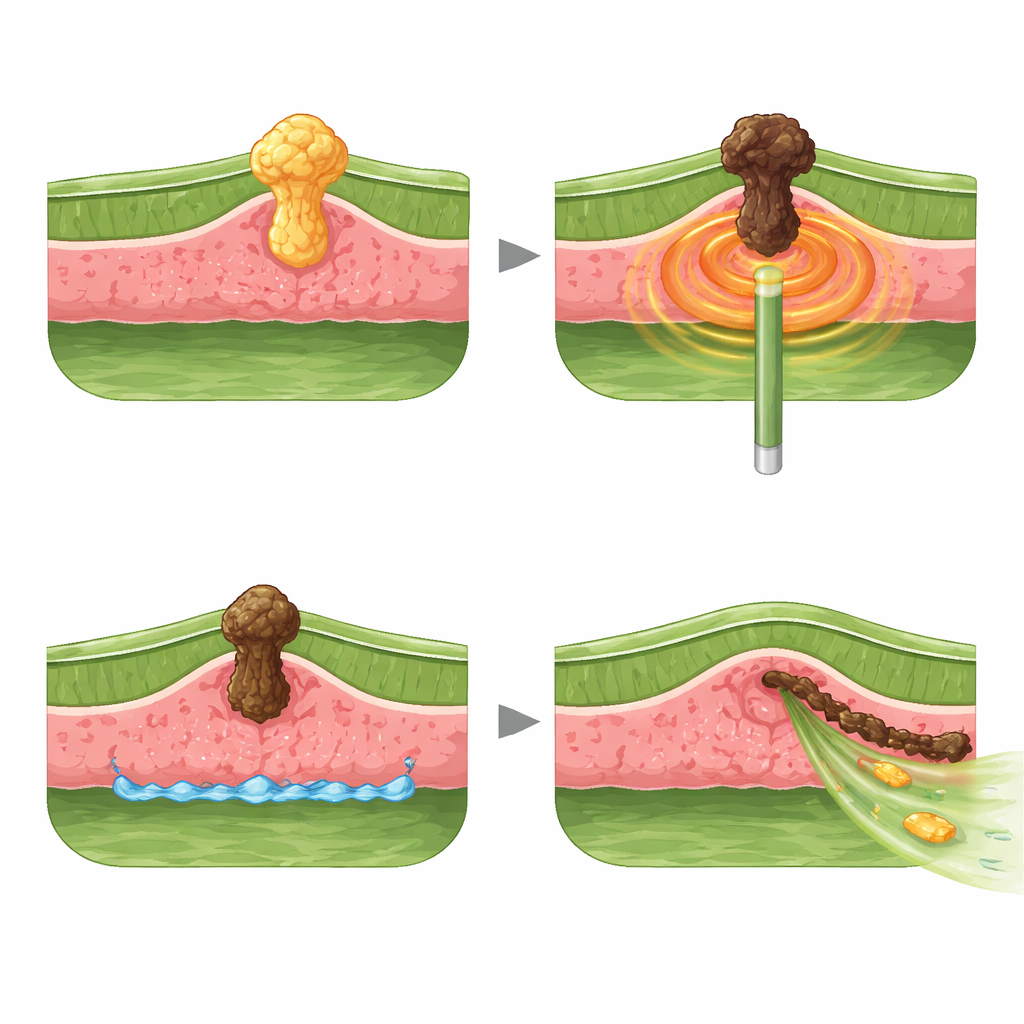
For the ablation group, the main question was simple: do the polyps truly disappear, and does the gallbladder still work? Follow-up scans over a year showed that more than four out of five treated polyps could no longer be seen after just one week, and every treated polyp had vanished by one year. The few remaining early on steadily shrank, suggesting they had been inactivated and were slowly being absorbed or shed. Measurements of the gallbladder wall thickness and its ability to contract and empty remained unchanged after treatment, indicating that the organ’s basic function was preserved. Other small, untreated bumps in the gallbladder did not grow noticeably during the first year, easing worries that the procedure might somehow encourage new trouble spots.
How the new method compares with surgery
Both treatments were effective at getting rid of benign polyps, but their impact on the rest of the body looked very different. In the surgery group, blood tests the day after the operation showed greater stress on the liver and lower protein levels, likely reflecting more tissue injury. These patients stayed longer in the hospital, took more time to pass gas and resume eating, and reported more pain on the first day after the procedure. Over the following year, people who had lost their gallbladder were far more likely to report abdominal pain, bloating, diarrhea, bile reflux–like symptoms, and signs of poor nutrient absorption such as weight loss or anemia. In contrast, those who had ablation while keeping their gallbladder rarely developed such long-term digestive complaints, even though the overall rates of serious complications and the cost of care were similar between the two approaches.
Managing risks and learning the limits
Ultrasound-guided ablation is not entirely risk-free. The main complication was leakage of bile into the abdominal cavity, which occurred more often when the polyps sat on a broad base rather than a narrow stalk. The team tried to prevent this by temporarily draining bile from the gallbladder and by injecting fluid between its inner and outer layers to create a protective cushion before heating. When leaks did occur, they were handled successfully with drainage tubes placed through the skin. Biopsy samples confirmed that all treated polyps were benign, and no blockages from shed tissue were seen during the relatively short follow-up, though the authors caution that longer observation and larger studies are needed. They also note that their work, based on past records rather than random assignment, can still be influenced by how patients and doctors chose each treatment.
What this means for patients and doctors
The study suggests that carefully performed, ultrasound-guided radiofrequency ablation can clear suspicious but benign gallbladder polyps just as effectively as surgery while preserving the organ and its role in digestion. Compared with removing the gallbladder entirely, this approach was linked to milder short-term recovery and far fewer long-term digestive problems. While more research is required before it becomes routine, this organ-sparing technique offers a promising new option for people whose polyps need treatment but who would prefer to keep their gallbladder whenever it is safely possible.
Citation: Zhao, H., Dong, G., Zhang, Z. et al. Efficacy and safety of ultrasound-guided radiofrequency ablation versus laparoscopic cholecystectomy in gallbladder polyps: a bicentric study. Sci Rep 16, 10161 (2026). https://doi.org/10.1038/s41598-026-40927-3
Keywords: gallbladder polyps, radiofrequency ablation, laparoscopic cholecystectomy, organ-sparing treatment, digestive side effects