Clear Sky Science · en
Effect of brass-alloy machining-swarf additive on the microstructure, hardness and toughness of gray cast iron
Turning Waste Metal into Stronger Iron
Gray cast iron is the workhorse of engine blocks, pumps, and heavy machinery, prized for its low cost and resistance to wear but held back by its brittleness. This study explores a clever way to toughen that familiar material using something most factories currently throw away: thin curly chips of brass produced during machining. By stirring these brass shavings into molten cast iron, the researchers show it is possible to reshape the metal’s inner structure, making it harder or tougher as needed while also recycling industrial waste.
Why Brittleness Is a Problem
Gray cast iron owes its usefulness to tiny flakes of carbon, known as graphite, scattered through a steel-like background. Those flakes help with lubrication and damping vibration, but they also act like built‑in cracks. Under sudden impact, stresses concentrate at the sharp graphite edges and the metal can snap in a brittle way. Industries would like a version of gray cast iron that keeps its good wear resistance and easy casting, but that resists cracking better when hit or cycled under load.
A New Use for Brass Chips
The team focused on “swarf” – long, curled chips that fall from lathes and mills when brass parts are machined. Brass is mostly copper and zinc, two elements already known to influence cast iron. Instead of adding pure copper or zinc, the researchers packed brass chips into foam patterns and poured molten gray cast iron around them using a lost‑foam casting process. They produced four materials: standard gray cast iron, and composites containing about 1, 3, and 5 percent brass swarf by weight. They then measured hardness (resistance to indentation), impact energy (a measure of toughness), and examined the internal structure with microscopes and computer simulations.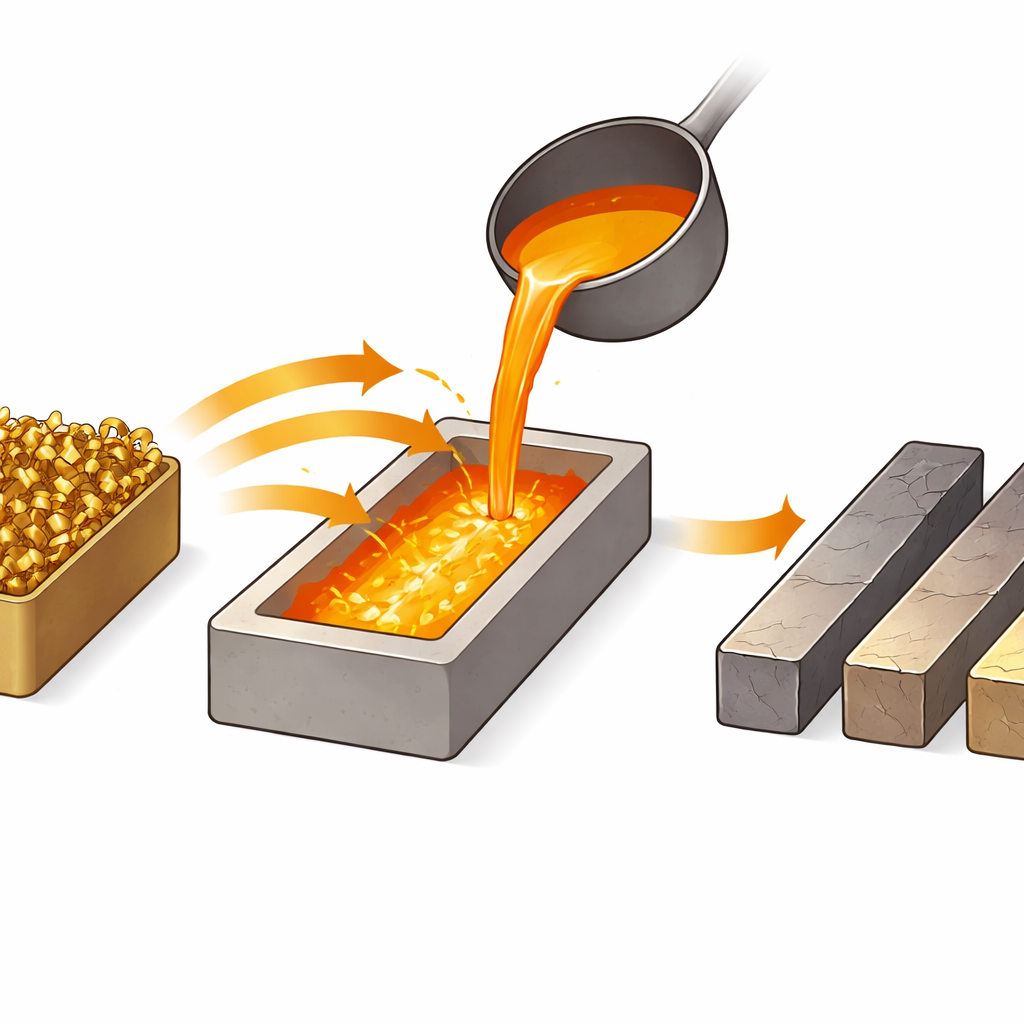
How the Inner Structure Changes
Inside the metal, the brass addition did two things at once: it changed cooling behavior and supplied extra copper (and some zinc) to the iron. With 1 percent brass, the chips dissolved fully into the melt. Copper atoms spread into the iron background and encouraged the formation of a finer, denser mixture of hard and soft layers known as pearlite, while also shrinking the average size of graphite flakes. Computer simulations and image analysis showed that the flakes became shorter and more compact, and the layered pearlite spacing tightened. This combination slightly raised hardness, from roughly 200 to 212 on the Brinell scale, and nudged toughness upward because the crack‑like graphite defects were less severe.
From Uniform Alloy to Metal–Metal Composite
At higher additions, the behavior shifted from simple alloying to the creation of a true composite. With 3 and especially 5 percent brass, many chips no longer dissolved completely. Instead, they froze in place as small, soft brass islands inside the harder cast iron. These particles acted as “cold spots” during solidification, speeding up local cooling, which further refined the pearlite and graphite around them. Microscopy revealed shells of very fine pearlite near the brass and a more mixed, somewhat softer structure farther away. The overall hardness now dropped slightly below the original iron, down to about 197 and 185 Brinell, because the embedded brass itself is much softer. Yet the microstructure near each brass island became more complex and refined, setting the stage for different fracture behavior.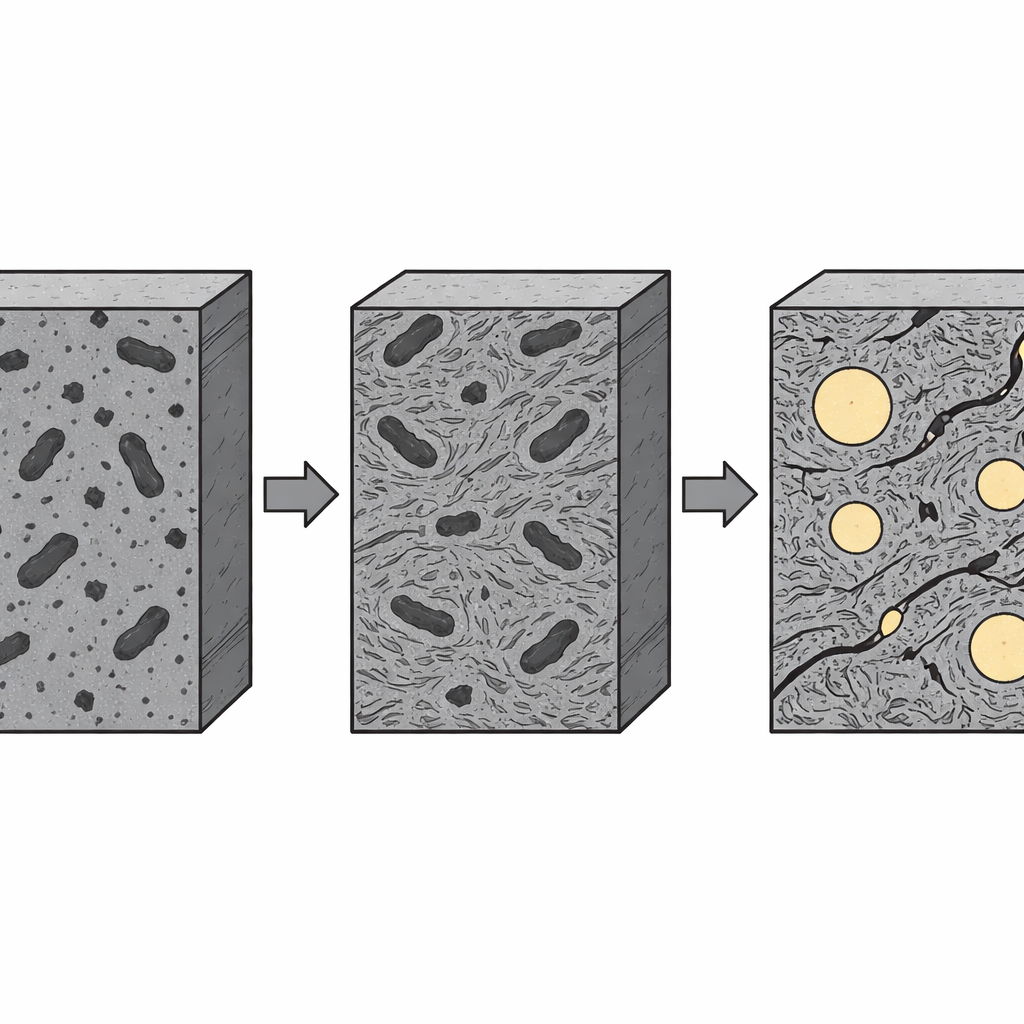
How Brass Chips Make Iron Tougher
Impact tests provided a striking result: while unmodified gray cast iron absorbed only about 3 joules before breaking, the version with 1 percent brass absorbed 4.2 joules, 3 percent reached 5.7 joules, and 5 percent swarf soared to around 10.6 joules, more than triple the original toughness. Fracture‑surface images explain why. In plain cast iron and the 1 percent sample, breaks were largely brittle, following the graphite flakes. In the 3 and 5 percent composites, cracks that started in the iron matrix were repeatedly deflected, slowed, or blunted when they met brass particles and the refined region around them. Within the brass, the metal deformed in a more ductile, dimpled manner, acting like tiny shock absorbers scattered through the iron. This mix of brittle and ductile regions forces a crack to do more work and change direction many times, which consumes more energy before complete failure.
What This Means for Real‑World Parts
For non‑specialists, the main message is that throwing carefully measured amounts of waste brass chips into molten cast iron can tune the balance between hardness and toughness. A small amount of swarf dissolves and subtly strengthens the iron; larger amounts create a metal–metal composite where soft brass inclusions toughen the structure by diverting and cushioning cracks. Because the feedstock is industrial scrap, the approach is both low‑cost and environmentally attractive. With further development, this strategy could lead to longer‑lasting, less brittle cast iron components in engines, machinery, and infrastructure, while turning a troublesome waste stream into a valuable resource.
Citation: Ranjbar, M., Javidani, M., Seydaroufi, ZS. et al. Effect of brass-alloy machining-swarf additive on the microstructure, hardness and toughness of gray cast iron. Sci Rep 16, 10005 (2026). https://doi.org/10.1038/s41598-026-40916-6
Keywords: gray cast iron, brass swarf, copper alloying, metal matrix composites, toughness improvement