Clear Sky Science · en
Lower-limb joint-coordination and coordination variability during lateral shuffle in colleague students with different vision acuity
Why Blurry Vision Matters for Everyday Sports
Many popular sports, from basketball to tennis, rely on quick sideways steps known as lateral shuffles. These moves help players track opponents, reach the ball, and stay in the game—but they also carry a high risk of ankle and knee injuries. This study asks a simple but important question: how does blurred vision, similar to what nearsighted people experience, change the way our legs work together during these fast side steps, and could those changes raise the chance of getting hurt?
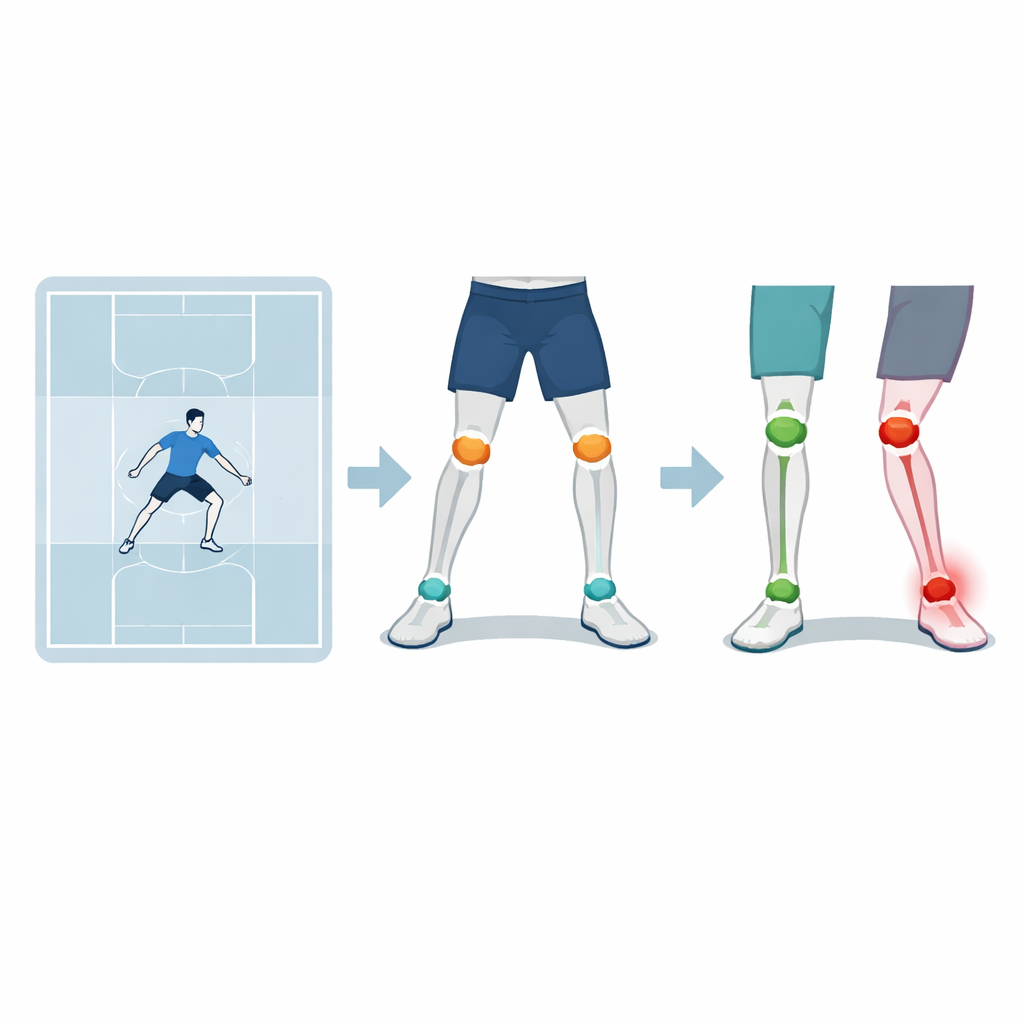
Side-Stepping Under Blurry and Clear Sight
The researchers recruited healthy male college students with normal eyesight and asked them to perform repeated lateral shuffle steps under three visual conditions: normal vision, mildly blurred vision using a weak convex lens, and strongly blurred vision using a stronger convex lens. While the students shuffled sideways along a walkway at a controlled speed, a network of small motion sensors placed on the head, trunk, arms, and legs recorded how their joints moved in three dimensions. Instead of looking only at single joints, the team focused on how pairs of joints—hip and knee, and knee and ankle—worked together over the full step cycle.
How the Joints Talk to Each Other
To capture this “conversation” between joints, the scientists used a mathematical measure that describes whether two joints are moving in sync or in opposite directions and how consistent that pattern is from step to step. Two main indicators were calculated: one that reflects how closely the joints move together on average, and another that reflects how much this pattern varies. Lower average values mean the joints are more in step with each other, while higher variability can signal either healthy flexibility or, if extreme or misplaced, loss of control. By slicing the lateral shuffle into distinct phases—push-off, support, and flight—the team could see exactly when vision changes had the strongest impact.
Blurred Vision Hits the Knee and Ankle Hardest
The key finding was that the connection between the knee and ankle joints was far more sensitive to visual disturbance than the link between the hip and knee. Under stronger blur, especially with the +450° convex lens, knee–ankle coordination in the landing leg changed markedly through the whole step, accounting for over 40 percent of the measured variation. In general, stronger blur was associated with shifts in how “in step” these two joints were and with noticeable changes in how steady that pattern remained. The right and left legs did not behave identically: the leg mainly responsible for pushing the body sideways tended to show larger swings in coordination during key phases, while the main support leg stayed comparatively stable, hinting that the body protects balance first and lets the propelling leg absorb more of the disturbance.
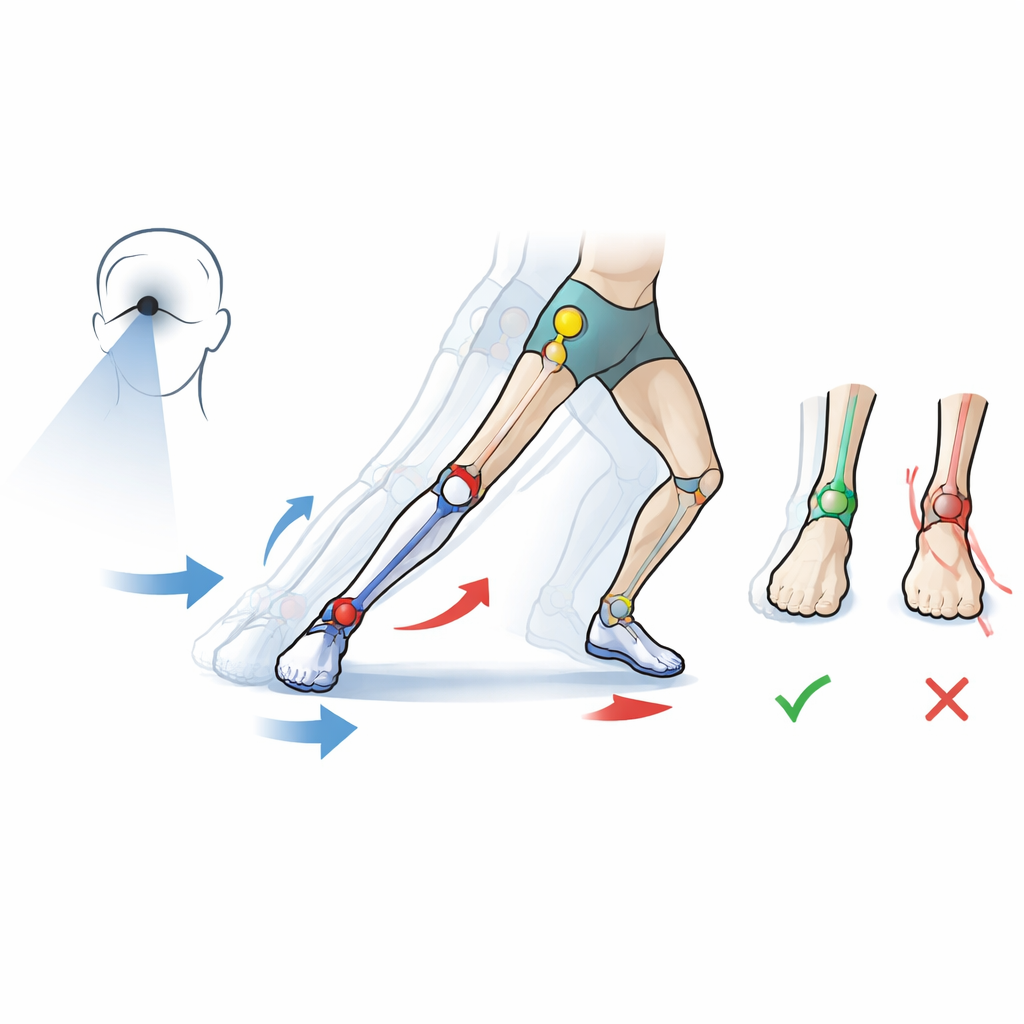
What the Results Mean for Balance and Injury Risk
These patterns suggest that when vision becomes less reliable, the body leans more heavily on ankle and knee adjustments to keep balance during quick sideways motion. The hips, which are closer to the body’s center of mass, seem to rely more on internal sense cues from muscles and the inner ear, and less on vision. In contrast, the more distant ankle and knee joints appear to depend strongly on visual information to fine-tune their timing. As that information becomes distorted, their coordination shifts, particularly in the leg driving the movement, which may increase strain at these joints.
Takeaways for Players, Coaches, and Clinicians
For non-specialists, the conclusion is straightforward: blurry vision does not just make it harder to see the ball—it quietly reshapes how your knees and ankles work together during fast, sideways movements. This study shows that even in young, healthy adults, worsening blur can meaningfully disturb lower-limb control, especially at the knee and ankle and especially under stronger visual distortion. For sports that involve frequent lateral shuffles, such as basketball and badminton, the authors recommend paying special attention to knee–ankle coordination in training, including drills that safely challenge vision. Doing so could help athletes adapt better to visual uncertainty and may reduce the risk of ankle and knee injuries linked to poor joint teamwork.
Citation: Wang, H., Wu, X., Zhang, L. et al. Lower-limb joint-coordination and coordination variability during lateral shuffle in colleague students with different vision acuity. Sci Rep 16, 10085 (2026). https://doi.org/10.1038/s41598-026-40892-x
Keywords: lateral shuffle, vision and balance, knee-ankle coordination, sports injury risk, myopia and movement