Clear Sky Science · en
Molecular dynamics study on the release of residual stress in milling of 7050 aluminum alloy by ultrasonic treatment
Why hidden stresses matter in everyday metal parts
From airplane wings to satellite frames, many critical structures are made from thin, lightweight aluminum panels. During machining, these parts can quietly accumulate hidden internal stresses that later cause them to twist or warp, threatening precision and safety. This study explores a promising way to tame those stresses in a widely used aerospace alloy, 7050 aluminum, by using powerful sound waves. By watching how atoms move in computer simulations and confirming trends in real tests, the authors show how ultrasound can help metals "relax" and keep large, delicate parts in shape.
How cutting leaves metal “wound up” inside
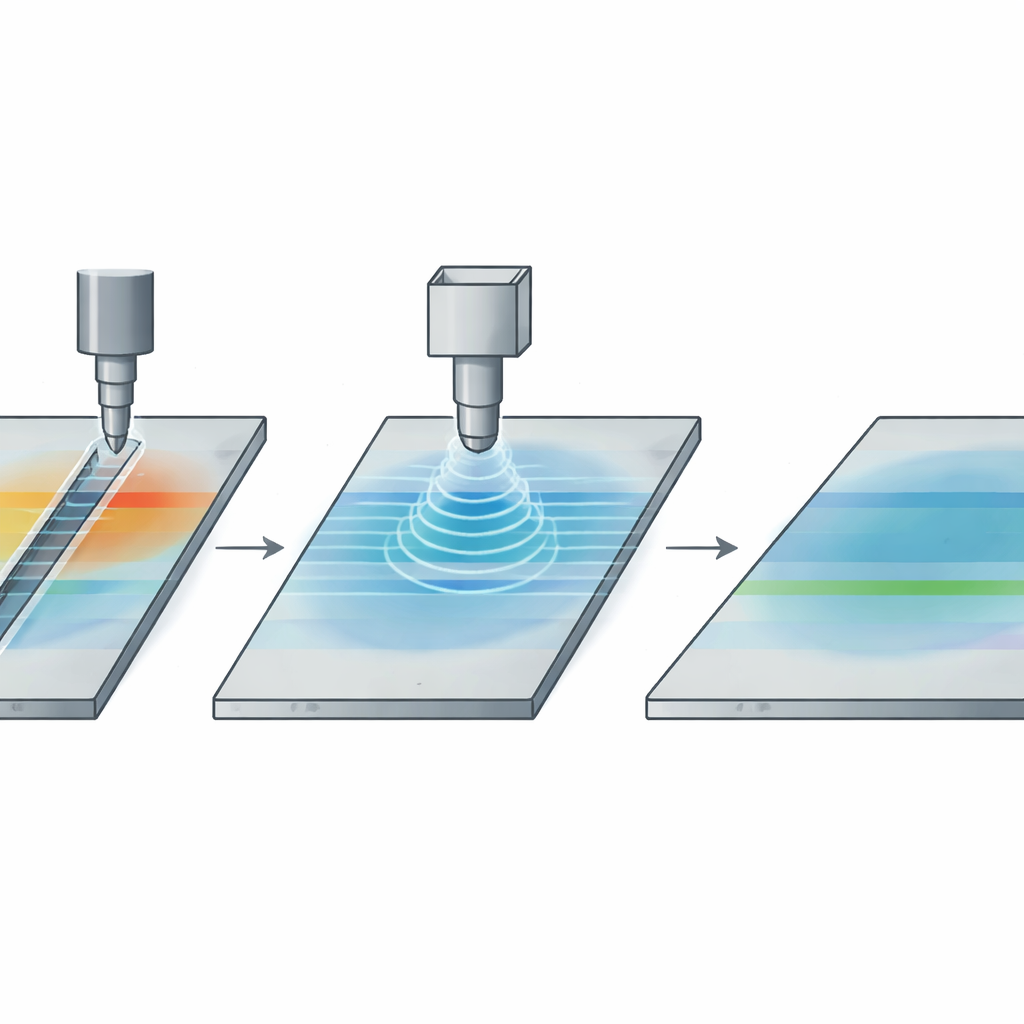
When a sharp tool mills a groove into an aluminum plate, it does far more than remove material. At the atomic level, the cutting edge shears off layers of atoms and pushes others aside, creating intense local heating and distortion just below the surface. In 7050 aluminum, tiny hard particles rich in magnesium and zinc act like boulders in a flowing stream: they block the motion of defects in the crystal, so these defects pile up around them. The simulations show bands of highly strained material forming beneath and ahead of the tool, as well as dense tangles of line-like defects known as dislocations. These tangled regions hold large amounts of elastic energy and show up as concentrated residual stress long after the tool is gone.
What the simulations reveal about stress build-up
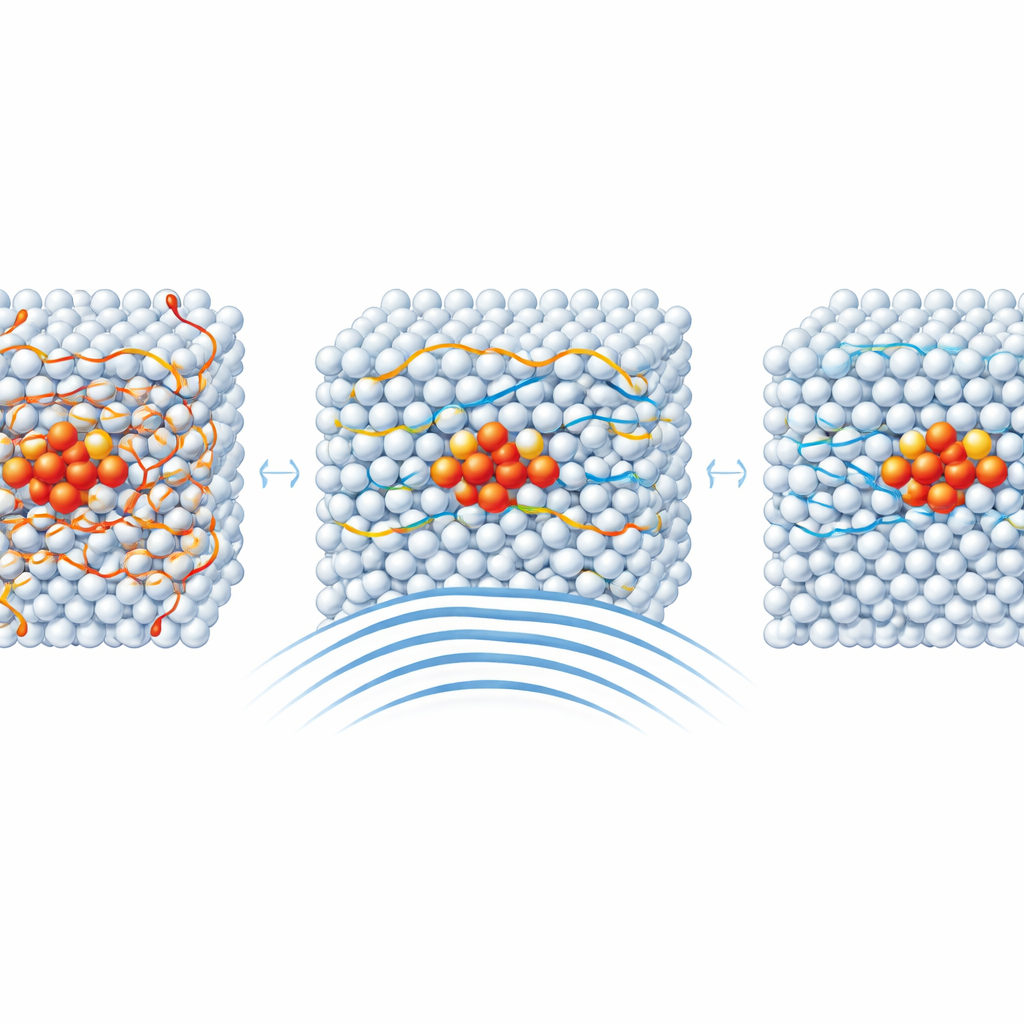
To probe this process in detail, the researchers built a molecular dynamics model of a 7050 aluminum block containing a realistic strengthening particle, then simulated a diamond tool cutting a small groove. The model tracks hundreds of thousands of atoms as the tool advances. It shows that material removal is dominated by shearing, which generates chips and a strongly deformed layer in the freshly machined surface. Around the embedded particle, dislocations accumulate and interlock, forming “traffic jams” that prevent further motion. Theory predicts—and the simulation confirms—that longer and denser piles of these dislocations create stronger local stress concentrations. In other words, the macroscopic residual stress measured in real parts is the large-scale expression of microscopic defect crowding.
Turning up the sound to calm the metal
Ultrasonic treatment attacks this problem not by changing the metal’s composition, but by shaking its atoms in a controlled way. In the model, this is mimicked by making all atoms vibrate at very high frequency with a small amplitude, similar to the action of a real ultrasonic transducer pressed against a plate. Once the vibration starts, the kinetic energy of atoms rises sharply and the existing dislocations begin to move. At first, the total number of dislocations even increases slightly, as some defects split and new ones form. Then, as the agitation continues, many of these dislocations collide and annihilate each other, especially a common type called Shockley partial dislocations. Overall defect density falls, and the internal stress drops and settles at a lower, more uniform level.
Linking atomic motion to practical treatment
The simulations were paired with experiments on aluminum plates treated with a single ultrasonic source. Measurements of internal stress before and after treatment showed that higher power and sufficient treatment time give stronger stress relief, but only up to a point. Beyond roughly ten minutes under the tested conditions, additional exposure brings little extra benefit. The effective influence of one transducer is limited to a circular region on the plate of about 10 centimeters across, suggesting that larger components should be treated by arranging multiple transducers in a planned pattern. Microscopic images of treated samples also revealed more broken and rearranged grain boundaries, consistent with gentle, localized plastic flow as the metal relaxes.
What this means for future lightweight structures
Overall, the work shows that ultrasonic treatment helps metal “let go” of stored stress by energizing and reorganizing its internal defects, allowing many of them to cancel out and returning the crystal to a lower-energy state. To a non-specialist, the message is simple: powerful sound waves can make previously machined aluminum parts less prone to bending and warping, without cutting, heating, or changing their chemistry. By clarifying how this works from the atomic scale up, the study offers engineers a more solid basis for designing ultrasonic treatment schedules that keep next-generation aircraft and other precision structures lighter, more stable, and more reliable.
Citation: Song, W., Jia, J., Ma, F. et al. Molecular dynamics study on the release of residual stress in milling of 7050 aluminum alloy by ultrasonic treatment. Sci Rep 16, 11291 (2026). https://doi.org/10.1038/s41598-026-40889-6
Keywords: ultrasonic stress relief, 7050 aluminum alloy, residual stress, milling deformation, molecular dynamics