Clear Sky Science · en
Coumarin compounds as fungicidal agents against powdery mildew and rust in cereals
Why cereal diseases matter to everyone
Cereal crops like wheat, oats and barley are the backbone of human and animal nutrition worldwide. Yet they are constantly under attack from microscopic fungi that steal their nutrients, weaken plants and cut yields. Two of the most damaging culprits are powdery mildew and rust diseases, which can turn once-healthy leaves into pale, dusty, rust-colored patches. This study explores whether a family of small, plant-derived molecules called coumarins can serve as cleaner, more sustainable fungicides to protect these staple crops.
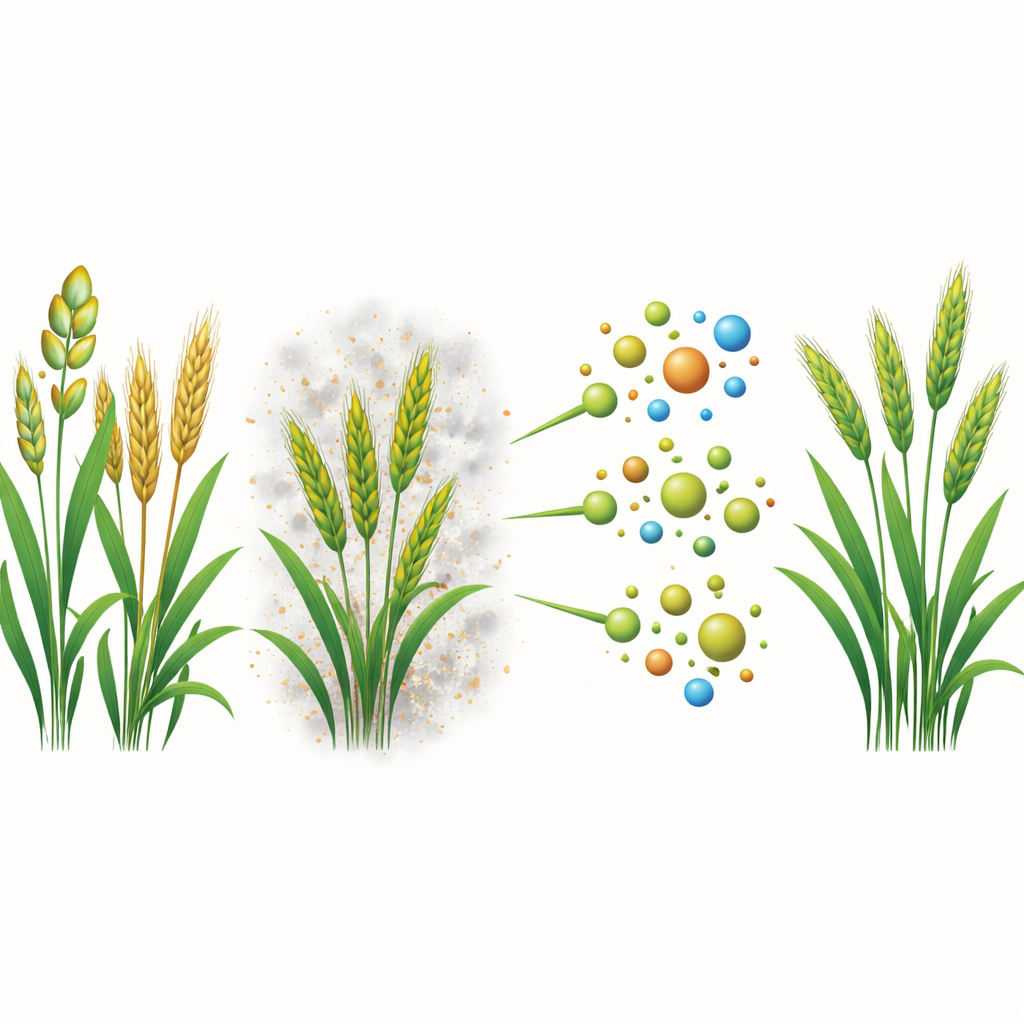
Silent thieves on cereal leaves
The fungi behind powdery mildew and rust are specialists known as biotrophs. Instead of killing plant tissue outright, they keep it alive and siphon off food using tiny feeding structures that grow into leaf cells. Powdery mildew, caused by Blumeria graminis, shows up as a white, flour-like coating on leaf surfaces. Rust fungi in the order Pucciniales form orange or brown “rusty” pustules packed with spores. Both types of fungi disrupt photosynthesis, weaken the plants, and can dramatically reduce grain yield and quality, including the protein content of the harvested grain. Because these pathogens are so well adapted to living on and in plants, they are especially hard to control.
Why new crop protectors are urgently needed
Farmers have long relied on synthetic chemical fungicides to hold these diseases in check. Over time, however, many fungal populations have evolved resistance, much like bacteria become resistant to antibiotics. At the same time, heavy use of conventional pesticides can harm beneficial organisms and the wider environment. Policies in regions such as the European Union are also pushing to halve chemical pesticide use by 2030. These pressures have sparked intense interest in natural, biodegradable compounds that can act as effective fungicides with fewer side effects. Coumarins, plant-derived substances already used in some medicines and crop-protection products, are promising candidates because their basic structure can be easily modified to fine‑tune biological activity.
Designing and testing new coumarin helpers
The researchers synthesized a panel of 15 coumarin-based compounds, building on the simple coumarin scaffold by attaching different chemical groups. Two natural reference molecules served as starting points, and the team created various “decorated” versions by adding ester groups and elements such as bromine or chlorine. They also used relatively mild, environmentally minded chemistry—avoiding some harsher reagents and employing catalysts like the natural amino acid L‑proline or Oxone, a less toxic oxidizing agent. Each new compound was carefully checked for purity, then mixed into agar media on which detached leaves of susceptible oat, wheat, barley and triticale plants were placed and inoculated with powdery mildew or rust spores.
How the fungi responded
At a working concentration of 4 mg of compound per milliliter of agar, most of the coumarin derivatives noticeably slowed or blocked fungal development on the leaves. For the mildew fungus on wheat, all 15 compounds reduced disease to some extent, and several completely stopped visible growth. For rust fungi on oats, wheat and barley, six to eight compounds per species achieved full suppression of disease symptoms, while others gave partial control. Overall, seven of the compounds curbed all tested powdery mildew strains by at least half, and six compounds fully blocked all rust fungi examined. Two molecules, labeled 6 and 9 in the study, stood out as especially powerful, showing 90–100% inhibition across both mildew and rust groups.
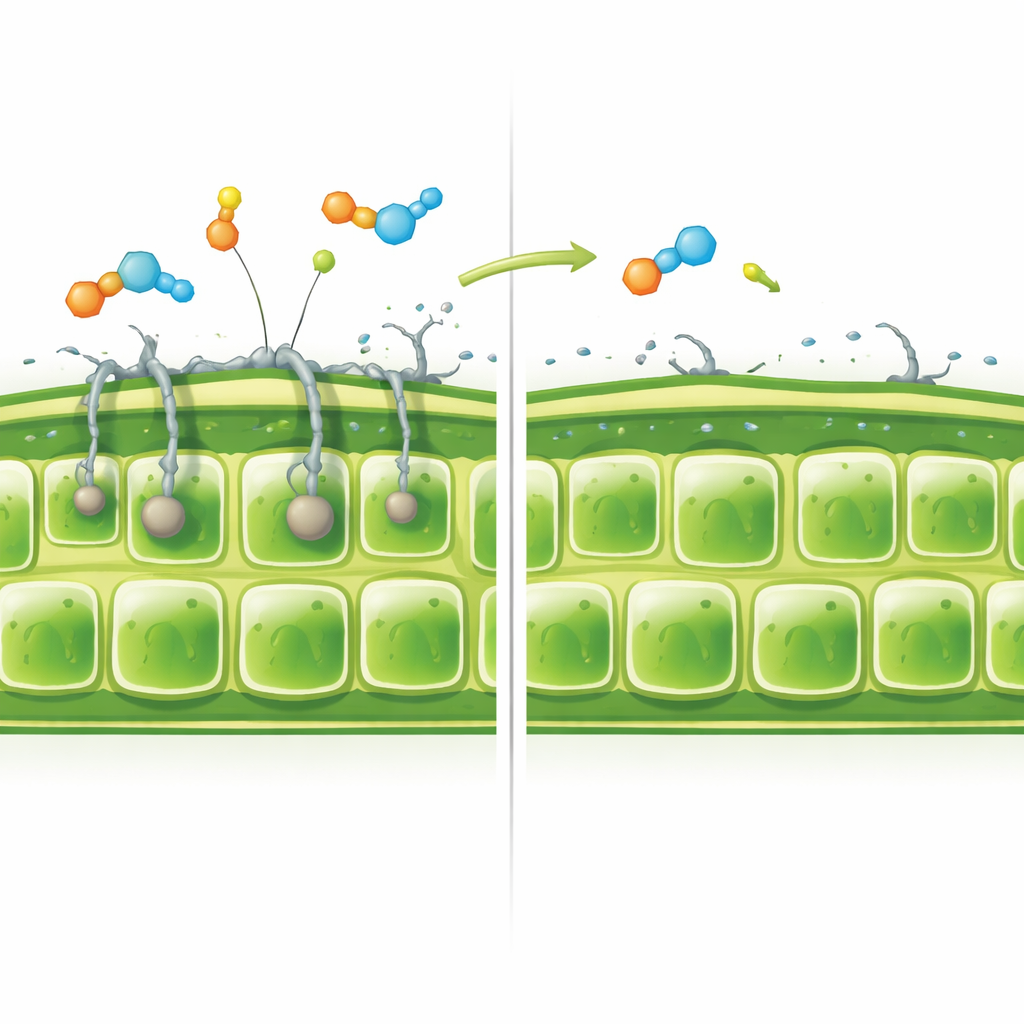
A closer look inside infected leaves
To understand how these standout compounds act, the team used light microscopy to visualize infection structures inside stained leaf pieces. In untreated samples, fungal spores germinated, formed anchoring pads, penetrated cells, and spread branching filaments between cells while establishing feeding organs called haustoria. When plants were treated with coumarin 6 or 9, the sequence of infection still began, but the numbers of key fungal structures often shifted. In several host–pathogen combinations, treated leaves had fewer haustoria, fewer spreading filaments and, in some cases, reduced spore production compared with controls. These patterns suggest that while the fungi can start to infect, their ability to fully colonize the tissue and reproduce is curtailed, limiting how far the disease can spread.
What this means for future crops
This work shows that thoughtfully modified coumarin compounds can strongly hinder the growth of some of the most troublesome cereal pathogens under controlled laboratory conditions. Two derivatives, in particular, nearly shut down both powdery mildew and rust on multiple cereal species at modest doses. The findings point to coumarin-based molecules as promising building blocks for next‑generation, more eco‑friendly fungicides. However, the tests were done on detached leaves and at just a few concentrations, and some early trials revealed leaf damage at higher doses. Field studies, formulation work and safety assessments will be essential next steps before these compounds could be used on farms. Even so, the study highlights a hopeful path: harnessing and refining natural plant chemicals to better protect the crops that feed the world.
Citation: Rząd, K., Nucia, A., Szwaczko, K. et al. Coumarin compounds as fungicidal agents against powdery mildew and rust in cereals. Sci Rep 16, 10385 (2026). https://doi.org/10.1038/s41598-026-40869-w
Keywords: cereal diseases, powdery mildew, rust fungi, coumarin fungicides, eco-friendly crop protection