Clear Sky Science · en
Timing of rainfall influences juvenile and yearling mass of a long-lived herbivore in a semiarid environment
Why Rainfall Timing Matters for Young Deer
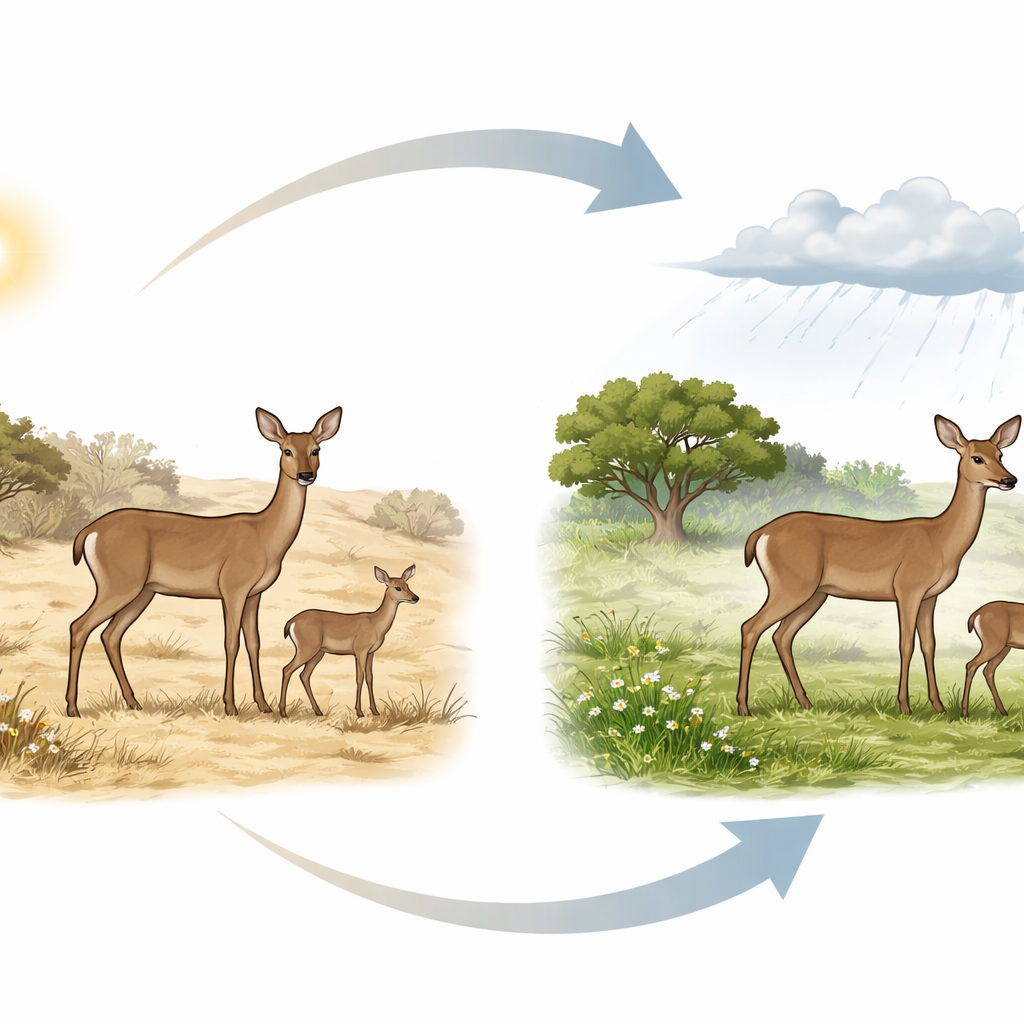
Across much of the world, drylands are getting hotter and more unpredictable. In these places, a few weeks of rain can mean the difference between sparse grass and a carpet of green. For white-tailed deer living in the semiarid rangelands of South Texas, that green-up is more than scenery—it can shape how big and healthy young deer become, and ultimately whether local herds thrive in a changing climate.
Growing Up in a Harsh, Dry Landscape
The study focused on white-tailed deer in a semiarid region where rainfall is highly variable from year to year. In this environment, plants rely on occasional bursts of rain, and deer in turn rely on those plants for food. Unlike plants, however, deer time their breeding using day length, which is the same every year. That means pregnant females and their growing fawns may or may not enjoy good forage at the moment they need it most. Scientists wanted to know: during which part of the year does rainfall matter most for the body mass of juvenile deer (around 3–4 months old) and yearlings (around 15–16 months old)? Body mass is a simple but powerful measure because heavier young deer are more likely to survive and reproduce over their lifetimes.
Tracking Deer, Seasons, and Storms
Over 12 years, the research team captured 1,123 juvenile and yearling deer across five large ranches in South Texas. Each animal was weighed and aged, and its capture location was recorded by GPS. The scientists then overlaid these locations with finely detailed rainfall records. They defined six biologically meaningful periods, including early plant growth in April, late pregnancy, birth season, the first month after birth, and the longer nursing period. For every deer, they calculated how much rain fell at its home site during each of these seasons and used statistical models to see which period’s rainfall best predicted the animal’s weight.
The Power of an Early Green Pulse
The clearest signal emerged from a surprisingly narrow window: the early growing season in April. For juveniles, rainfall during this month explained body mass better than rain during late pregnancy, birth, or nursing. A 10-centimeter increase in April rainfall was associated with about 2.3 kilograms of extra mass for young deer captured in the fall. For yearlings, early growing-season rainfall in both the current year and the year they were born mattered. In that age class, each 10-centimeter boost in April rain in the current year was linked to roughly 4.4 kilograms higher mass, and April rain in the birth year still added about 3.0 kilograms a year later. Rainfall in all other seasons had much weaker or no detectable effects once early growing-season rain was accounted for.
How Early Rains Shape Mothers and Offspring
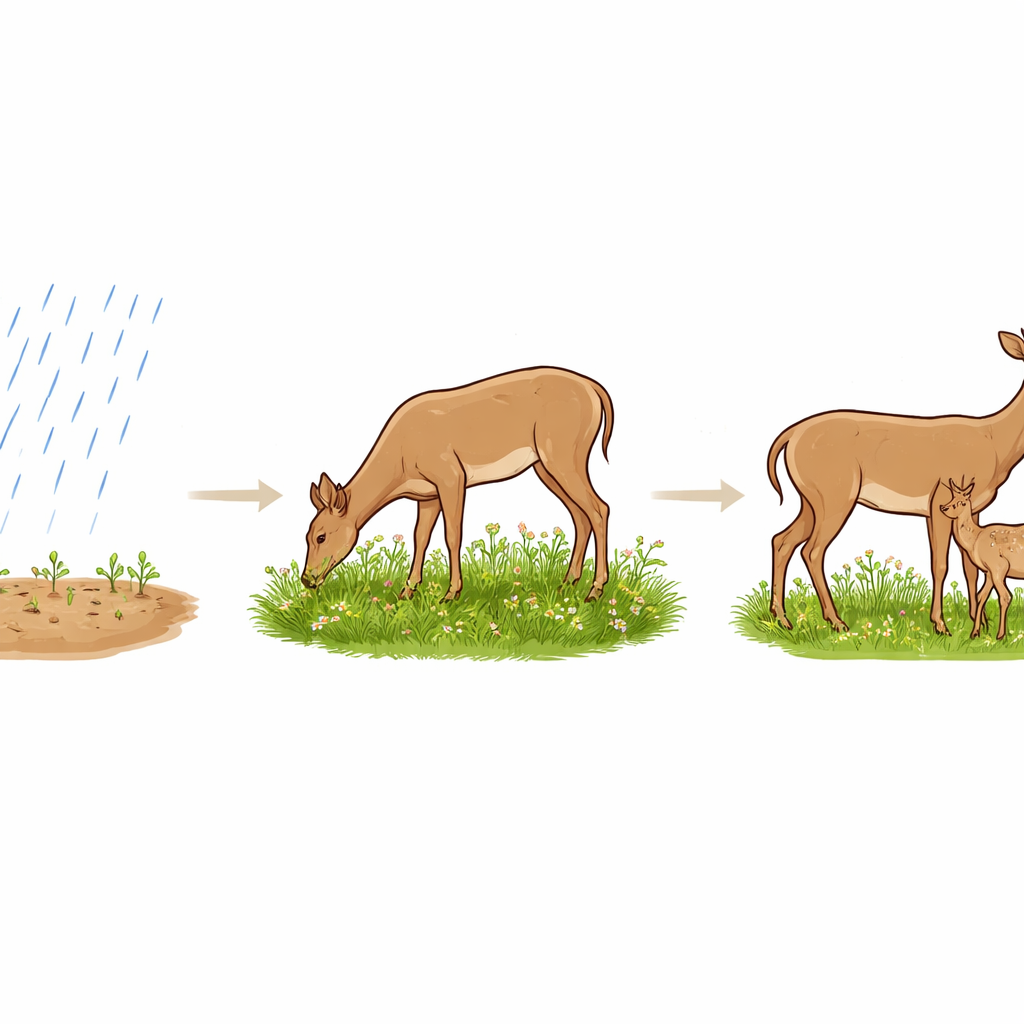
Why is this early green pulse so influential? In this system, April rains trigger a flush of high-quality forage just as pregnant females enter their final trimester. Because plant growth and soil moisture respond with a delay, that April rainfall effectively fuels fetal development in May and June, when unborn fawns are growing fastest. Well-fed mothers can build their own body reserves and invest more in gestation, setting their offspring on a heavier growth path that lasts at least into the yearling stage. By contrast, even if rains arrive later during peak nursing, the benefits to young deer’s body mass appear smaller than when the same water falls earlier and prepares mothers in advance.
What This Means in a Changing Climate
As climate change reshapes rainfall patterns, the timing of storms may become just as important as the total amount of rain. This study shows that in a highly variable, semiarid environment, an early-season burst of rain creates a “match” between plant growth and the needs of pregnant deer, boosting the mass of juveniles and yearlings. If that early rain is delayed or fails, young deer are likely to be smaller, with potential ripple effects on survival and reproduction for years to come. Understanding which brief periods of the year are most critical for forage can help wildlife managers anticipate when droughts will hit herds hardest and design conservation and land-use strategies that support healthy populations under increasingly erratic weather.
Citation: Hopper, M.L., Spencer, B.D., DeYoung, R.W. et al. Timing of rainfall influences juvenile and yearling mass of a long-lived herbivore in a semiarid environment. Sci Rep 16, 11470 (2026). https://doi.org/10.1038/s41598-026-40861-4
Keywords: white-tailed deer, rainfall timing, body mass, semiarid ecosystems, climate change