Clear Sky Science · en
VPS13B, gene responsible for Cohen syndrome, regulates gingival epithelial barrier function via intracellular trafficking of coxsackievirus and adenovirus receptor
Why gum health matters in a rare genetic disorder
Cohen syndrome is a rare inherited condition best known for causing developmental delays and distinctive facial features, but many affected people also suffer from severe gum disease at a young age. This study asks a simple but important question: what is going wrong at the surface of the gums that leaves them so vulnerable? By zooming in on how a single gene shapes the protective lining of the mouth, the work sheds light on why everyday mouth bacteria can cause unusually serious damage in these patients—and hints at new ways to protect their oral health. 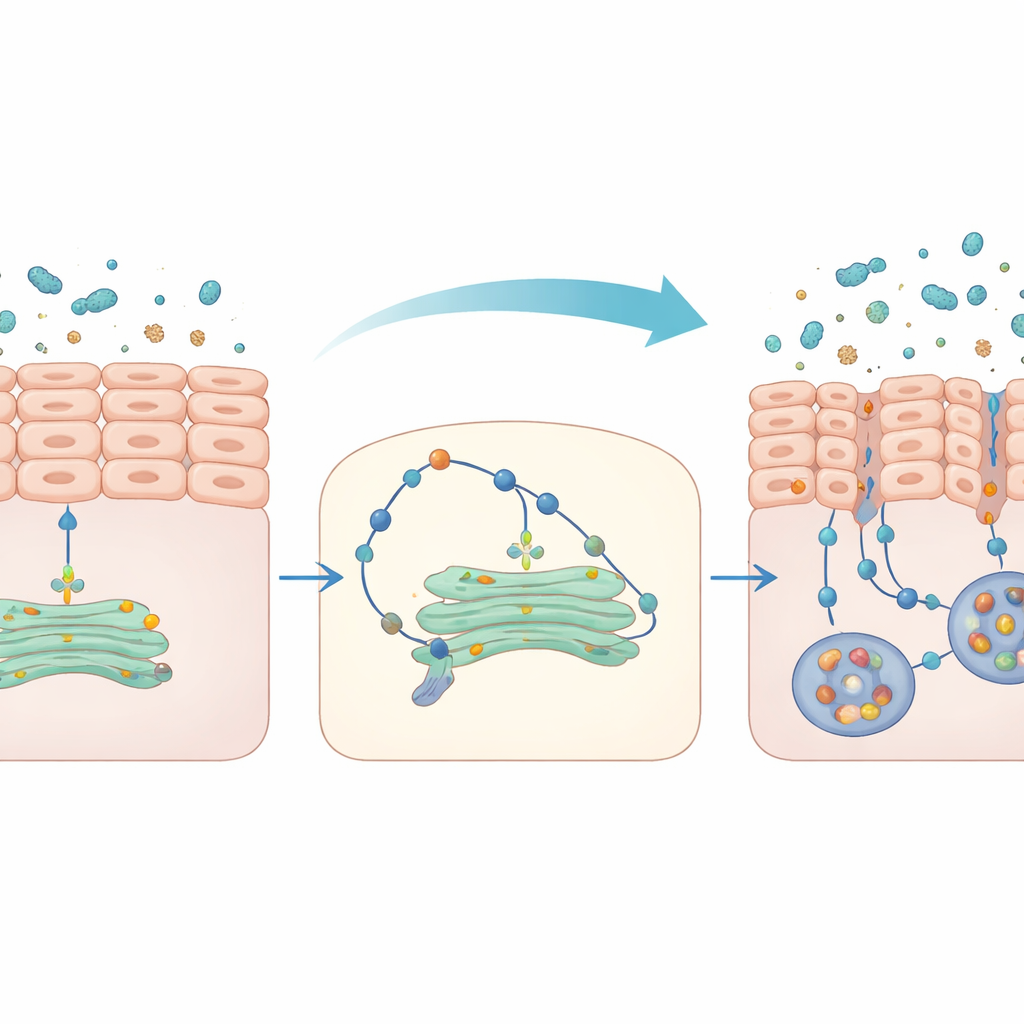
The gum surface as a living shield
The soft pink tissue around our teeth is more than decoration; it is a living shield that keeps bacterial products from seeping into deeper tissues and triggering chronic inflammation, or periodontitis. This shield is built from tightly connected epithelial cells whose outer surfaces carry specialized proteins that act like molecular rivets between neighboring cells. Earlier work by the same group showed that one such protein, called CXADR, helps seal the gum surface and keeps toxic components from mouth bacteria—from substances like lipopolysaccharide (LPS) and peptidoglycan (PGN)—from leaking inward. When certain periodontal bacteria chew up CXADR, the barrier loosens and gums become inflamed.
A traffic manager protein with a wider role
People with Cohen syndrome carry damaging changes in a gene called VPS13B. This gene encodes a very large protein that lives mainly in the Golgi apparatus, the cell’s central shipping hub where proteins are sorted into small membrane packages and sent to their proper destinations. Until now, it was unclear how faults in this internal traffic manager could specifically contribute to gum disease. Using human gingival epithelial cells grown in dishes and three-dimensional tissue-like layers, the researchers first confirmed that VPS13B sits in a particular region of the Golgi and physically associates with the mature form of CXADR inside these cells.
When the traffic goes to the wrong place
To test VPS13B’s role, the team used genome editing and RNA interference to reduce or eliminate the VPS13B gene in gum epithelial cells. Without VPS13B, the Golgi structure became fragmented and the amount of CXADR detected at the cell surface dropped sharply, even though the cell was still making normal levels of CXADR RNA. Microscopy showed that instead of being routed to the surface, CXADR was diverted into lysosomes—acidic recycling compartments—where it was degraded. Blocking lysosomal breakdown rescued CXADR levels on the surface, supporting the idea that misdirected trafficking, not reduced production, was the core problem. Interestingly, a related junction protein called JAM1 was unaffected, suggesting that VPS13B has a selective effect on CXADR.
Pinpointing the key part of the receptor
To understand what makes CXADR uniquely dependent on VPS13B, the scientists engineered chimeric proteins that swapped pieces between CXADR and JAM1. They found that replacing the tail end of CXADR that spans the membrane and faces the cell interior with the corresponding region from JAM1 made the hybrid protein largely independent of VPS13B: it still reached the cell surface even when VPS13B was missing. Conversely, attaching the CXADR tail to JAM1 made JAM1 vulnerable to VPS13B loss. These experiments pinpoint the inner tail of CXADR as the address label that requires VPS13B and its partner RAB6A to guide the receptor to the correct destination.
From faulty trafficking to leaky gums
Do these molecular changes actually weaken the gum barrier? In layered cell cultures and thicker 3D gum-like tissues, the team measured how easily fluorescently labeled dextran, LPS, and PGN passed from the top to the bottom of the epithelial layer. Cells lacking VPS13B allowed much more of these molecules to pass through, indicating a leakier barrier. Crucially, restoring surface expression of the CXADR–JAM1 tail chimera in VPS13B-deficient cells tightened the barrier again, reducing leakage back toward normal levels. 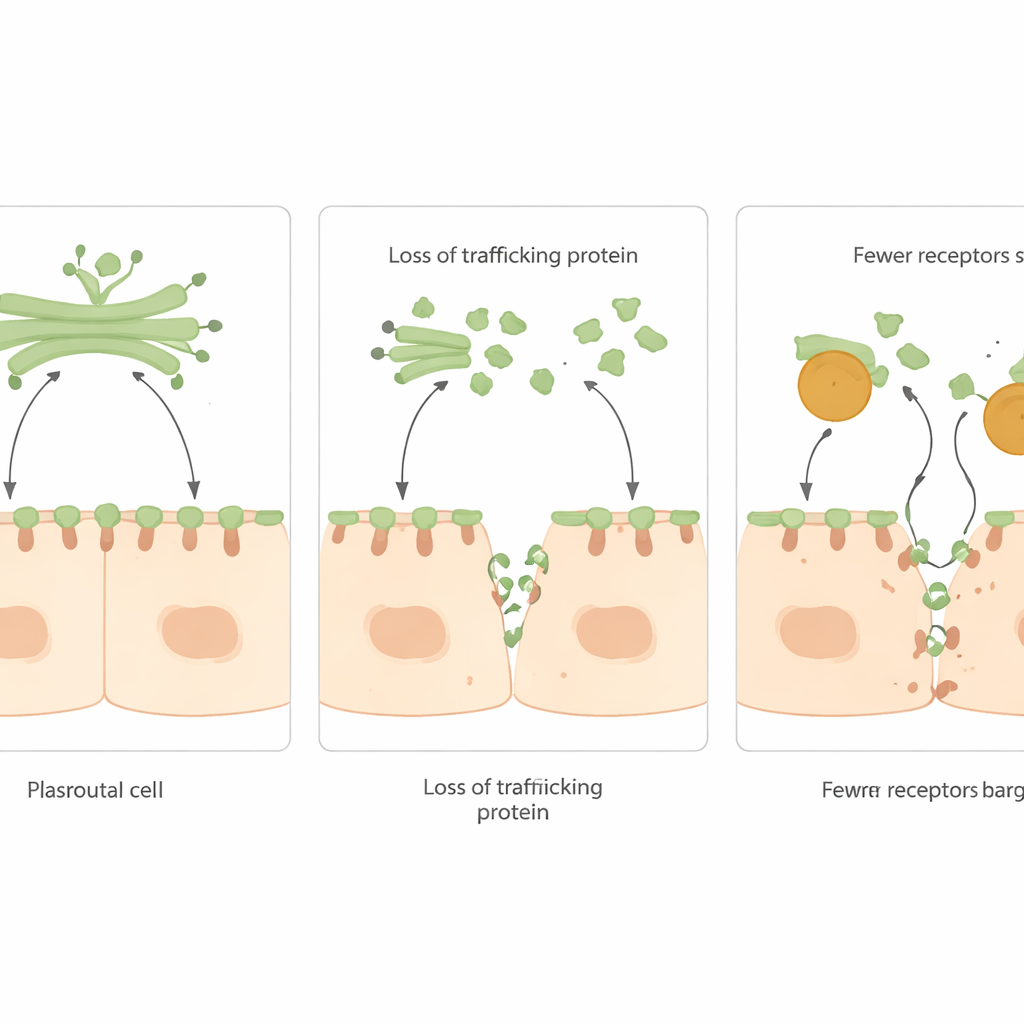
What this means for people with Cohen syndrome
For non-specialists, the takeaway is that Cohen syndrome weakens the gum’s protective lining not just through immune problems but also by disrupting an internal delivery system that normally brings a key sealing protein, CXADR, to the cell surface. When VPS13B is faulty, CXADR is misrouted and destroyed in cellular recycling bins, leaving gaps between cells that bacterial products can slip through. This discovery offers a concrete molecular explanation for the severe gum problems seen in many patients and suggests that future treatments might aim to stabilize CXADR at the surface or otherwise reinforce the gum barrier, potentially improving oral health and overall quality of life.
Citation: Matsumura, R., Tanigaki, K., Sasaki, N. et al. VPS13B, gene responsible for Cohen syndrome, regulates gingival epithelial barrier function via intracellular trafficking of coxsackievirus and adenovirus receptor. Sci Rep 16, 10313 (2026). https://doi.org/10.1038/s41598-026-40840-9
Keywords: Cohen syndrome, gingival barrier, CXADR, VPS13B, periodontitis