Clear Sky Science · en
Optimized PI controller-based hybrid model for adaptive energy management in photovoltaic integrated electric vehicle charging microgrids
Why smarter charging matters
The rise of electric vehicles promises cleaner air and quieter streets, but it also creates a new problem: how to supply millions of cars with electricity without overloading the power grid or driving up costs. This paper explores a way to run small, local power networks—called microgrids—that combine solar panels, fuel cells, batteries, and fast chargers so that EVs can be filled cheaply, reliably, and with far fewer greenhouse gas emissions.
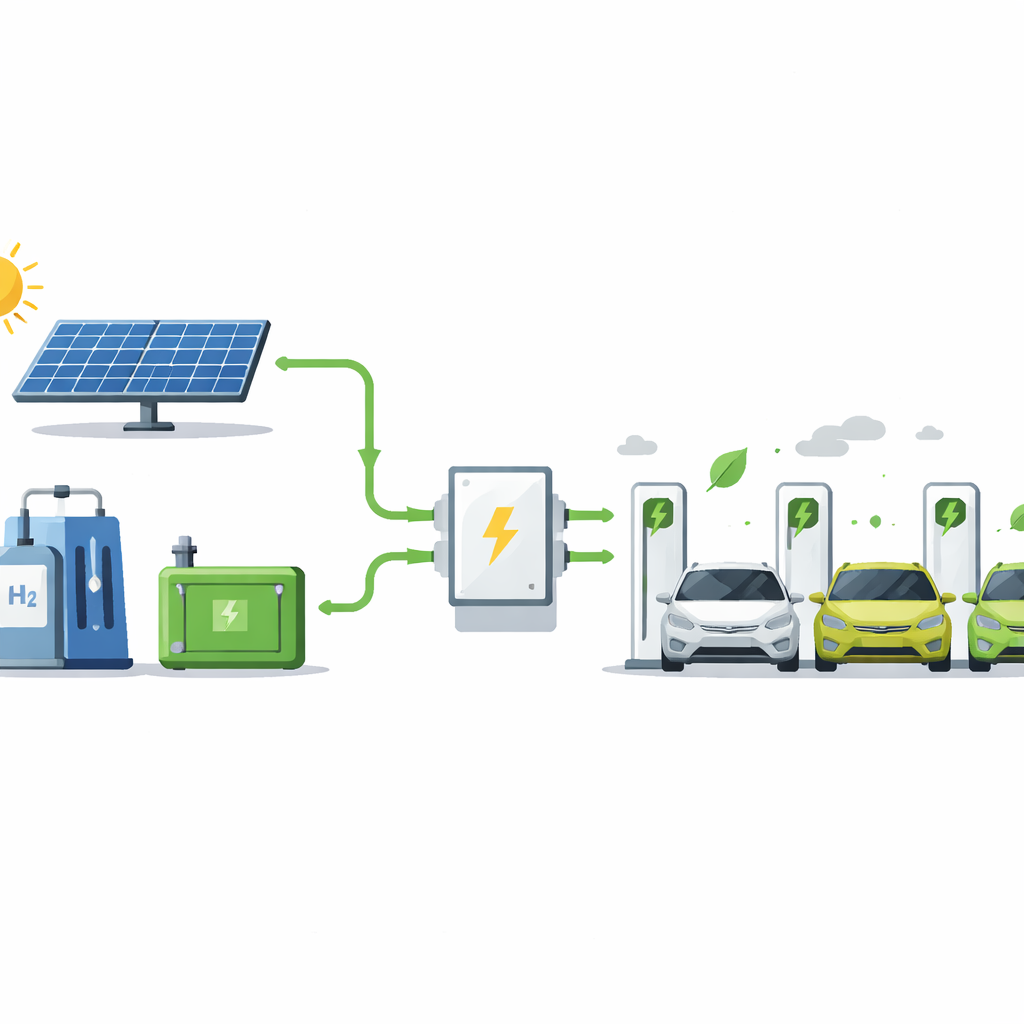
Powering cars from the sun and beyond
The study focuses on a direct-current (DC) microgrid built around several clean energy sources. Rooftop-style solar panels provide most of the power when the sun is shining. A hydrogen fuel cell steps in as a clean backup when sunlight is weak, and a large battery pack absorbs extra energy or releases it when demand spikes. All of these devices connect to a common DC bus that feeds electric vehicle chargers. Because sunshine and driving patterns are both unpredictable, the system must constantly decide when to draw power from each source, when to store it, and when to tap the main grid, all while keeping voltages steady and chargers running.
A brain for the local power network
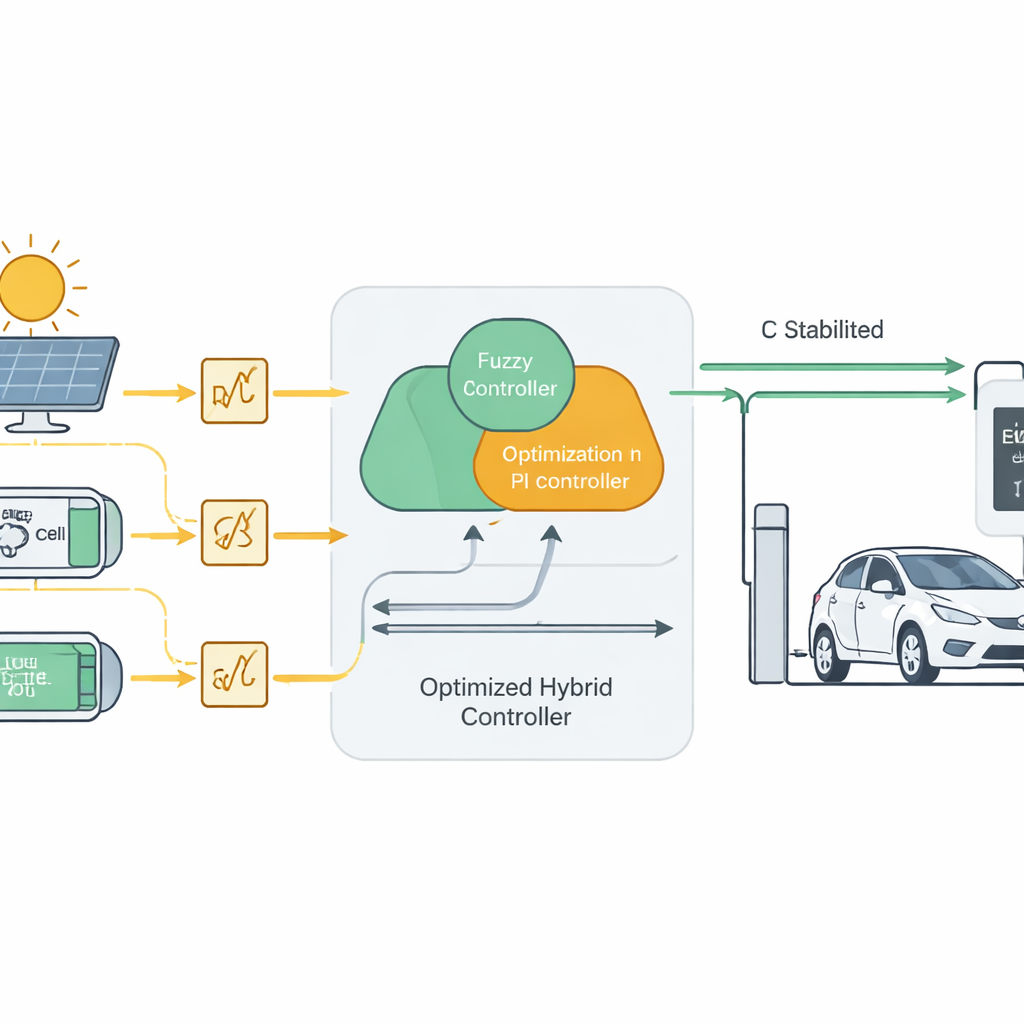
To coordinate this juggling act, the authors design an "energy management" brain that sits on top of the microgrid. At its core is a common type of feedback controller, known in engineering as a PI controller, which nudges converter hardware to keep voltages and currents within safe limits. On its own, this controller can struggle when conditions change quickly. The paper strengthens it with two layers of artificial intelligence: fuzzy logic, which mimics human if‑then reasoning about uncertain situations (such as "demand is high" or "solar is low"), and a bio-inspired search method that tunes the PI controller’s settings. This search algorithm blends ideas from the hunting and social behavior of dwarf mongooses and red pandas to efficiently probe many possible control settings and choose the ones that minimize charging cost and keep the grid stable.
How the system reacts in real life
The researchers build a detailed computer model of the microgrid using MATLAB/Simulink, including realistic solar behavior, battery characteristics, fuel cell dynamics, and the stop‑and‑go arrival of EVs at a station. They test many scenarios: different levels of renewable energy, varying charging demand, and weekday versus weekend usage patterns. The smart controller continuously senses solar output, battery charge, fuel cell status, and EV demand, then adjusts power converters so that solar and fuel cell power are used first, the battery is charged or discharged within safe limits, and grid power is only drawn when needed. A fuzzy decision layer also shifts more charging into hours when renewable power is plentiful and tariffs are low, easing stress on the wider grid.
Savings, stability, and cleaner air
The simulations show sizeable gains over existing management methods based on neural networks or other optimization schemes. During sunny off‑peak hours, the cost of charging drops as low as about 0.009–0.015 USD per kilowatt-hour delivered, far below typical flat rates. On average, weekday and weekend charging costs fall to around 0.086 and 0.088 USD per kilowatt-hour, cuts of roughly 45% and 56% compared with conventional setups. Because the controller prioritizes local solar and fuel cell power, the microgrid can reach up to 84% renewable contribution, reducing greenhouse gas emissions by as much as about 55% relative to a grid‑only station. At the same time, the tuned controller keeps the DC bus voltage within tight limits and reacts quickly to sudden plug‑ins or disconnections, outperforming several well-known optimization algorithms in both speed and reliability.
What this means for future charging hubs
This work suggests that pairing local clean energy with intelligent control can turn EV charging stations into low‑cost, low‑carbon power hubs that also protect the wider grid from sudden peaks in demand. By combining simple, fast-acting control with adaptive, nature-inspired tuning, the proposed system offers a practical path to making fast, affordable, and climate‑friendly charging widely available as electric vehicles become the norm.
Citation: Natarajan, R., Selvaraj, J., Daniel, S. et al. Optimized PI controller-based hybrid model for adaptive energy management in photovoltaic integrated electric vehicle charging microgrids. Sci Rep 16, 10341 (2026). https://doi.org/10.1038/s41598-026-40839-2
Keywords: electric vehicle charging, microgrids, renewable energy, energy management, fuzzy control